English Spelling & Phonics Learning Hub
Curriculum-standard spelling worksheets and guided phonics study aligned with Macmillan & Pearson frameworks. Interactive Web Speech audio supports both full-sentence listening and individual word pronunciation.
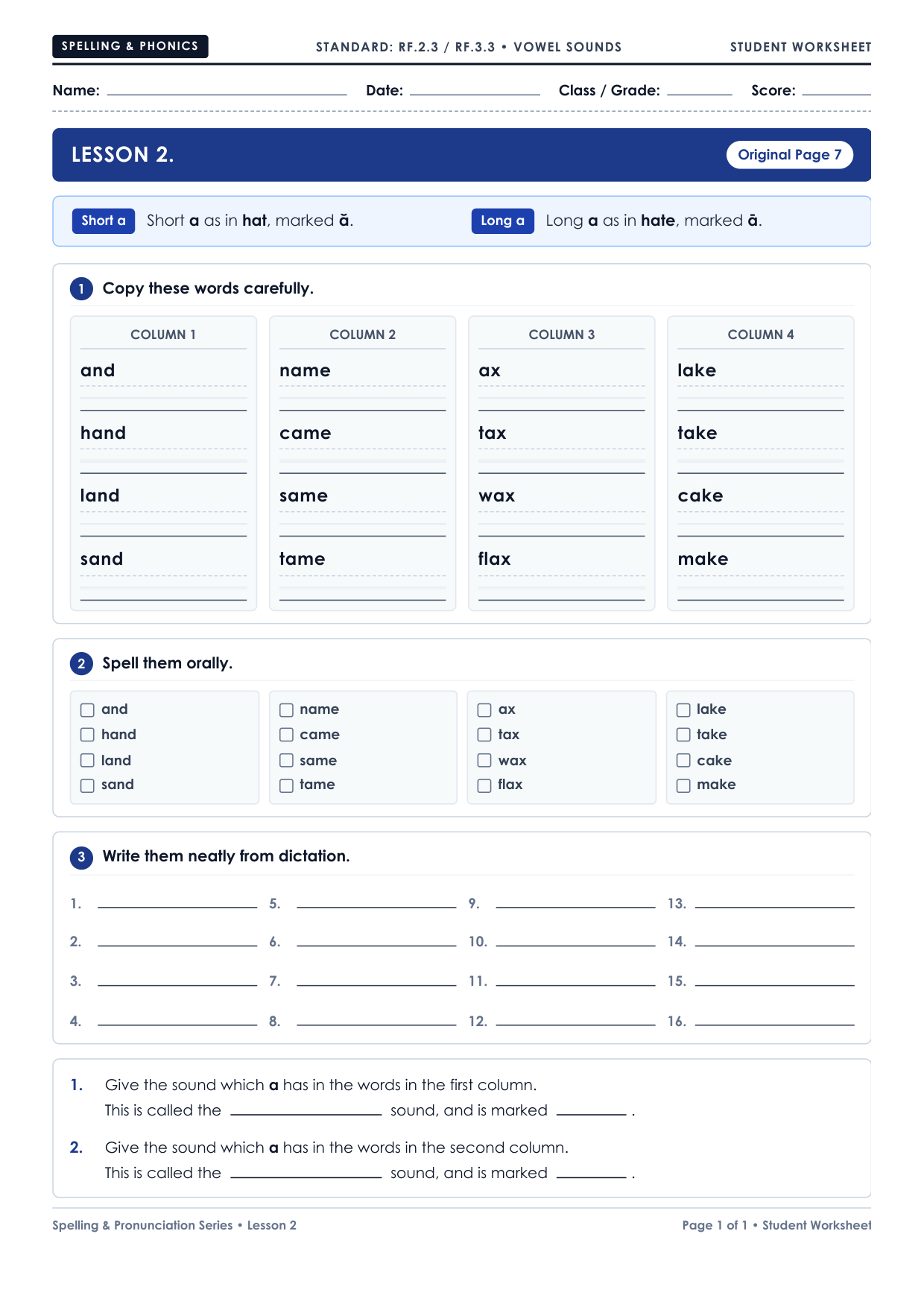
Lesson 2: Short a & Long a
Distinguish between short ă (/æ/) and long ā (/eɪ/) with silent -e. Features a 4-column penmanship table, oral spelling drills, and dictation assessment.
Open Student HTML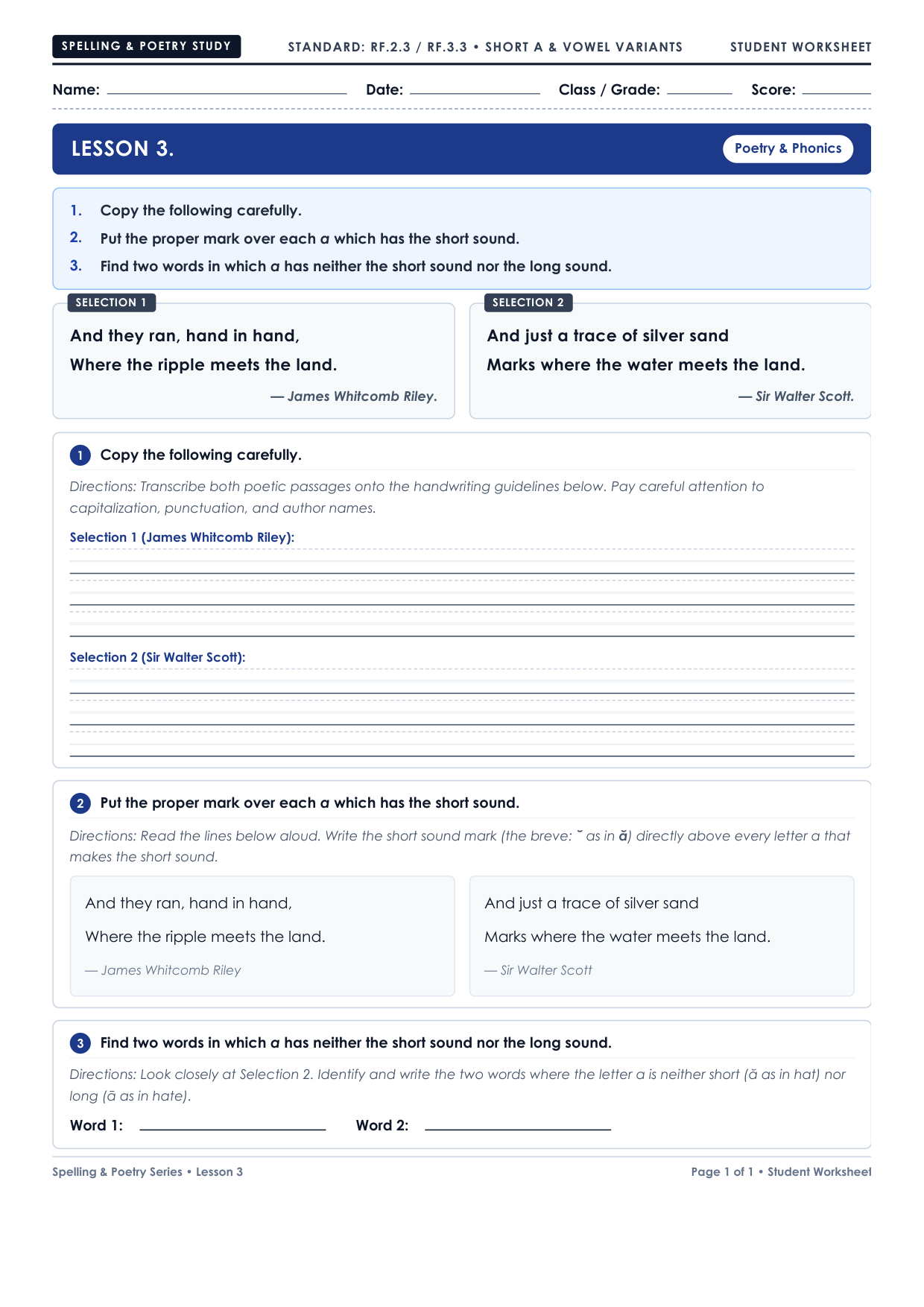
Lesson 3: Poetry & Phonics
Explore vowel sounds through classic poetry by James Whitcomb Riley and Sir Walter Scott. Practice oral reading fluency, handwriting lines, and phonics analysis.
Open Student HTML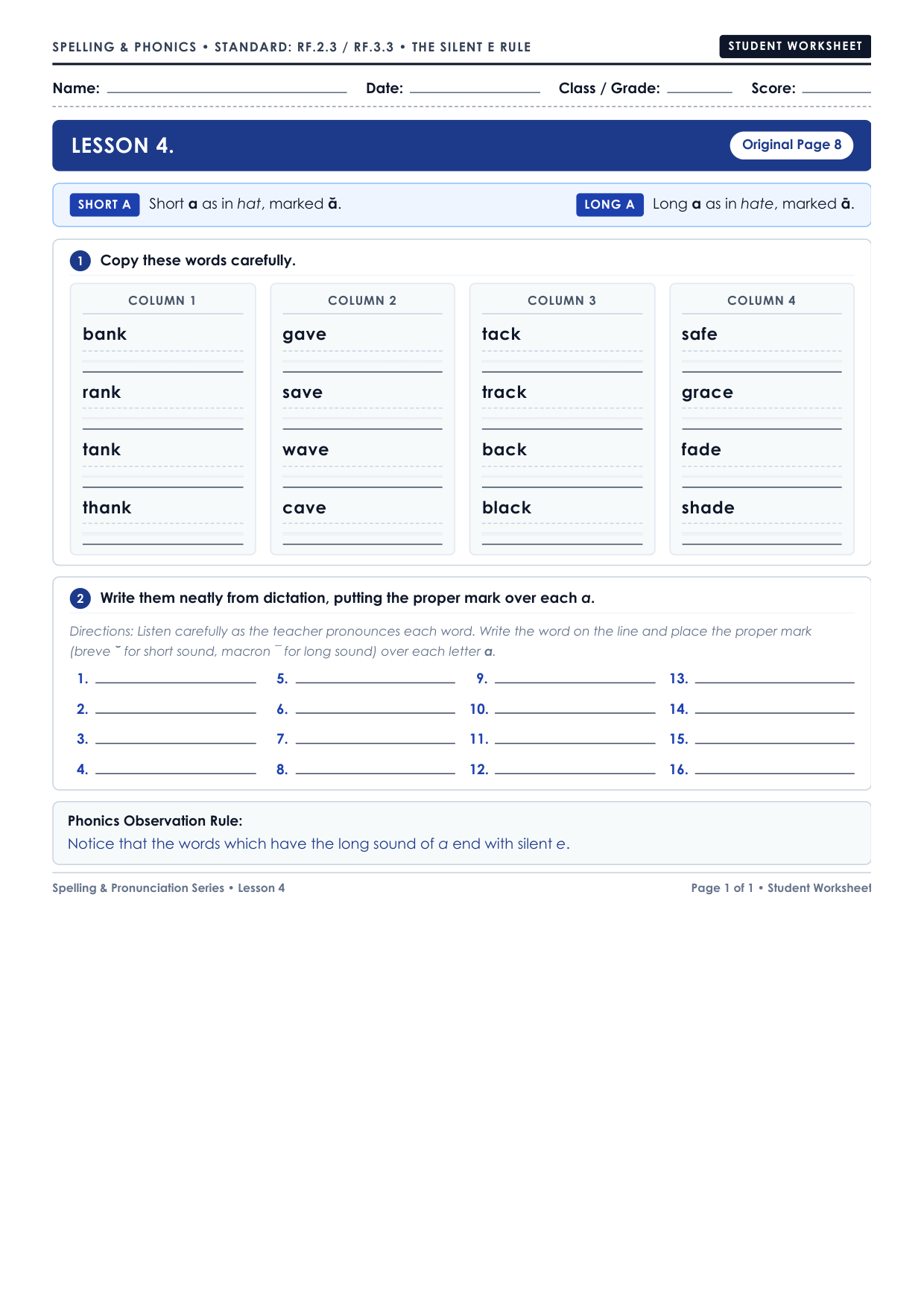
Lesson 4: Silent E & Vowel Sounds
Study silent -e rules forming long ā in families like -ave, -afe, -ace, -ade. Includes orthographic analysis, handwriting, and phonics transcription.
Open Student HTML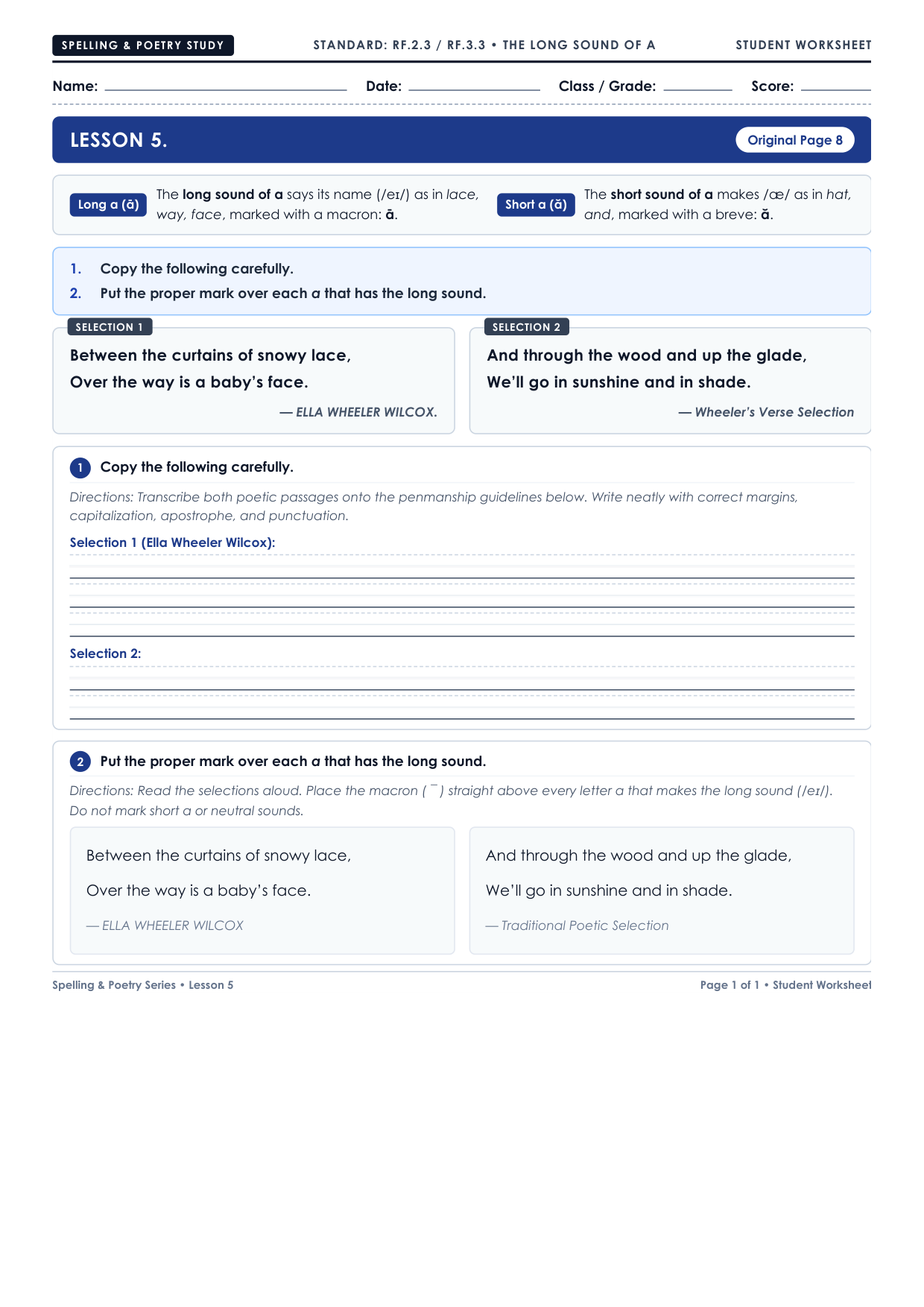
Lesson 5: Poetry & Long a Study
Study long ā in two poetic selections by Ella Wheeler Wilcox. Compare closed syllable forms with silent -e structures and diacritical markings.
Open Student HTML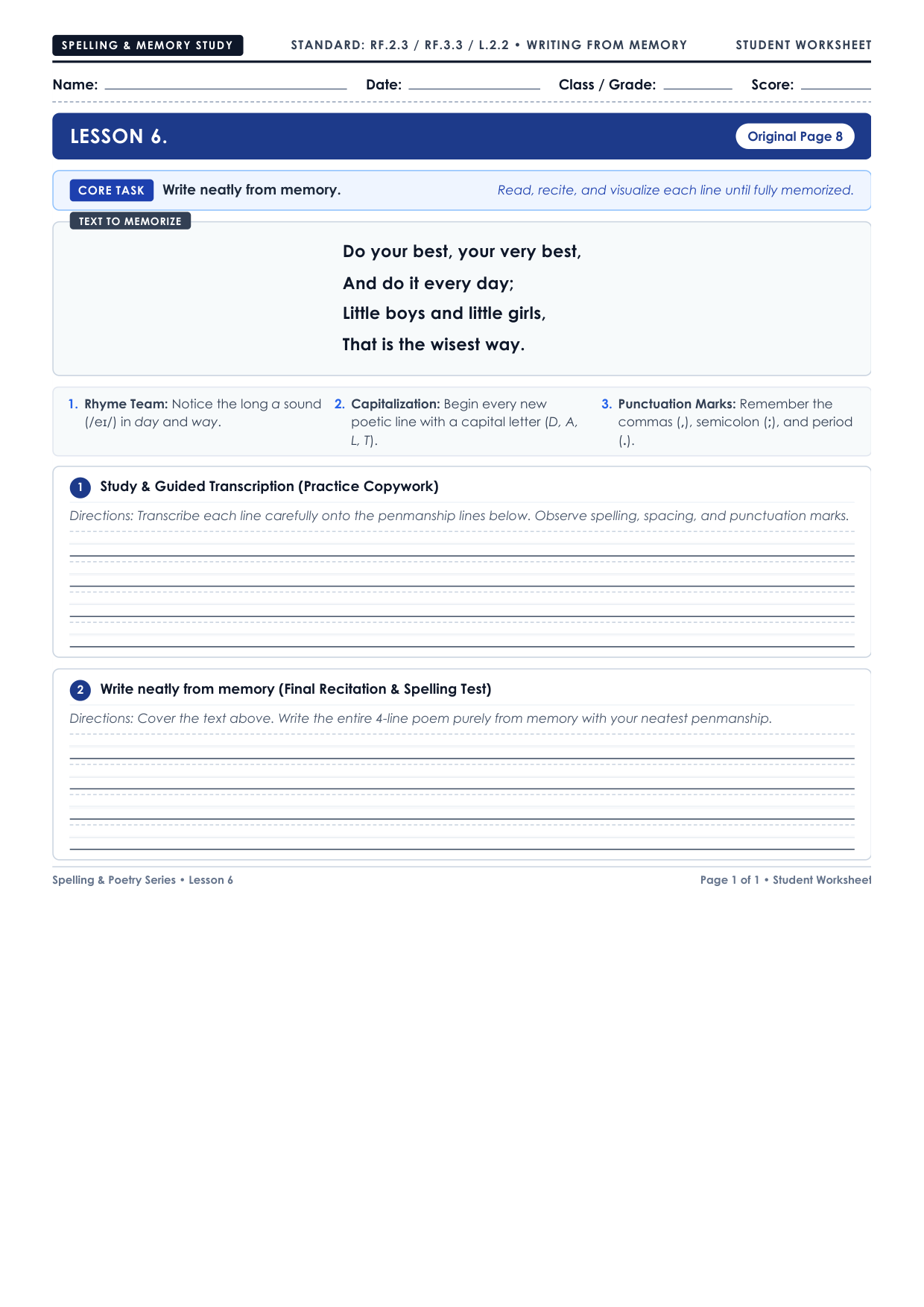
Lesson 6: Write from Memory
Build visual and auditory memory through a four-line classical verse (Do your best...). Features structured transcription lines and teacher dictation prompts.
Open Student HTML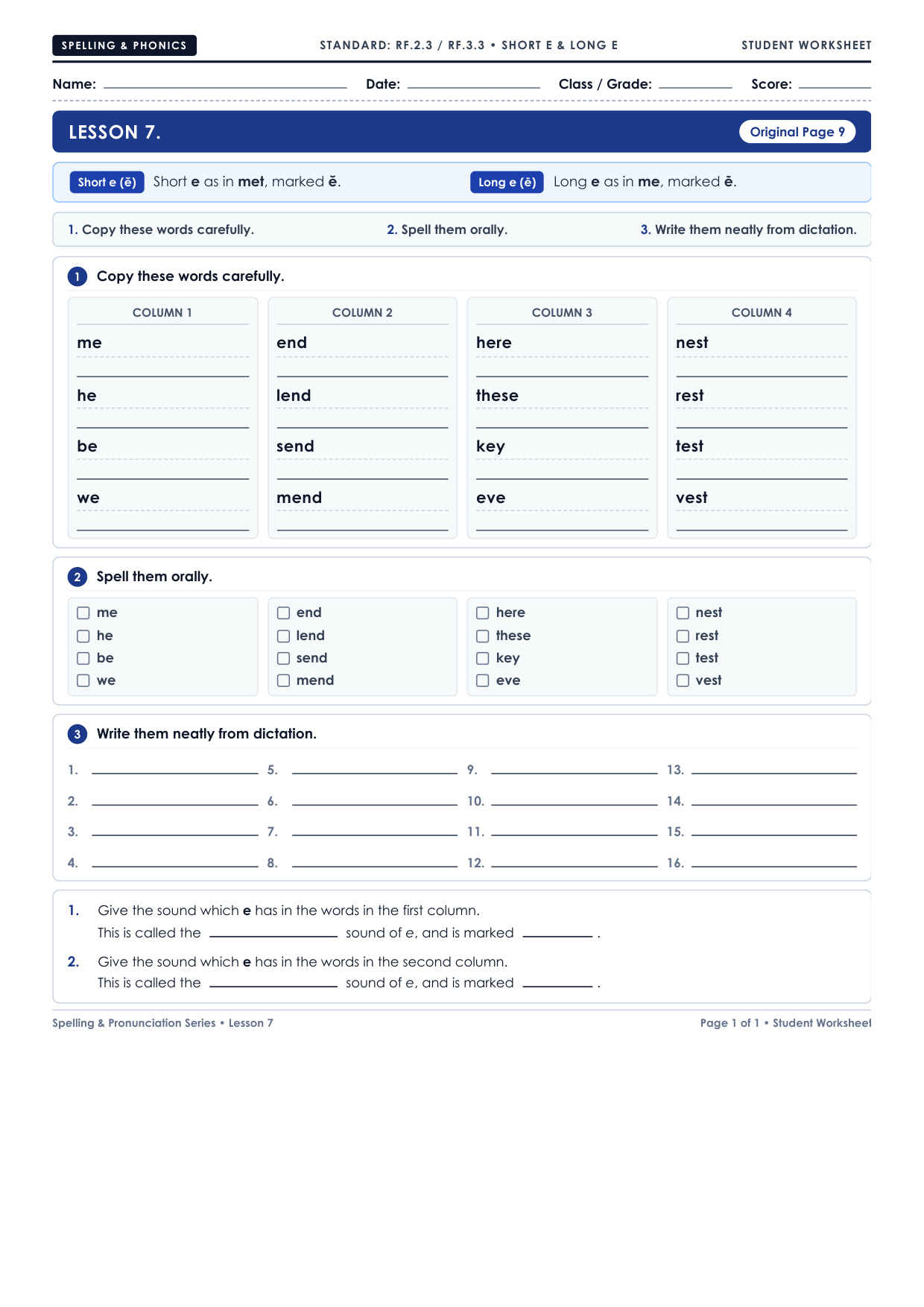
Lesson 7: Short e & Long e
Distinguish between short ĕ (/ɛ/) and long ē (/iː/). Includes a 4-column word study table, oral spelling questions, and sentence penmanship lines.
Open Student HTML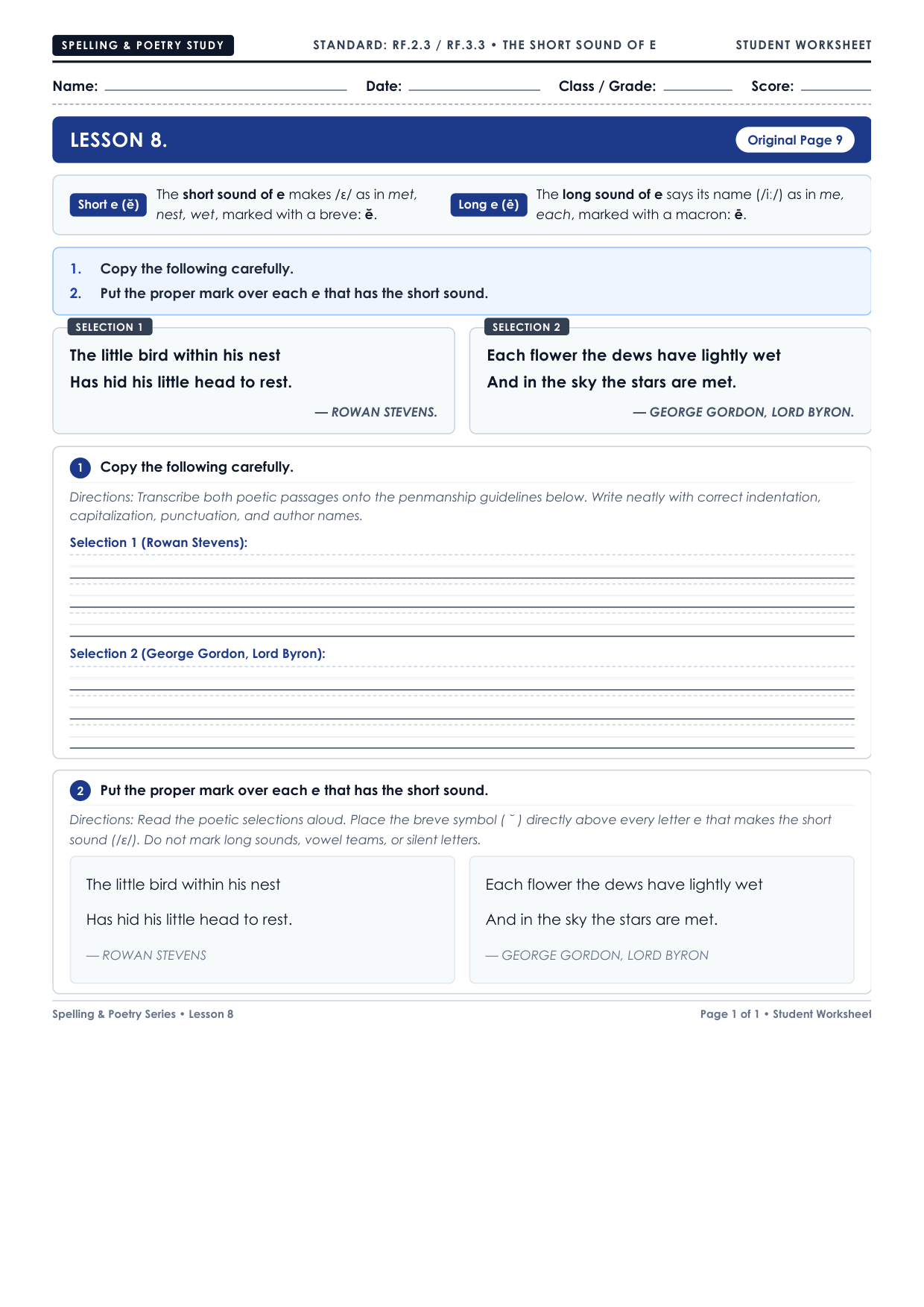
Lesson 8: Poetry & Short e Study
Study short ĕ (/ɛ/) in two verses by Robert Louis Stevenson. Focuses on closed syllables (bed, nest, best, tell) and diacritical marking.
Open Student HTML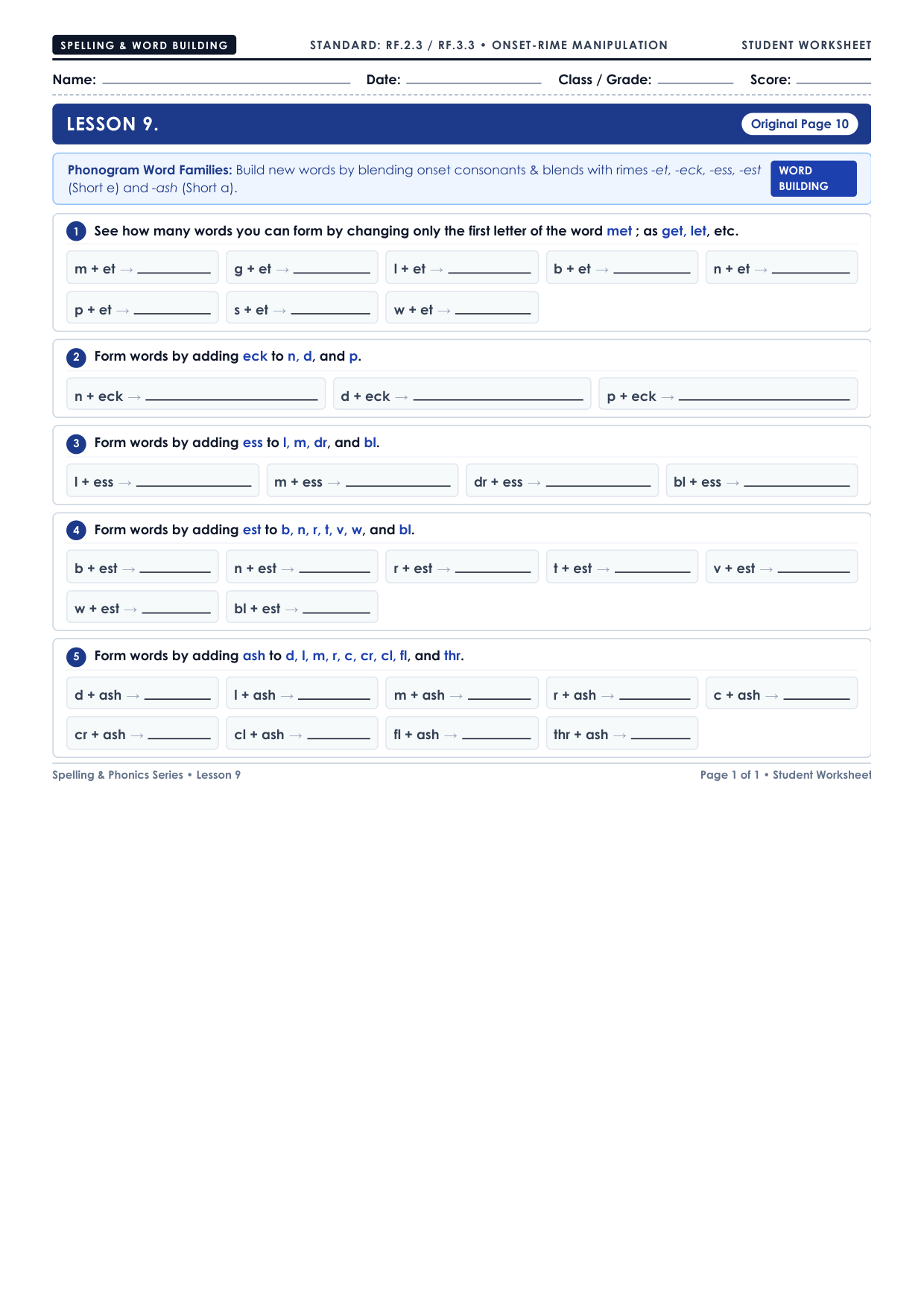
Lesson 9: Word Building & Onset-Rime
Build words and practice onset-rime manipulation across 5 high-frequency word families: short -ed, -ell, -ess, -end, -est. Includes 25 vocabulary slots.
Open Student HTML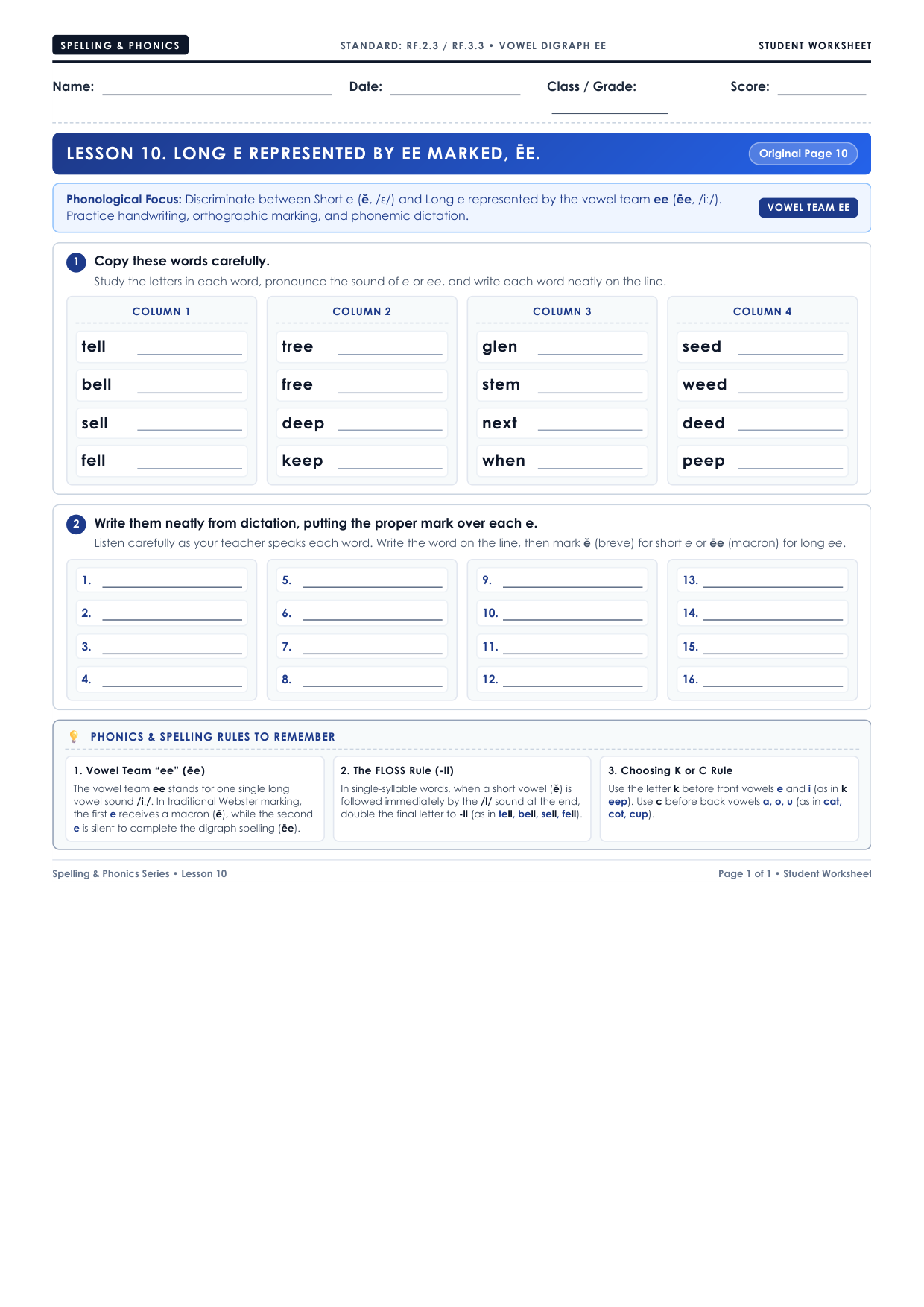
Lesson 10: Long e • Vowel Team ee (ēe)
Contrast short ĕ (/ɛ/) with the long ee vowel team (ēe, /iː/). Compare minimal pairs like fed/feed, met/meet, red/reed with guided questions.
Open Student HTML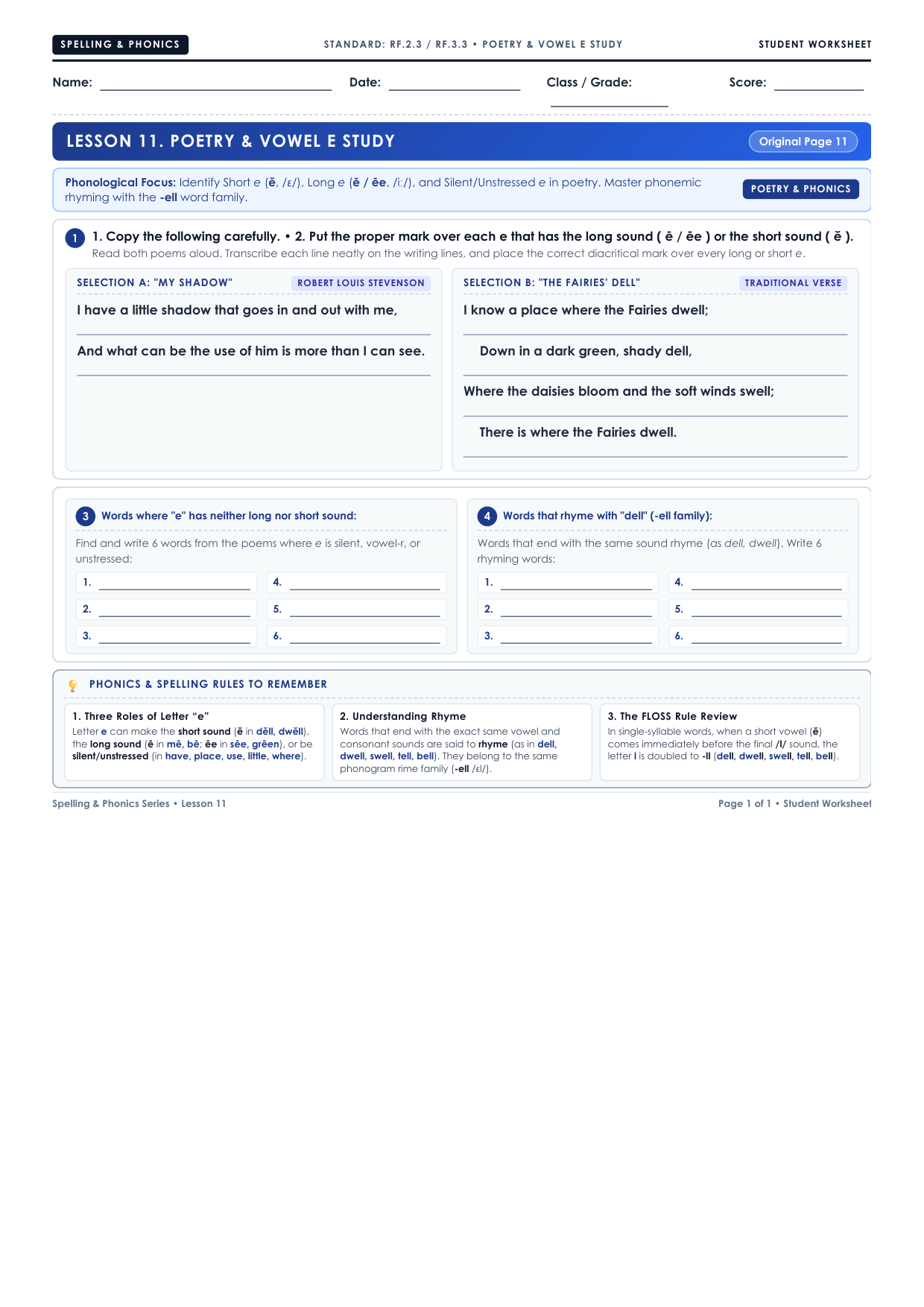
Lesson 11: Poetry & Vowel e Study
Examine three phonetic roles of letter e across two classic verses by Robert Louis Stevenson. Practice vowel discrimination and expressive reading.
Open Student HTML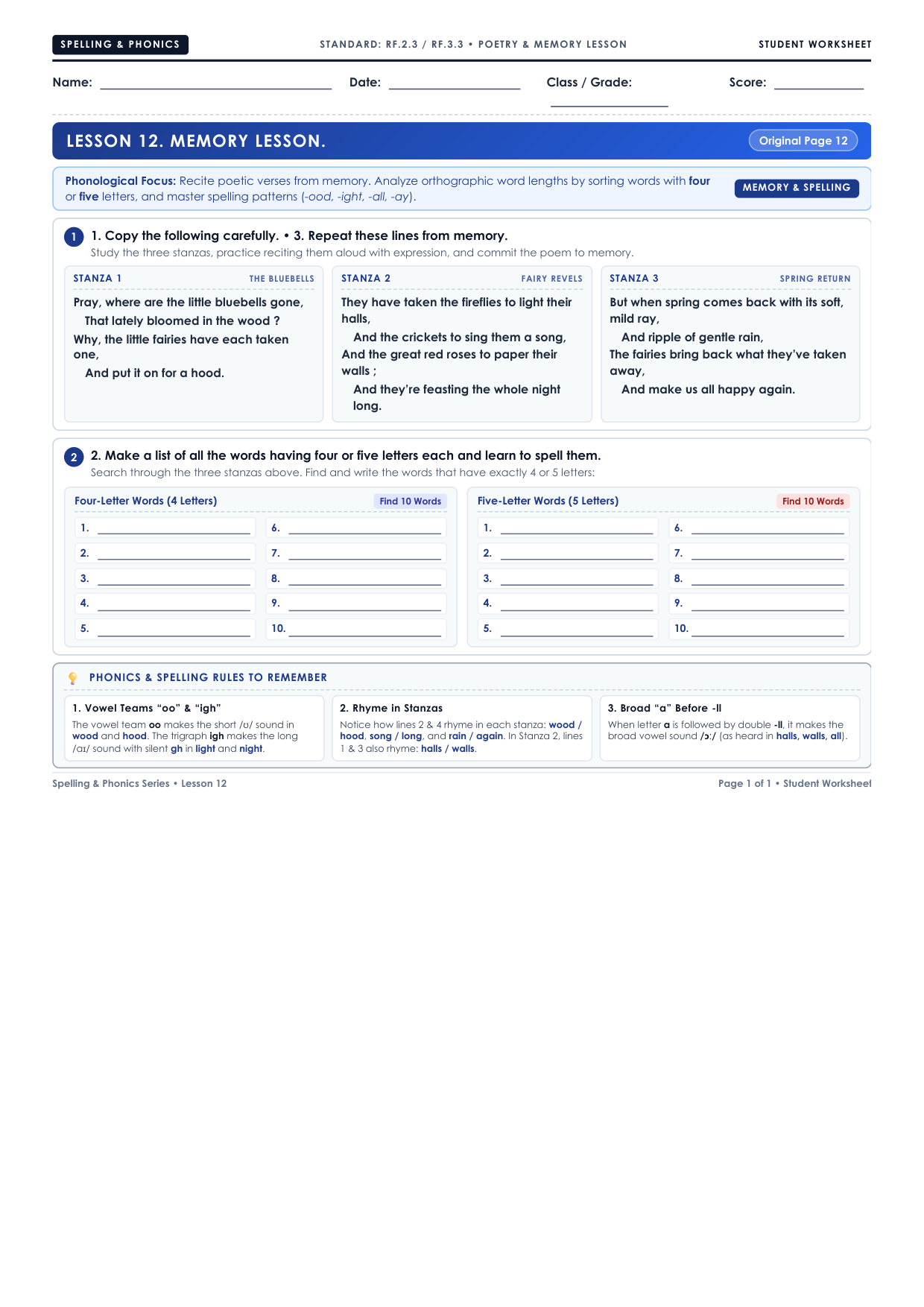
Lesson 12: Memory Lesson • The Bluebells
Develop poetic memory and expressive recitation with the 3-stanza classic (The Bluebells). Features handwriting transcription and diacritical marks.
Open Student HTML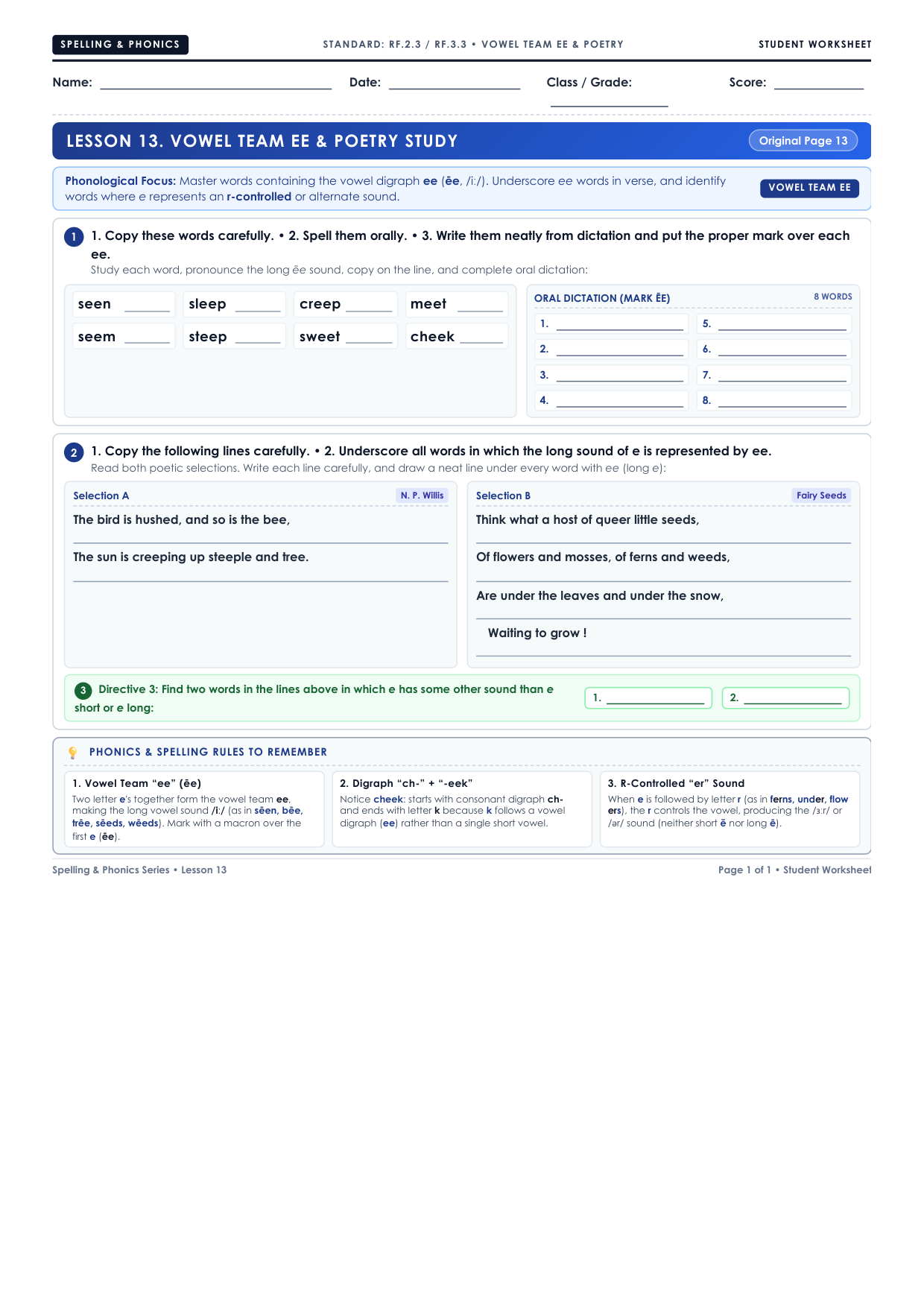
Lesson 13: Vowel Team ee • Poetry Study
Practice 8 words containing vowel team ee (ēe, /iː/) in closed syllables. Features a poem on autumn leaves with oral reading questions.
Open Student HTML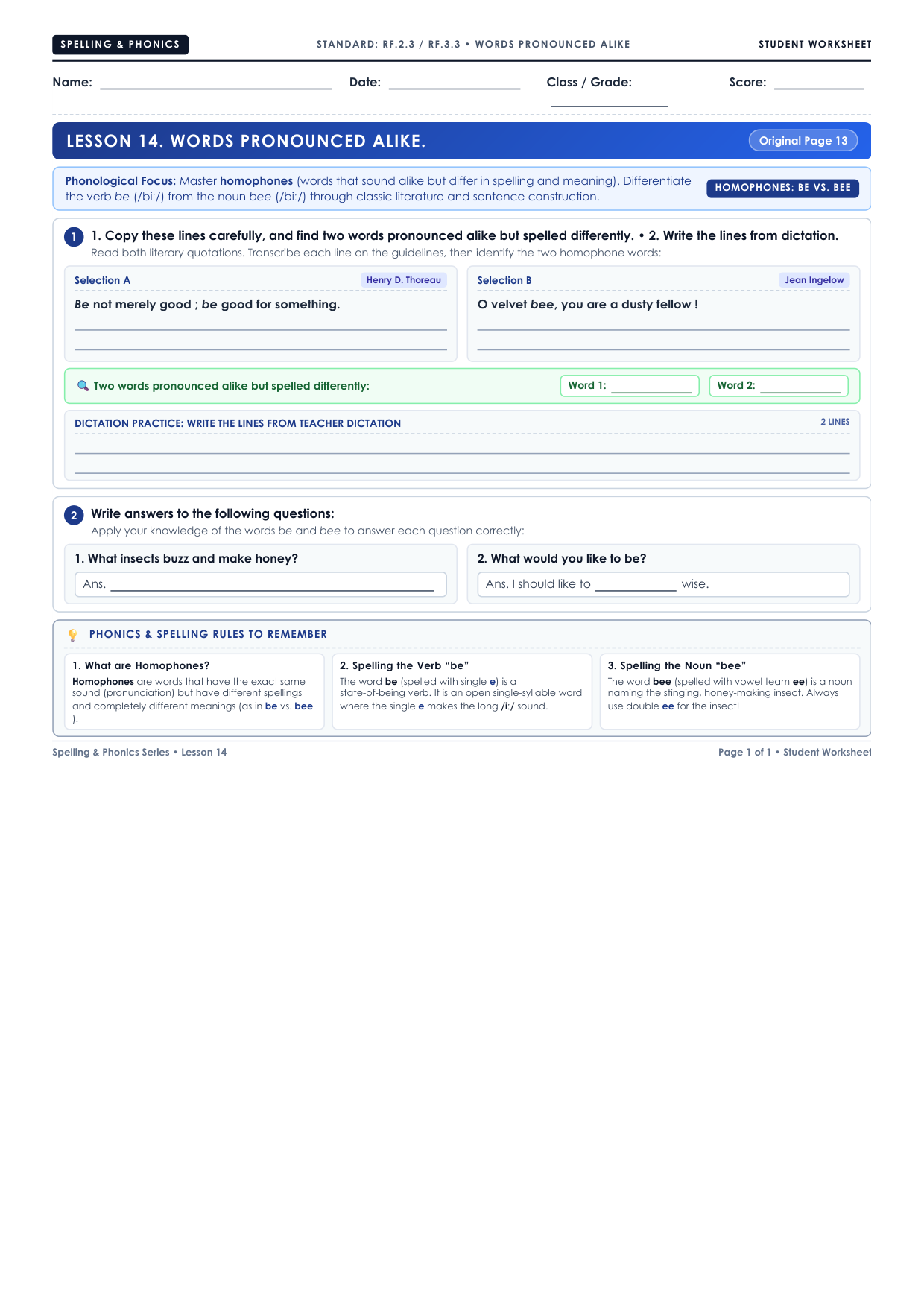
Lesson 14: Words Pronounced Alike • Homophones
Distinguish classic homophones be and bee. Master parts of speech (linking verb vs. insect noun) and practice dictation sentences.
Open Student HTML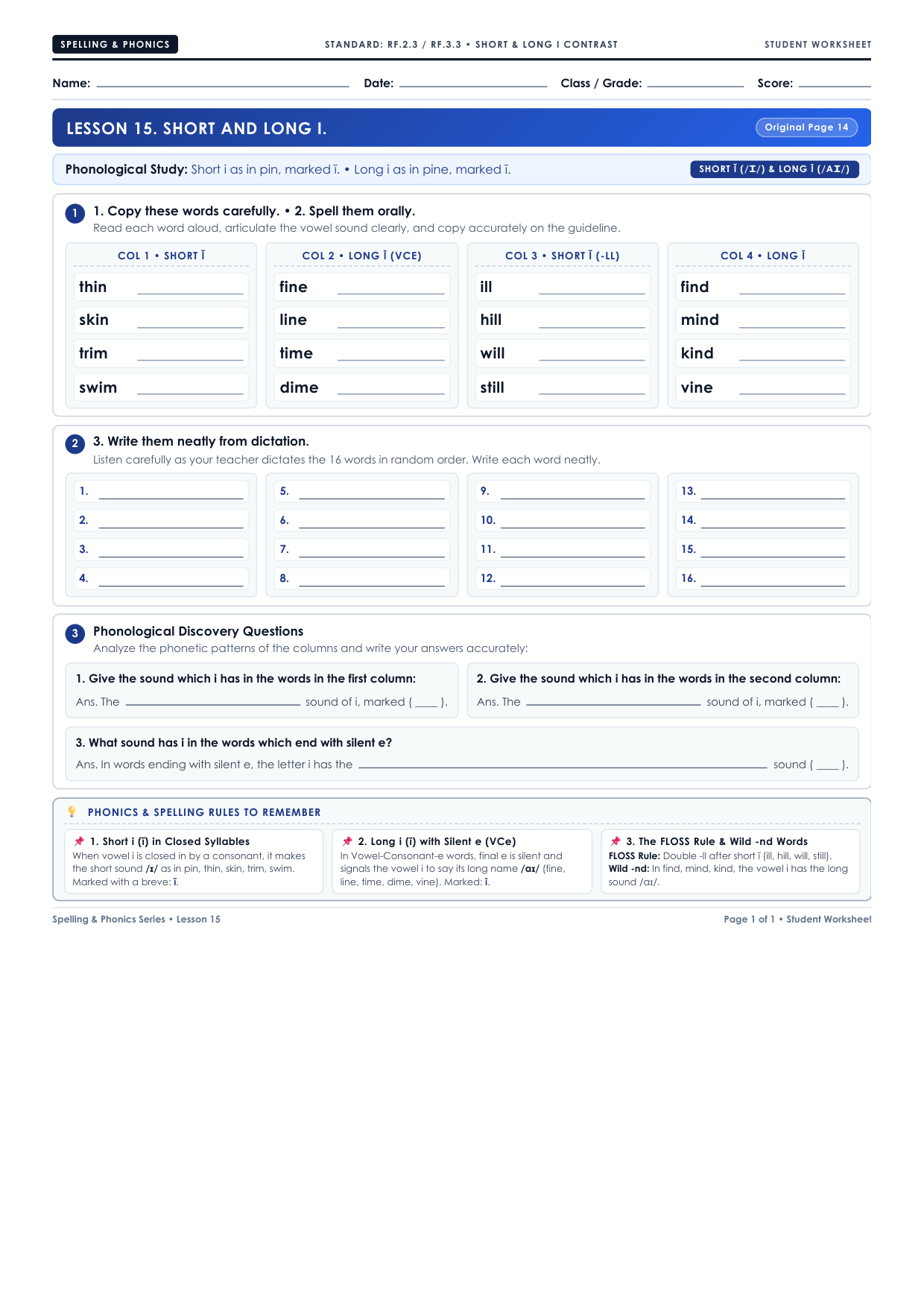
Lesson 15: Short & Long I • pin vs. pine
Contrast short ĭ (/ɪ/) in closed syllables with long ī (/aɪ/) with silent -e (pin/pine, rip/ripe, bit/bite, hid/hide).
Open Student HTML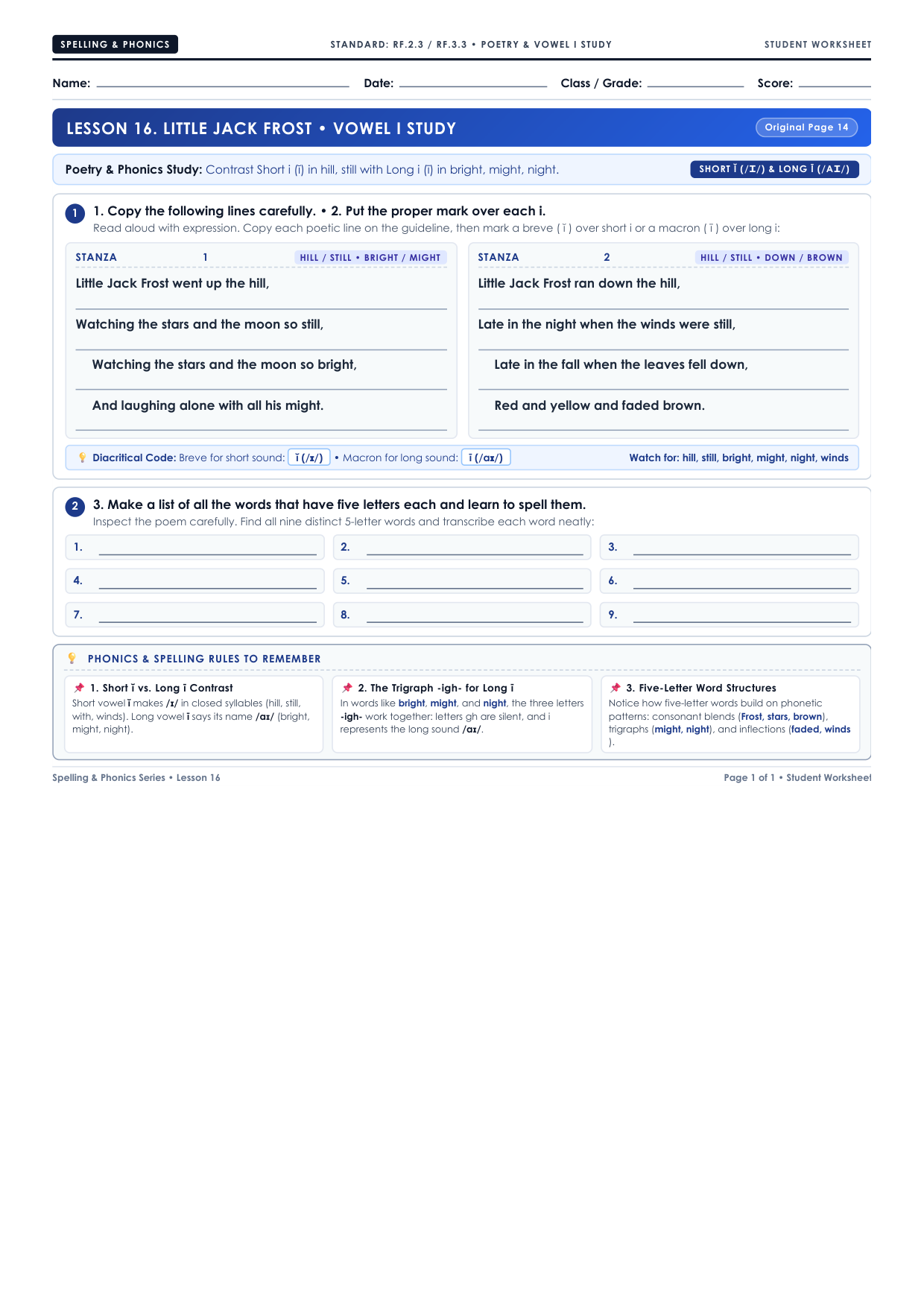
Lesson 16: Little Jack Frost • Vowel I Study
Study vowel sound i through two stanzas of Little Jack Frost. Features reading comprehension, transcription, and syllable analysis.
Open Student HTML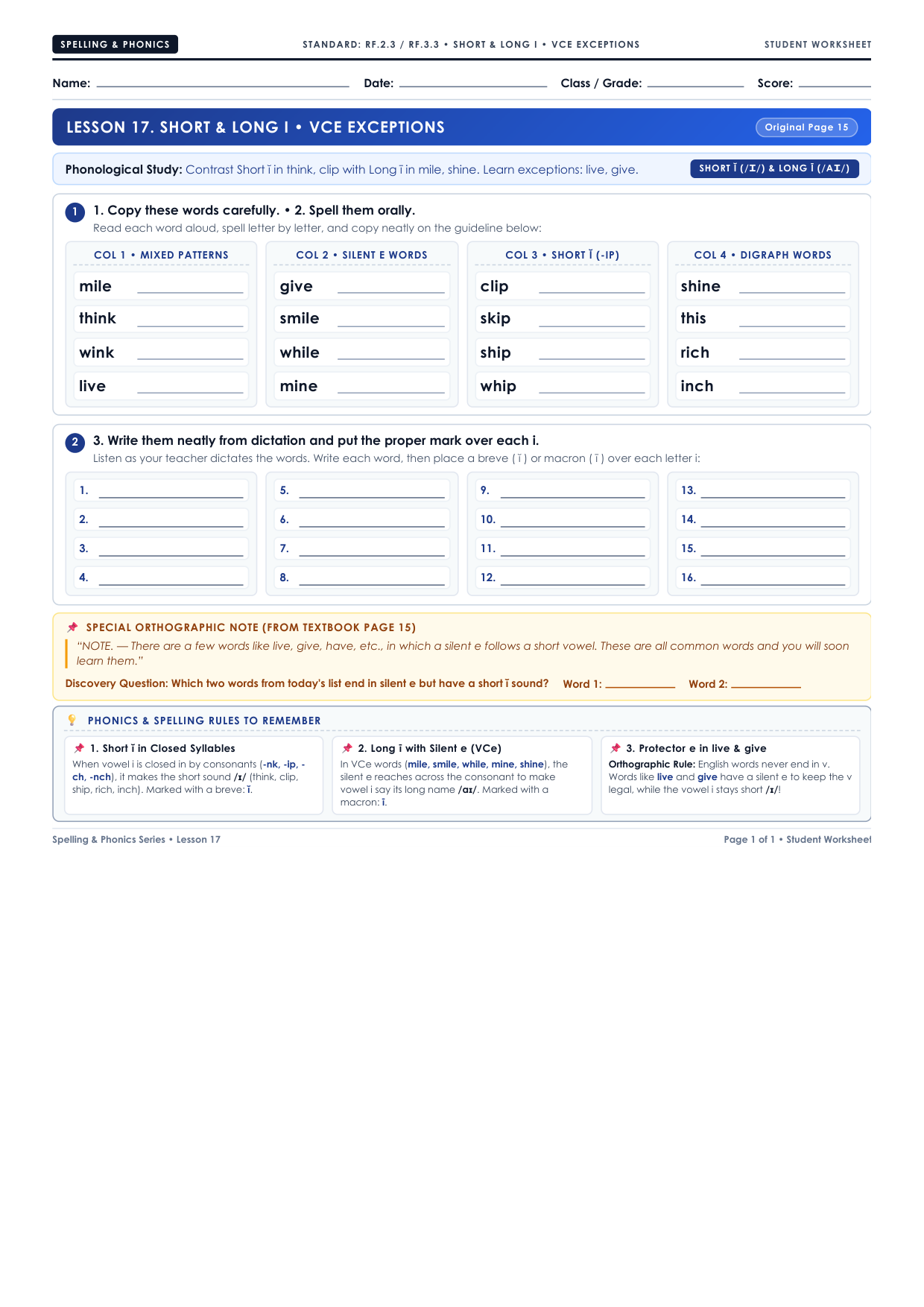
Lesson 17: Short & Long I • VCe Exceptions
Distinguish short ĭ and long ī across 16 vocabulary words. Master historical VCe exceptions like give and live.
Open Student HTML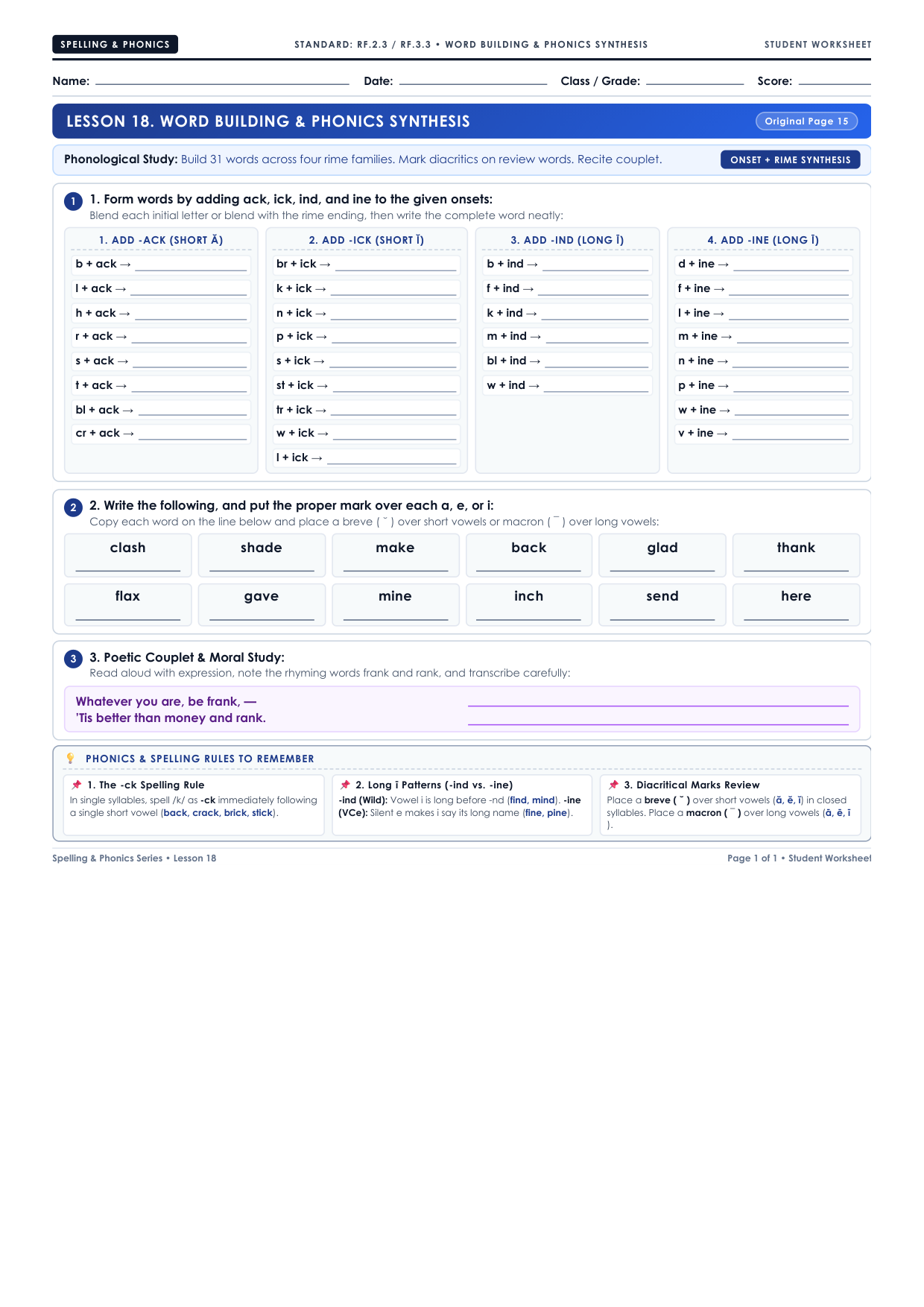
Lesson 18: Word Building • Phonics Synthesis
Synthesize and build 31 words across four classic rimes (-ack, -ick, -ind, -ink). Features nasal clusters and historical vowel lengthening.
Open Student HTML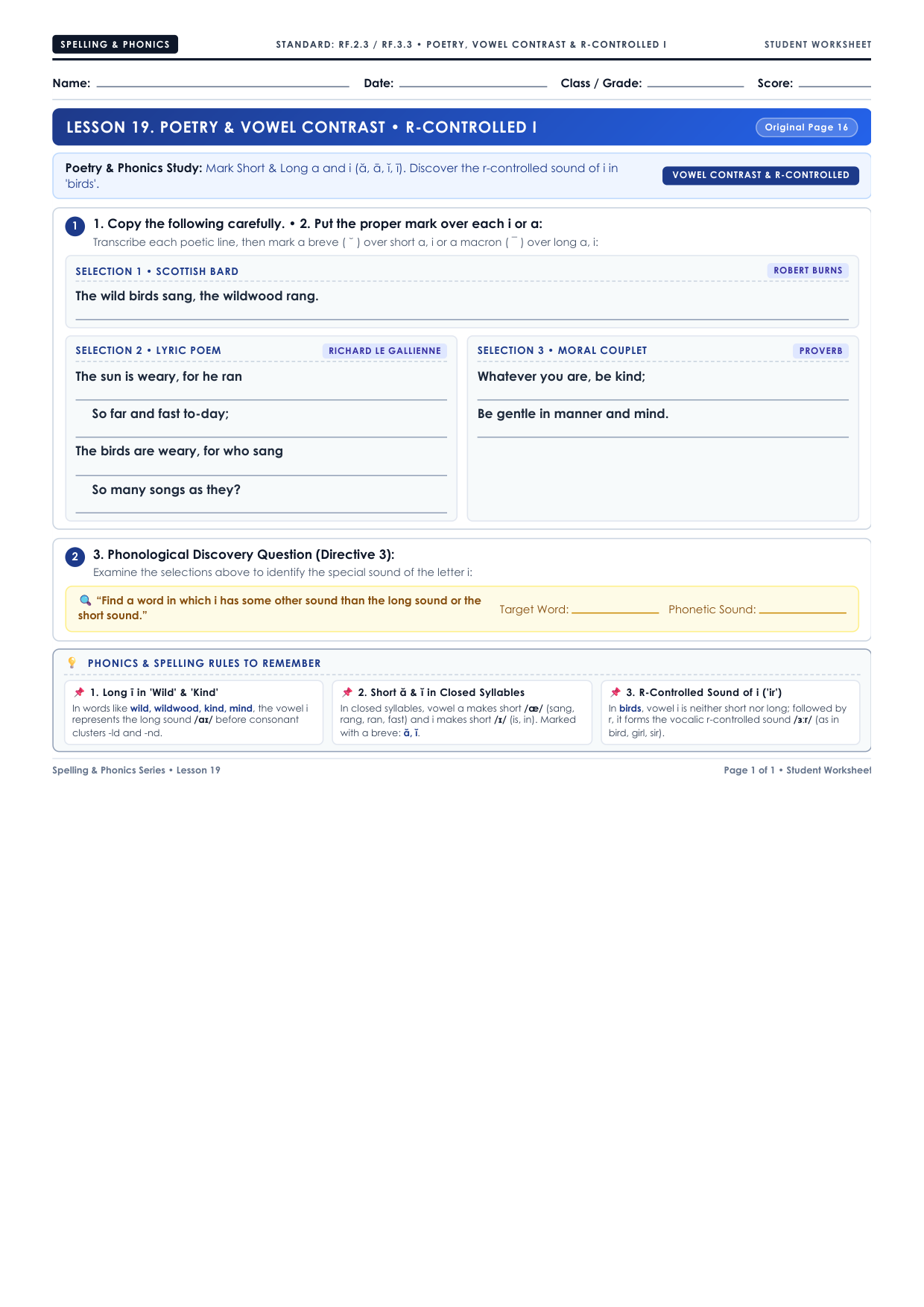
Lesson 19: Poetry • Vowel Contrast & R-Controlled I
Explore poetry by Robert Burns & Richard Le Gallienne. Contrast short vs. long vowels and r-controlled ĩr (birds, girl, third).
Open Student HTML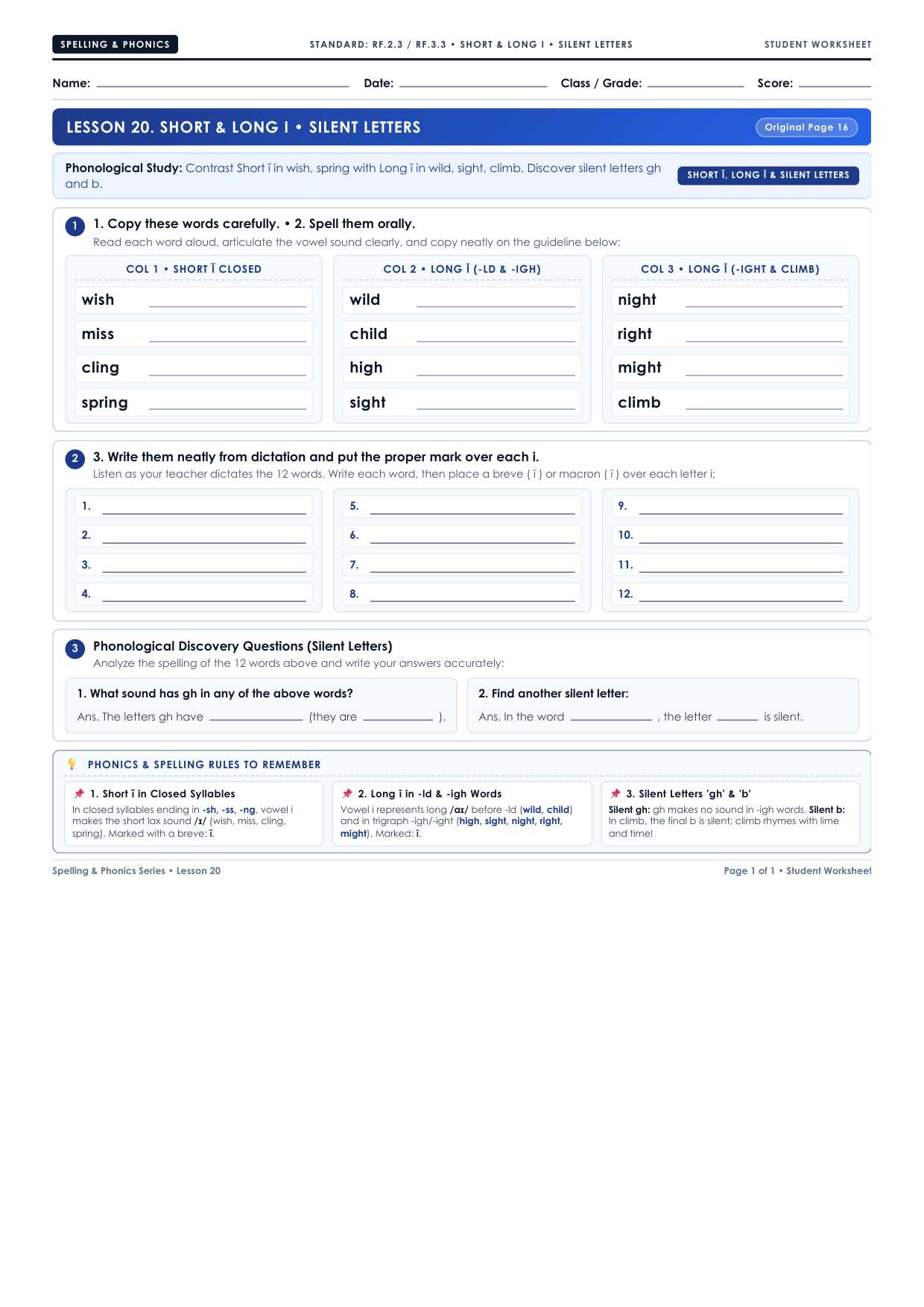
Lesson 20: Short • Long I • Silent Letters (gh & b)
Study 12 words contrasting short ĭ with long ī. Explore silent consonants in igh (high, sigh) and final silent -b (climb).
Open Student HTML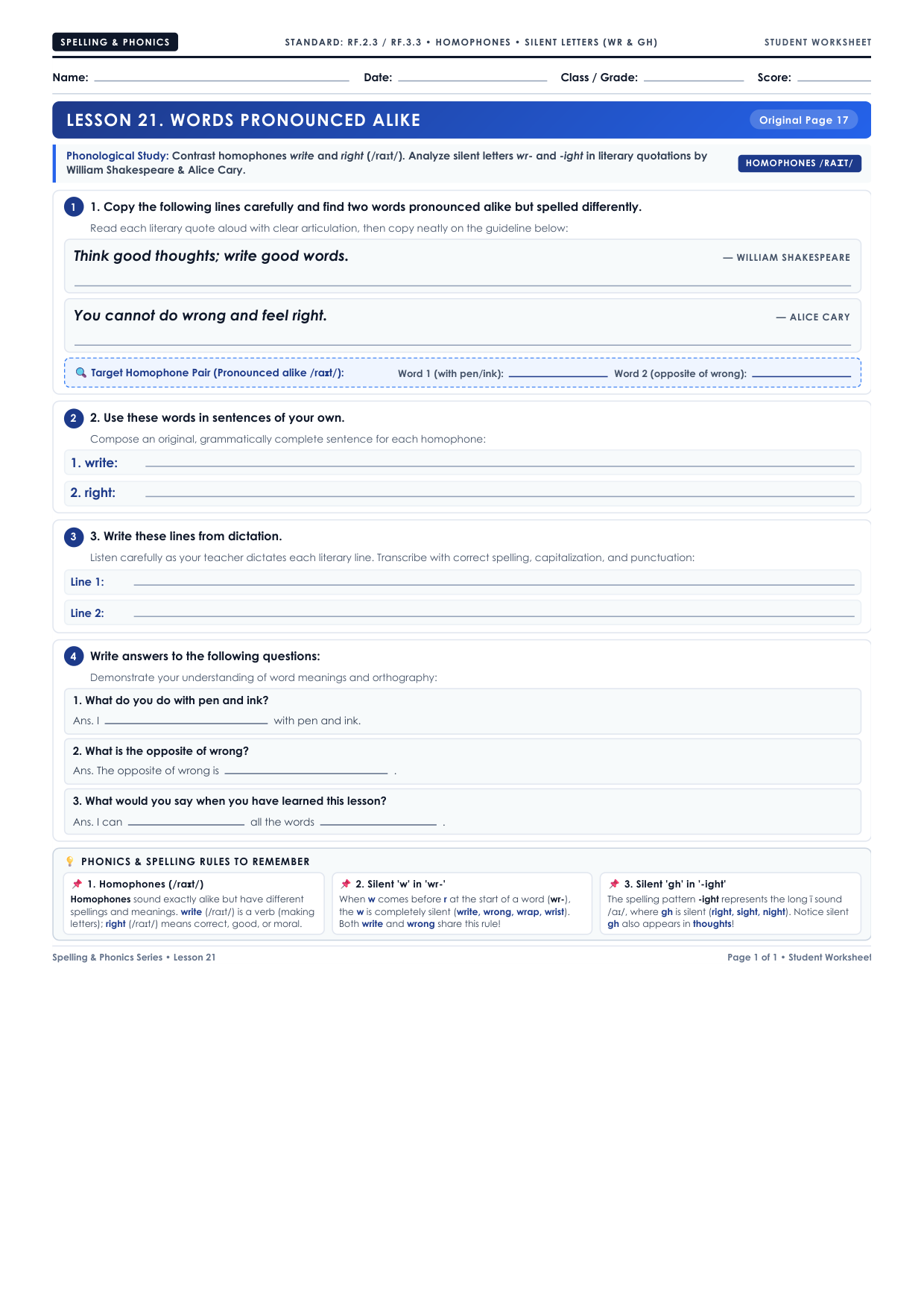
Lesson 21: Words Pronounced Alike • write vs. right
Distinguish classic homophones write and right (/raɪt/). Master verb vs. adjective/direction meanings with contextual fill-in-the-blank sentences.
Open Student HTML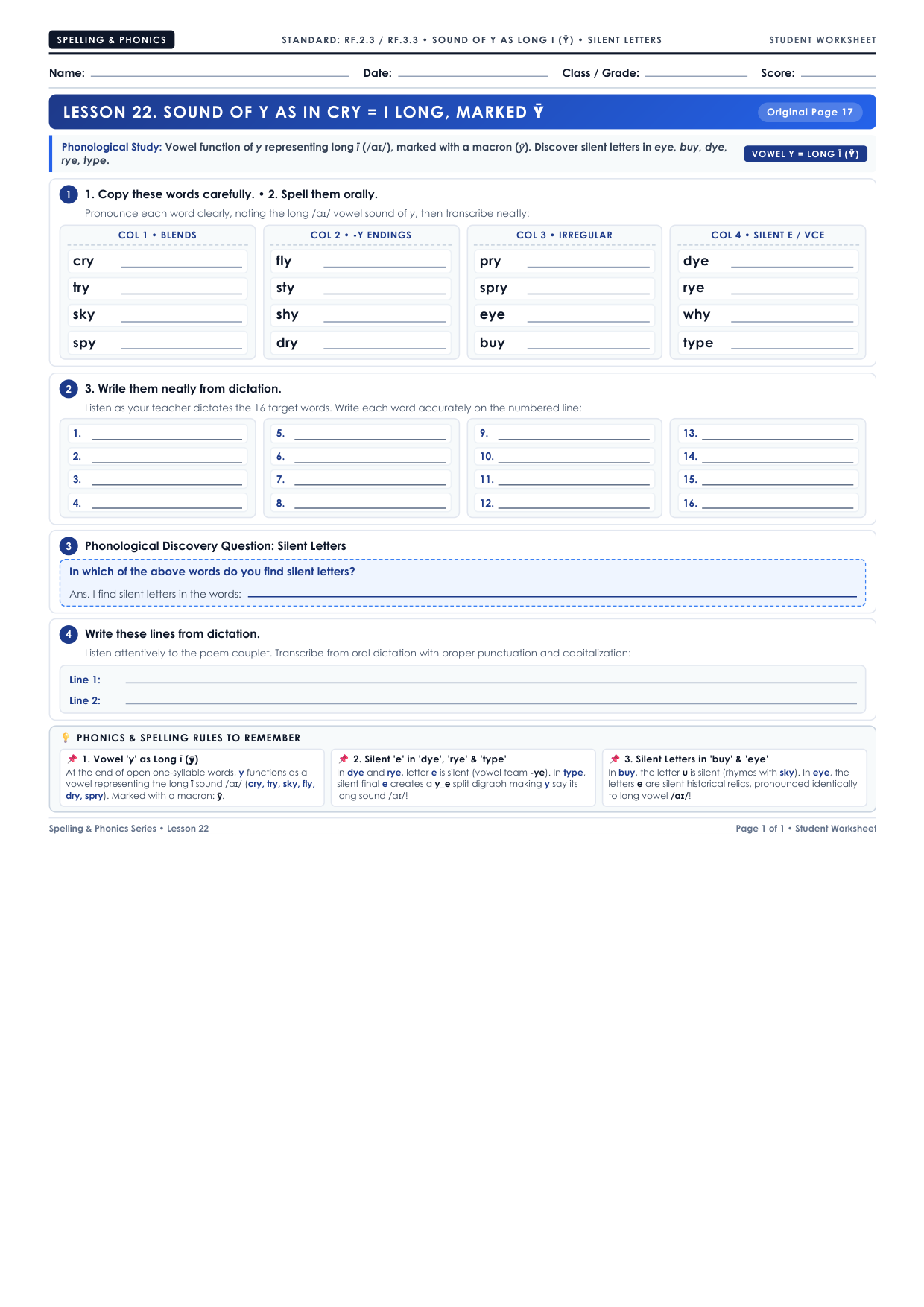
Lesson 22: Sound of Y as Long I • Silent Letters
Master the vowel role of letter y representing long ī (/aɪ/) in open syllables (fly, cry, dry, try, sky, sly, fry, why). Examine silent -k in knight.
Open Student HTML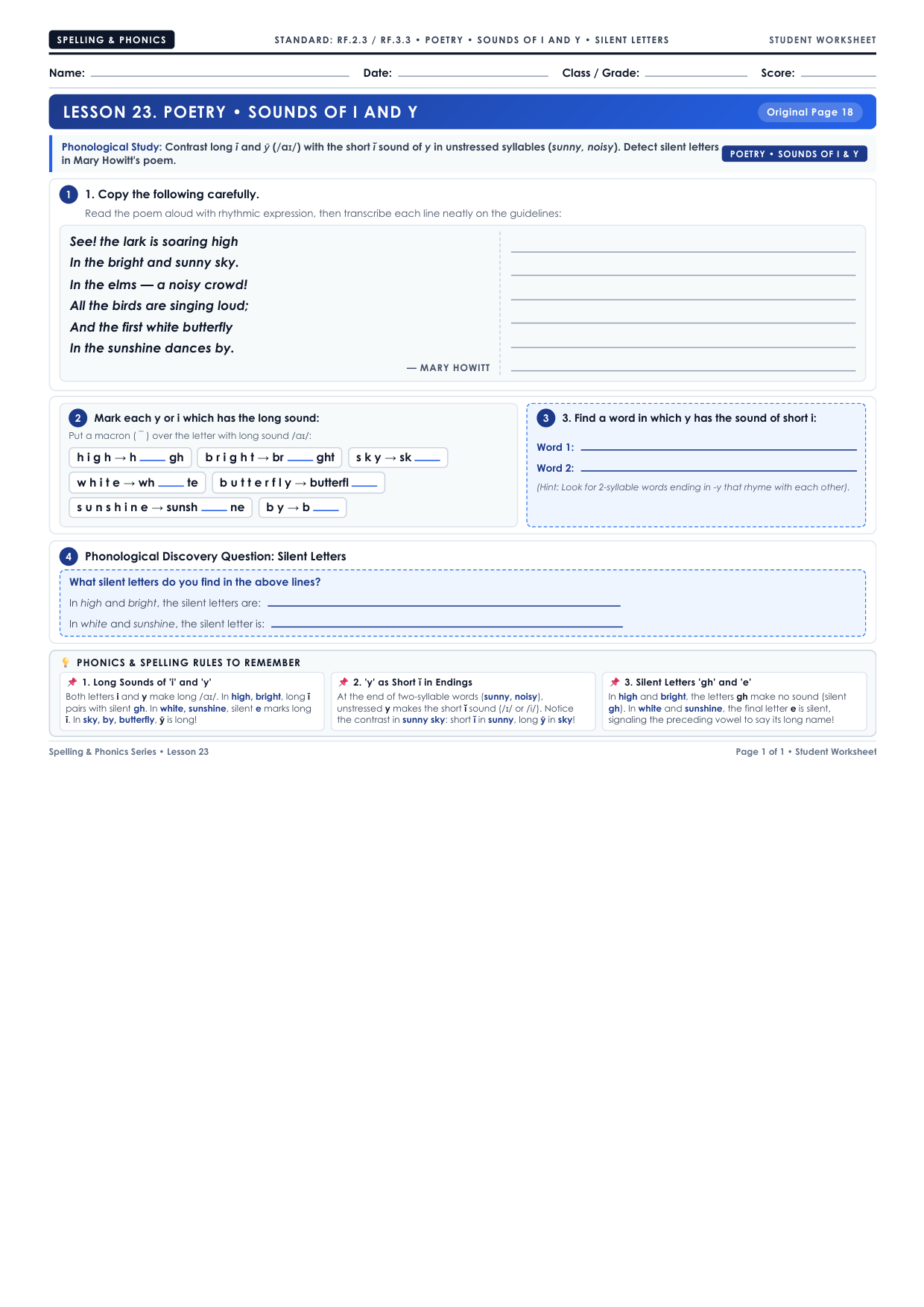
Lesson 23: Poetry • Sounds of I & Y • Silent Letters
Study Mary Howitt's spring nature poem. Contrast long /aɪ/ spellings between letters i and y, along with silent letters in bright, night, flying.
Open Student HTML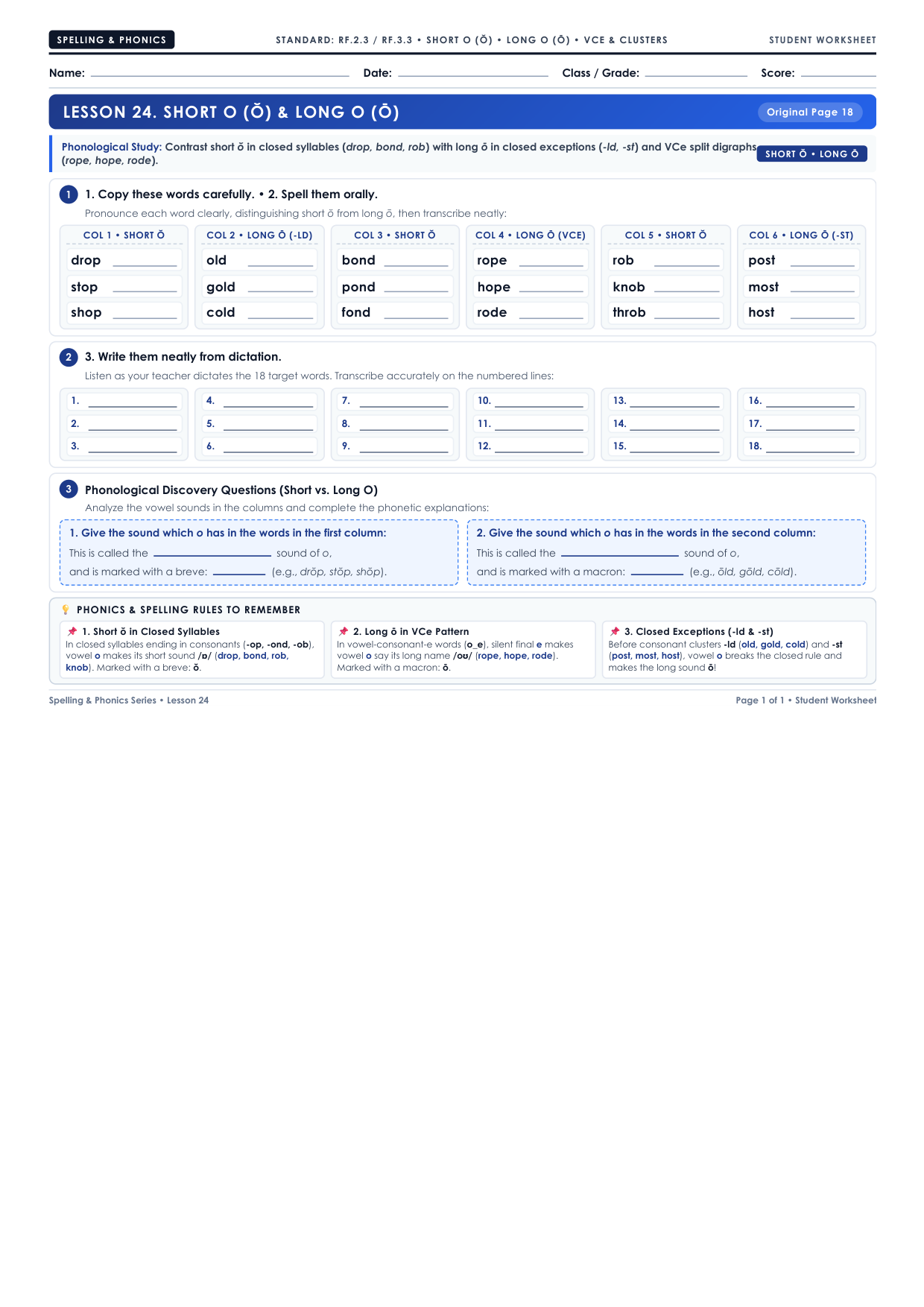
Lesson 24: Short O • Long O • Closed Exceptions
Practice 18 words balancing short ŏ in closed syllables (drop, shop, plot) with long ō in VCe and closed-syllable exceptions (cold, gold, hold, most).
Open Student HTML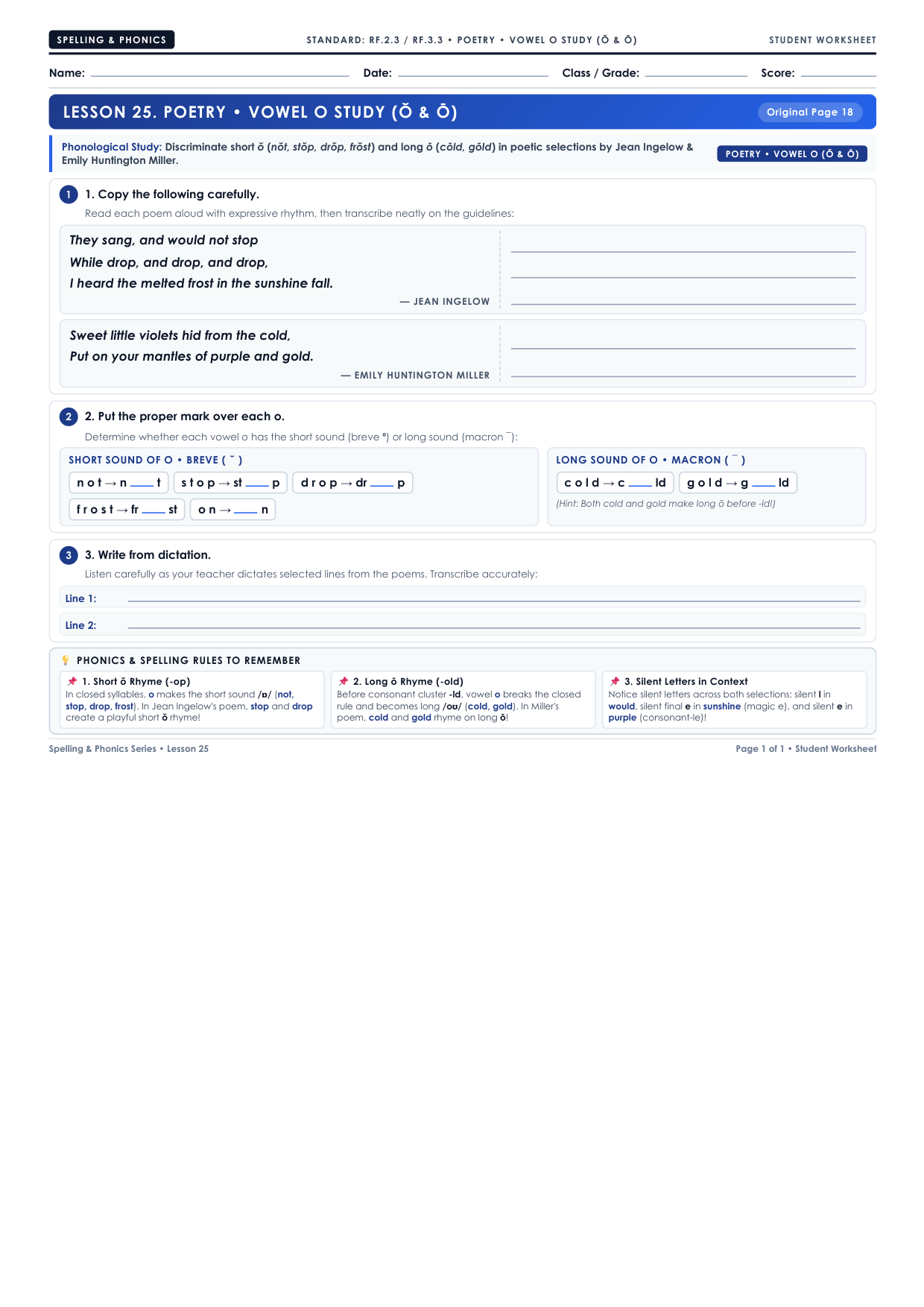
Lesson 25: Poetry • Vowel O Study • Short ŏ & Long ō
Apply Lesson 24 vocabulary to classic children's poetry. Listen to spring rhythms while distinguishing short ŏ from long ō.
Open Student HTML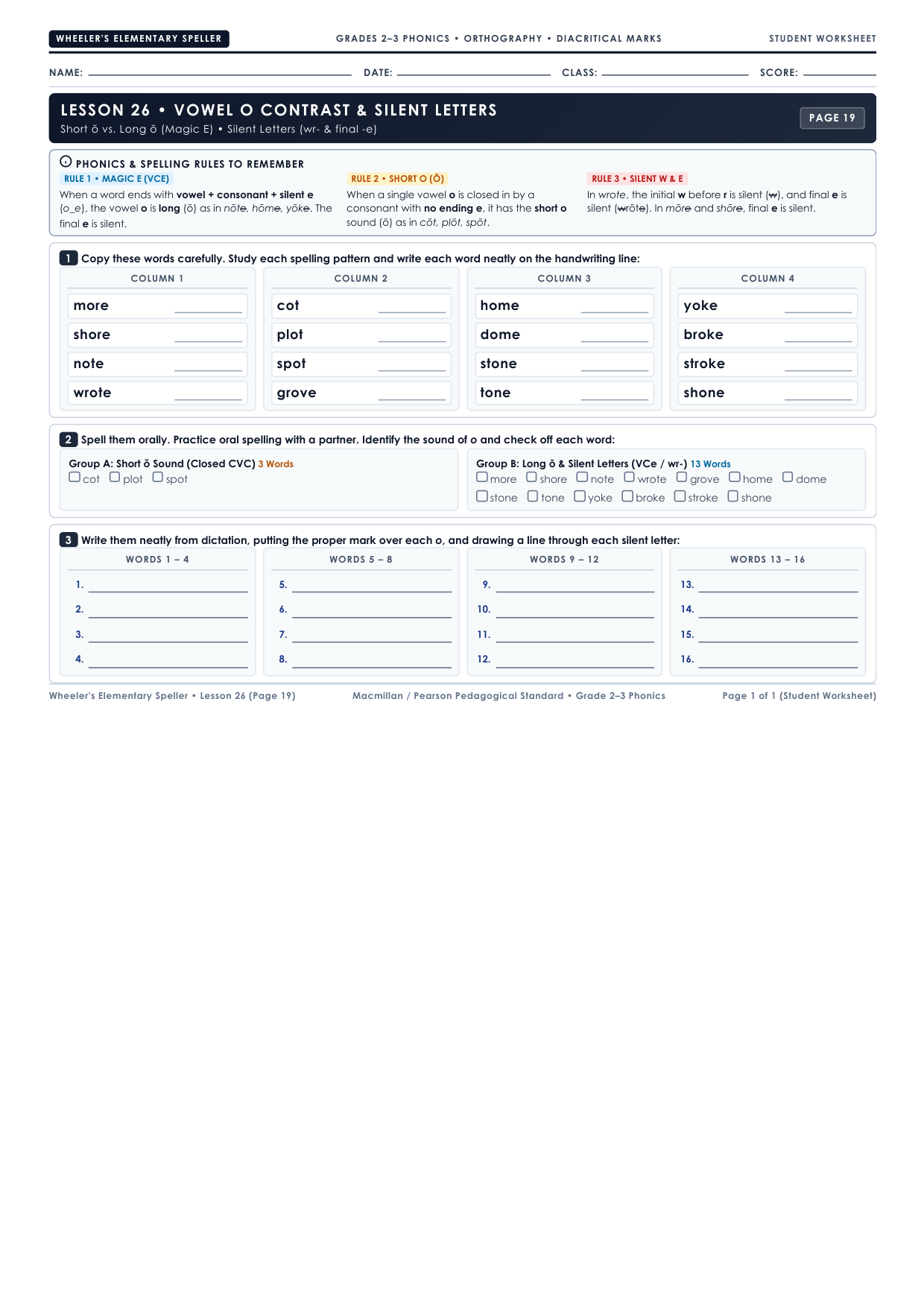
Lesson 26: Vowel O Contrast • Magic E • Silent Letters
Analyze 16 words contrasting short ŏ with long ō and silent consonants in folks, smoke, choke. Includes dictation and transcription.
Open Student HTML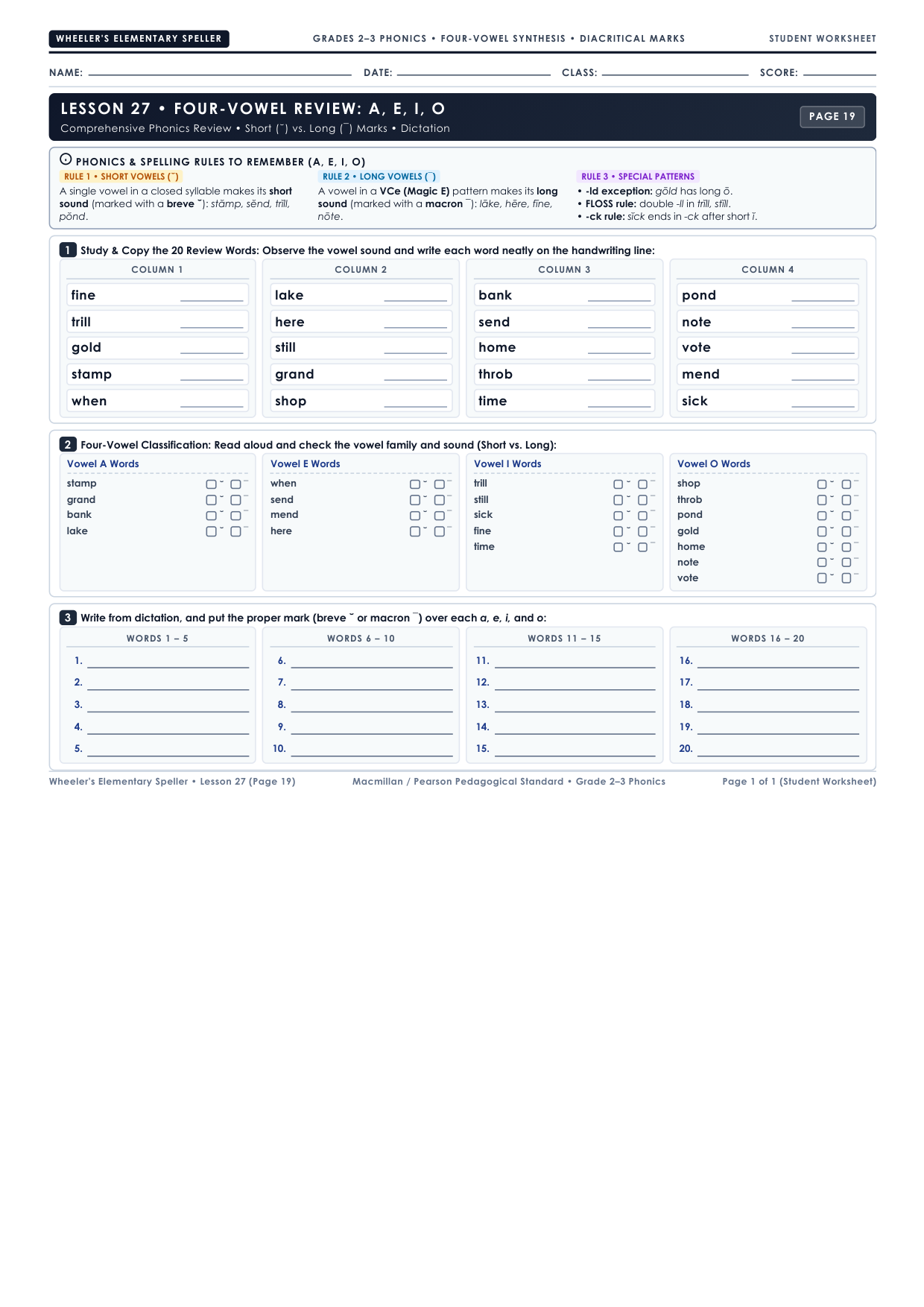
Lesson 27: Four-Vowel Synthesis • a, e, i, o Review
Comprehensive synthesis and review of four vowels: a, e, i, o across 20 vocabulary words. Reinforce phonetic and diacritical discrimination.
Open Student HTML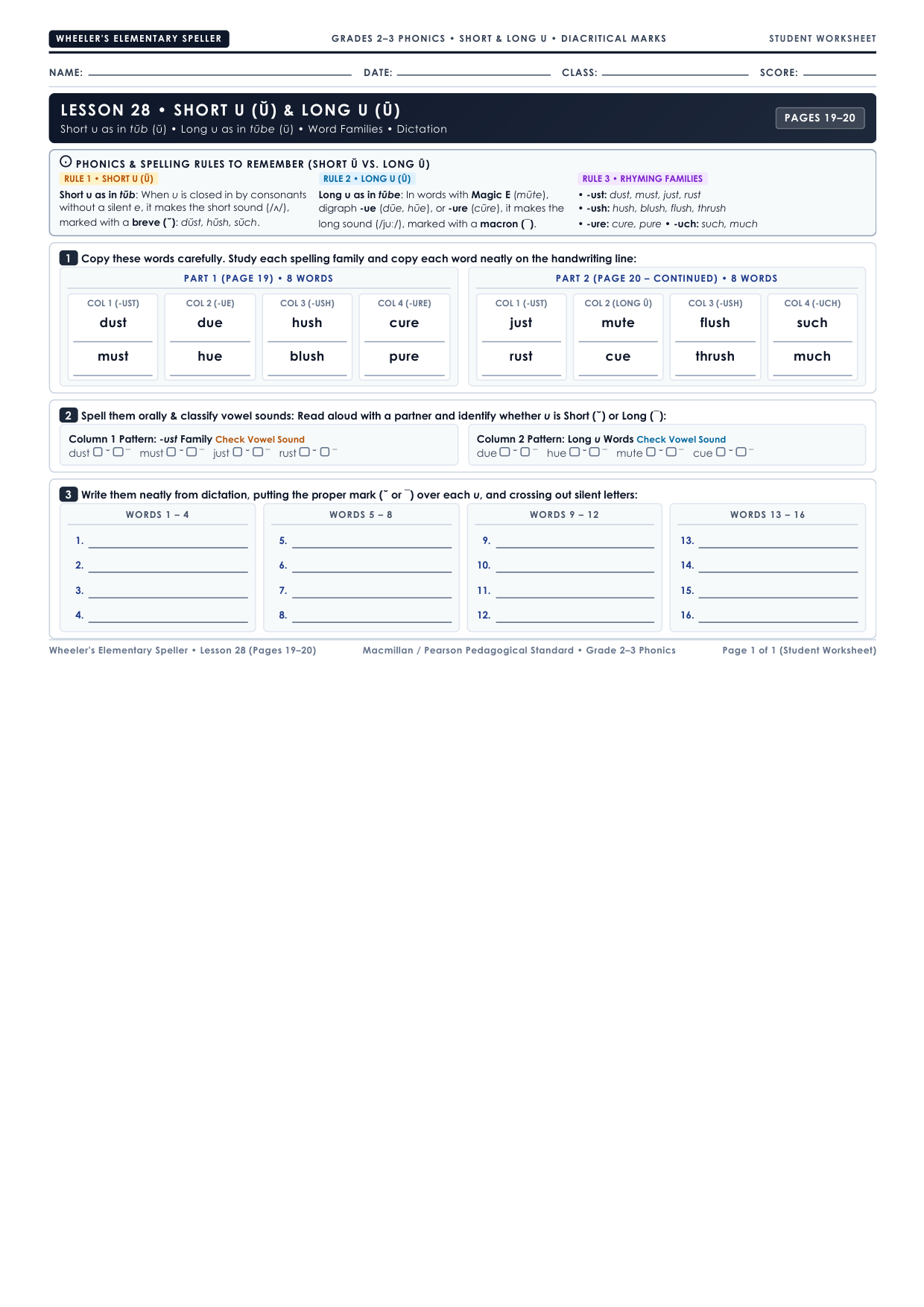
Lesson 28: Short u (ŭ) • Long u (ū) • Word Families
Introduction of vowel U with 16 words. Distinguish short ŭ in closed syllables (tub, cub, cut, run) from long ū (tube, cube, cure, mute).
Open Student HTML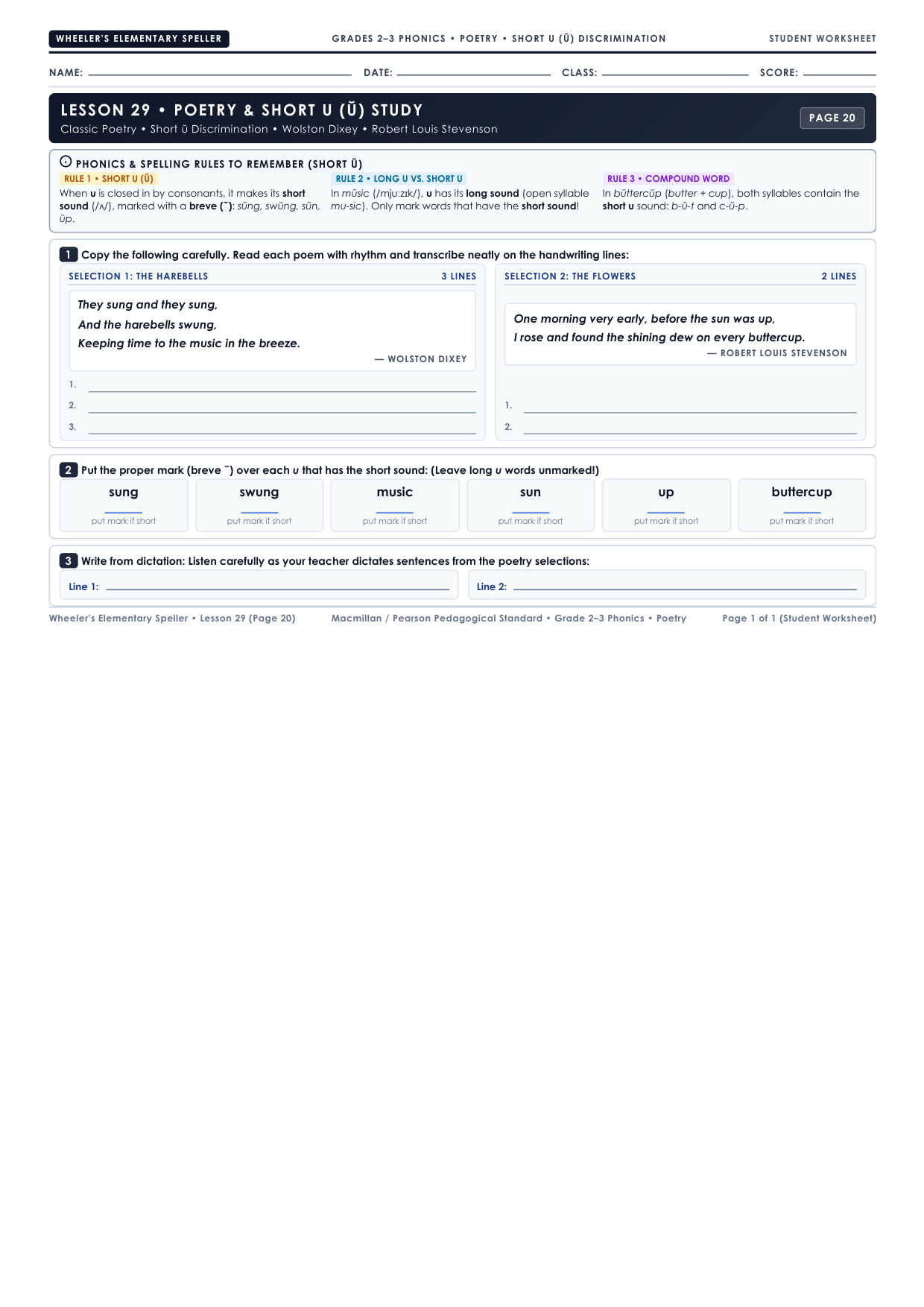
Lesson 29: Poetry • Short u (ŭ) Discrimination
Explore two classical children's verse excerpts by Wolston Dixey. Contrast short ŭ with vowel digraphs and r-controlled sounds.
Open Student HTML
Lesson 30: Word-Building Synthesis
Build and synthesize 36 words across 5 high-frequency word families: -uff, -uck, -ump, -ush, -ock. Reinforce onset-rime blending.
Open Student HTML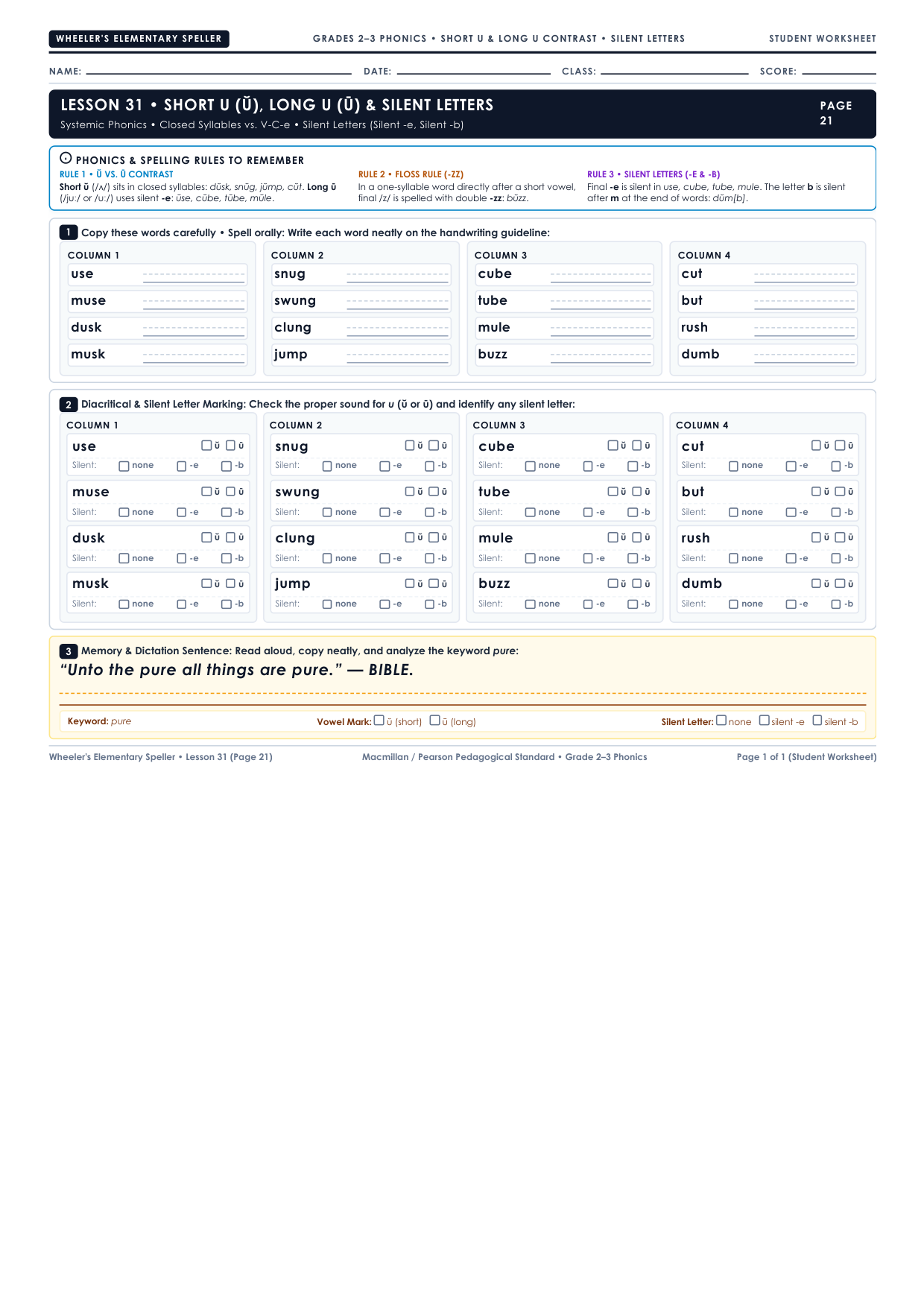
Lesson 31: Short u (ŭ), Long u (ū) & Silent Letters
Distinguish short ŭ in closed syllables (dusk, snug, cut, buzz) from long ū. Examine silent letters in dumb, crumb, thumb.
Open Student HTML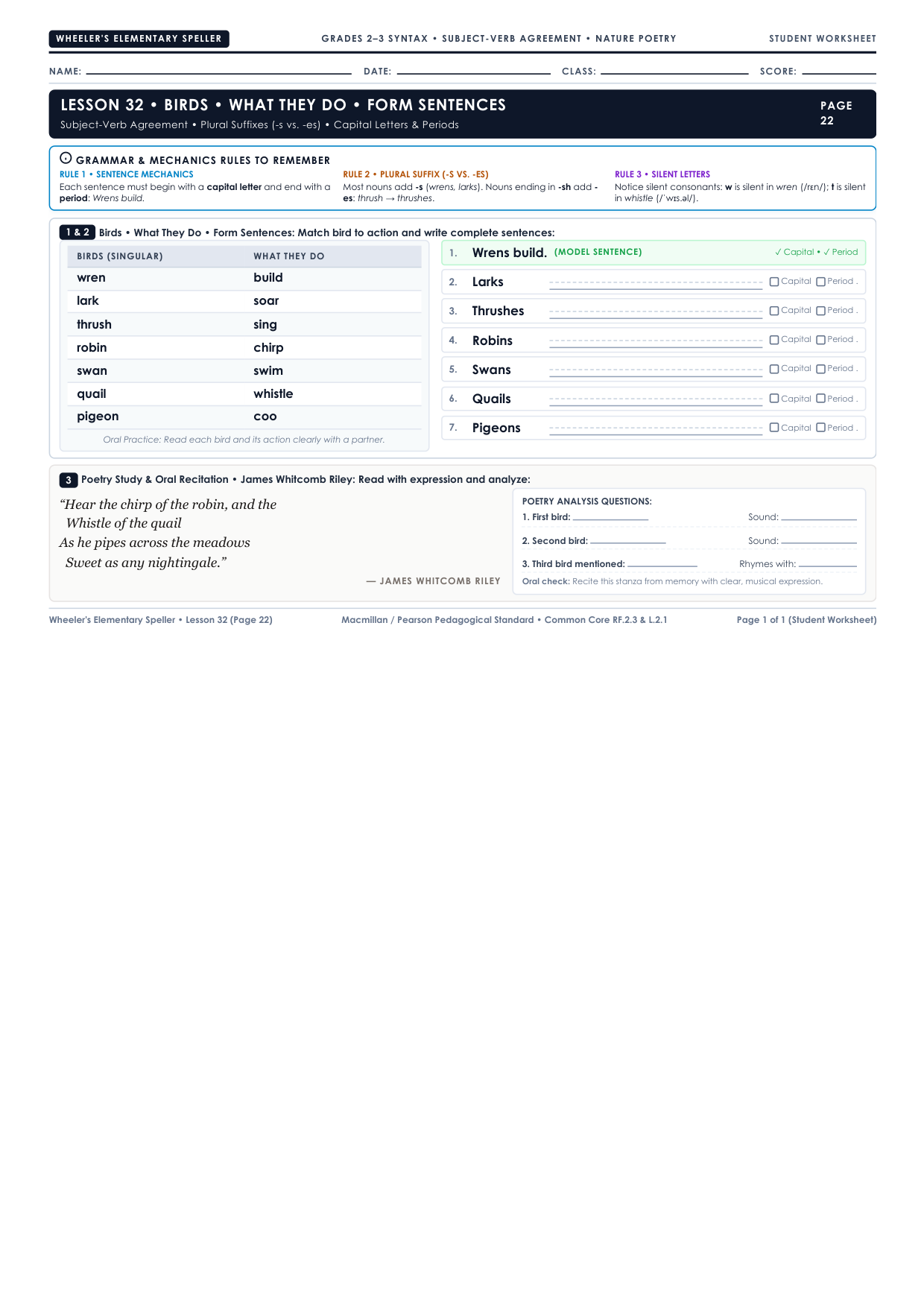
Lesson 32: Birds • What They Do • Form Sentences
Practice subject-verb agreement between plural nouns and action verbs (Wrens build, Larks fly, Owls hoot) with sentence structure exercises.
Open Student HTML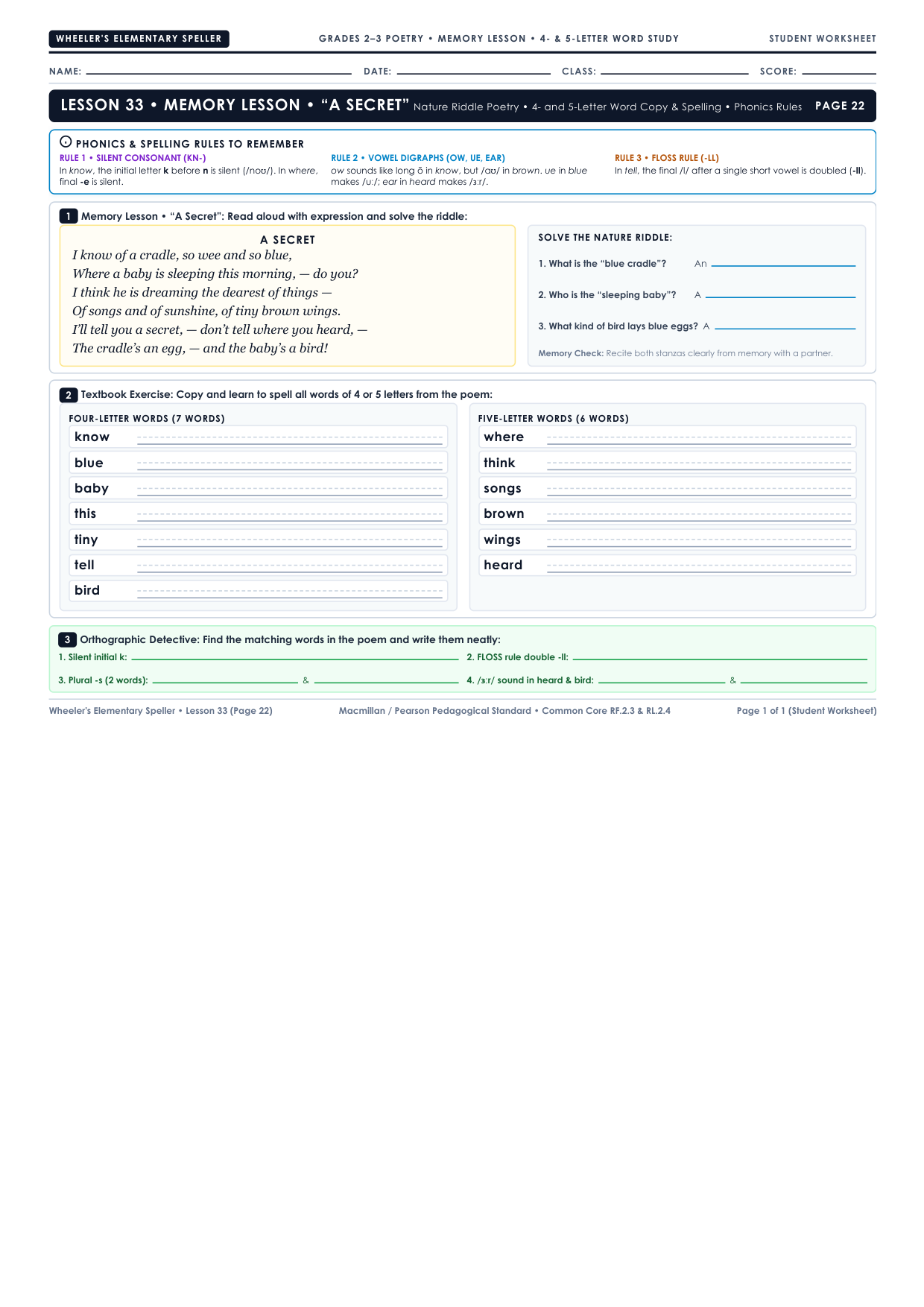
Lesson 33: Memory Lesson • “A Secret”
Memorization and recitation of the nature riddle poem “A Secret” (a cherry tree with three eggs). Focuses on expressive penmanship.
Open Student HTML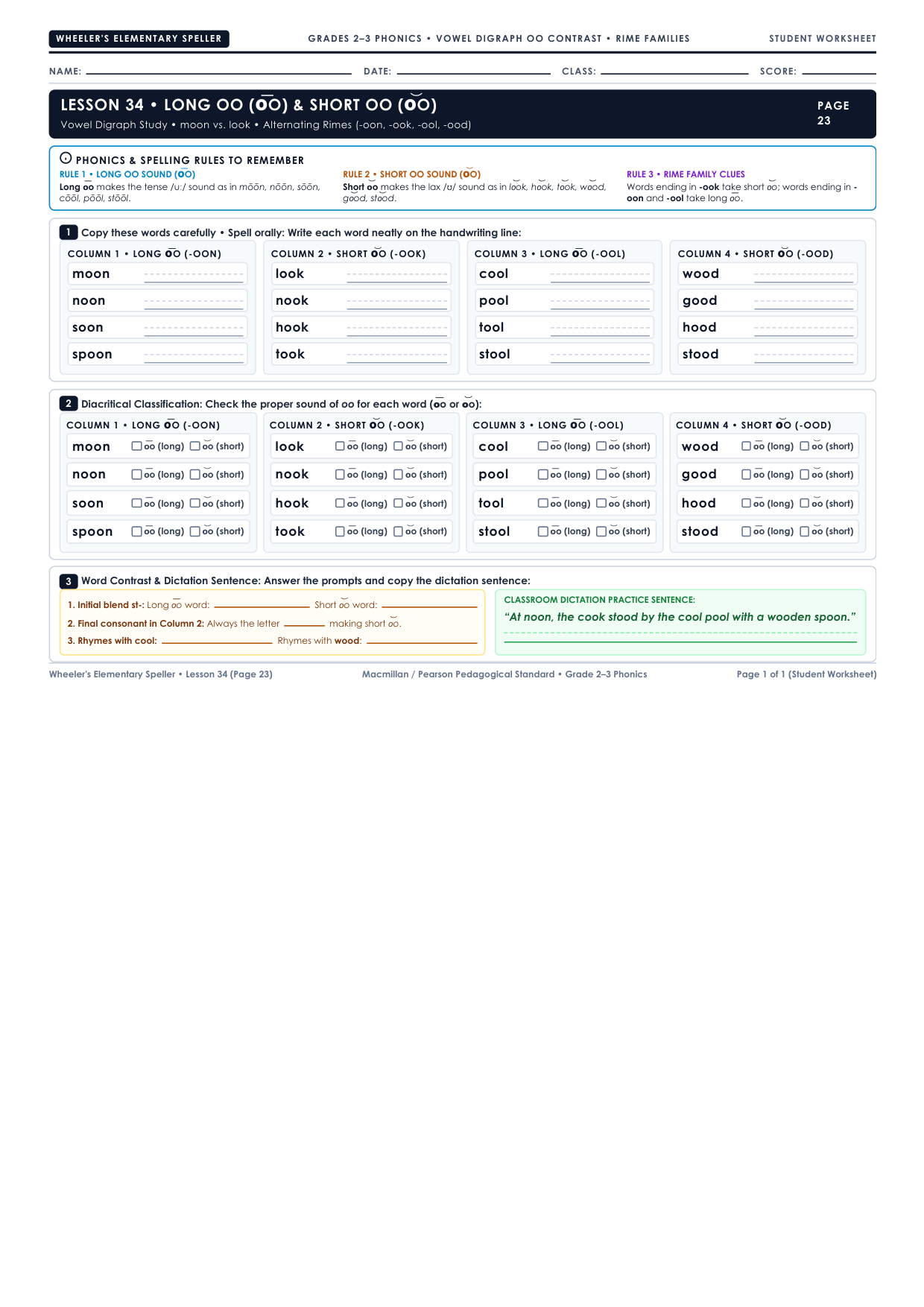
Lesson 34: Long oo (o͞o) • Short oo (o͝o)
Contrast vowel digraph pairs: long oo (/uː/ - moon, noon, soon, spoon, cool) and short oo (/ʊ/ - book, look, took, good, wood).
Open Student HTML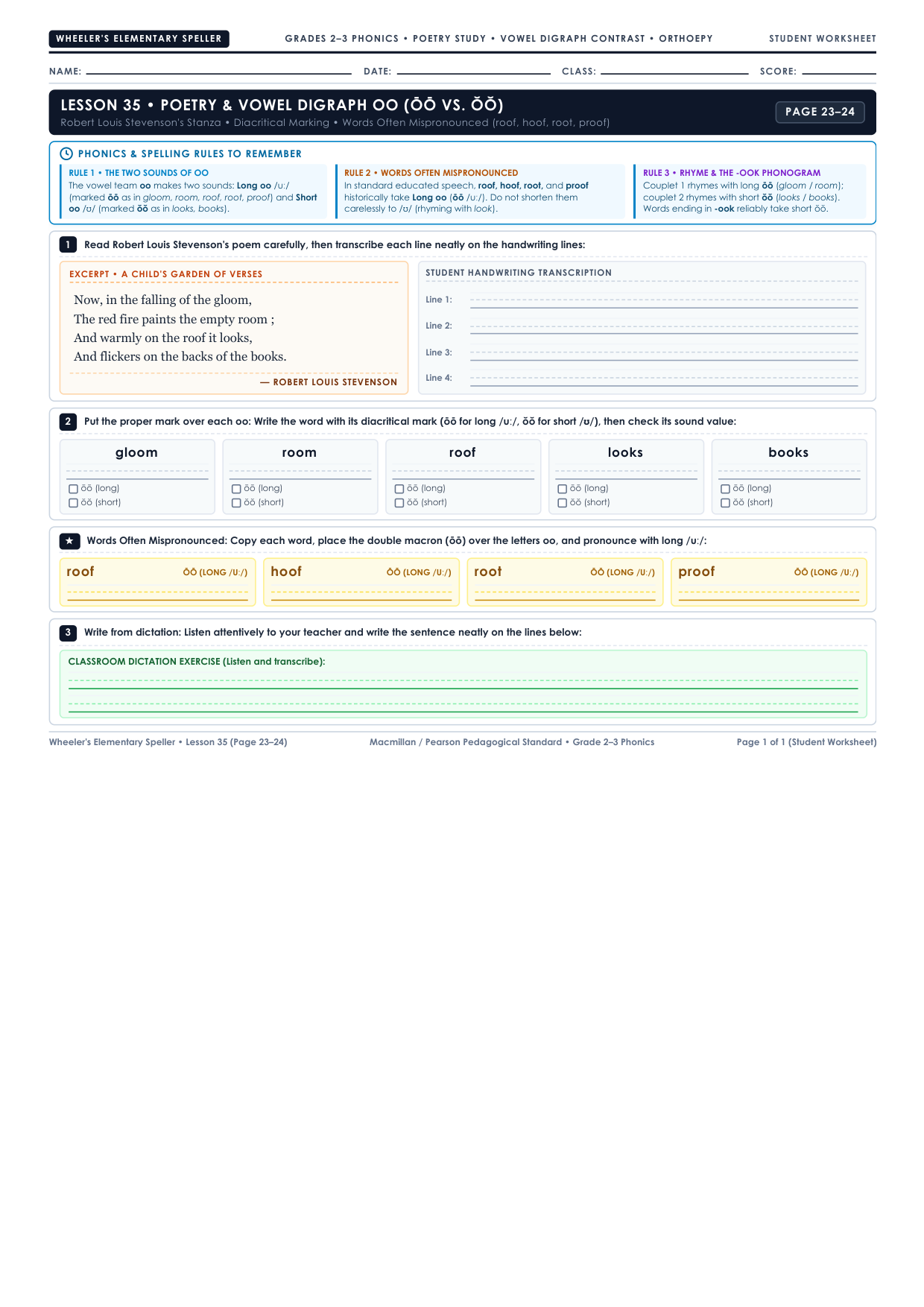
Lesson 35: Poetry • Vowel Digraph OO (o͞o vs. o͝o)
Study Robert Louis Stevenson's classic verse from A Child's Garden of Verses. Contrast long oo (/uː/) and short oo (/ʊ/).
Open Student HTML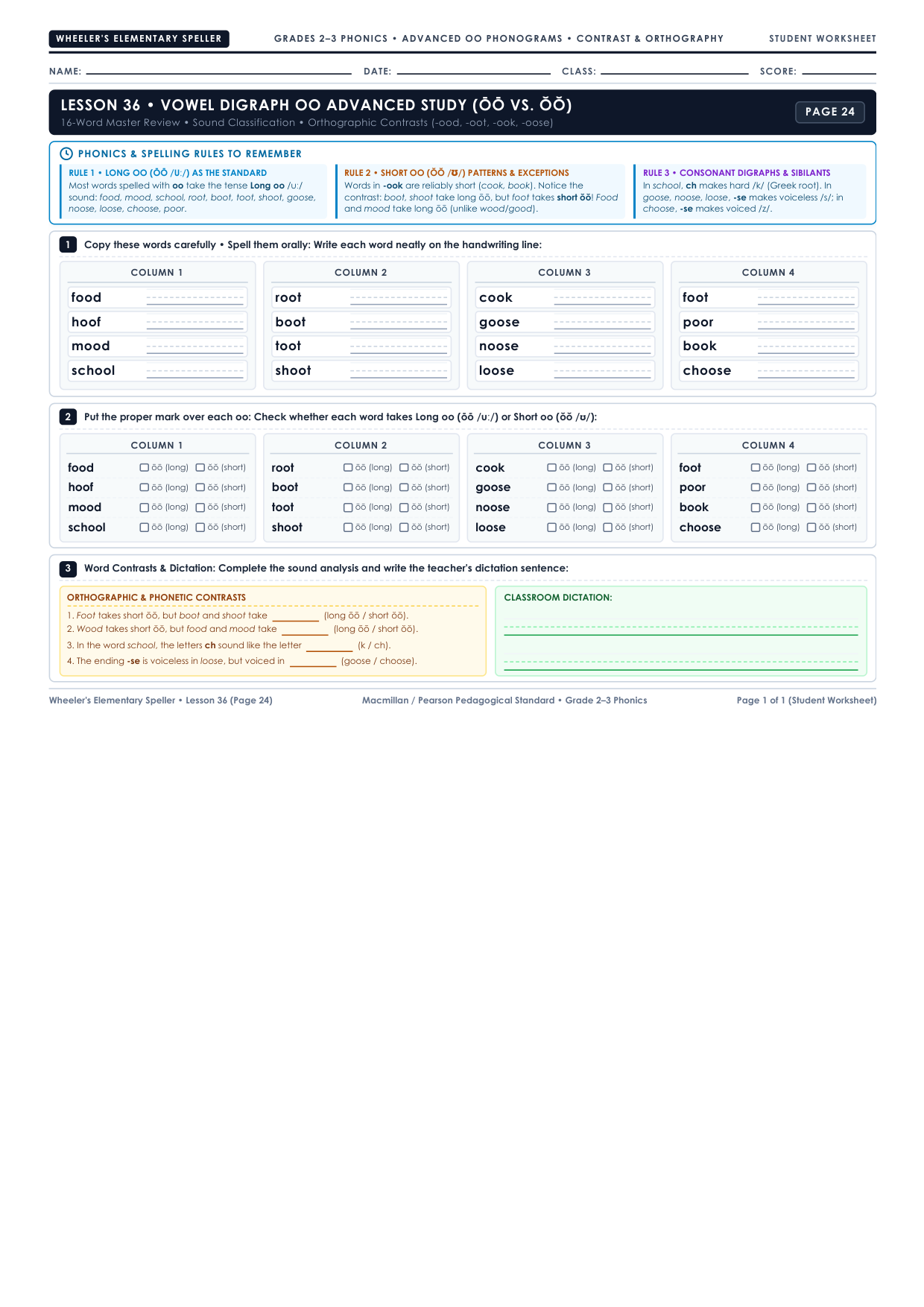
Lesson 36: Vowel Digraph OO Advanced Study (ōō vs. ŏŏ)
Advanced review of 16 words with digraph oo. Understand pre-plosive vowel laxing (/uː/ vs. /ʊ/) and complete dictation exercises.
Open Student HTML
Lesson 37: Homophones • Bee vs. Be • Song of the Bee
Distinguish classic homophones bee (insect noun) and be (auxiliary verb). Read Marion Douglas's The Song of the Bee.
Open Student HTML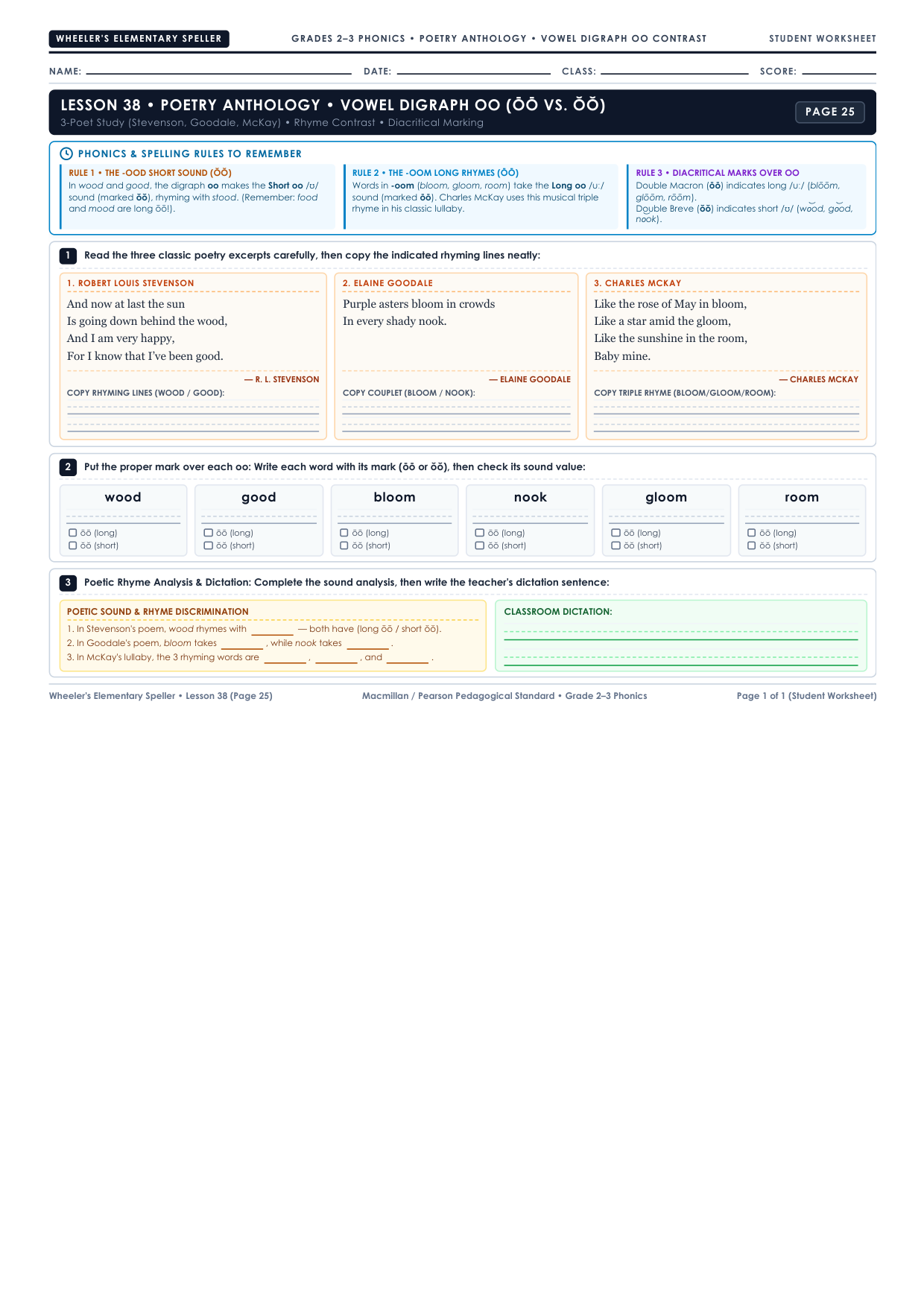
Lesson 38: Poetry Anthology • Vowel Digraph OO (ōō vs. ŏŏ)
Poetry anthology featuring R.L. Stevenson, Elaine Goodale, and Charles McKay. Contrast long oo and short oo across rich literary stanzas.
Open Student HTML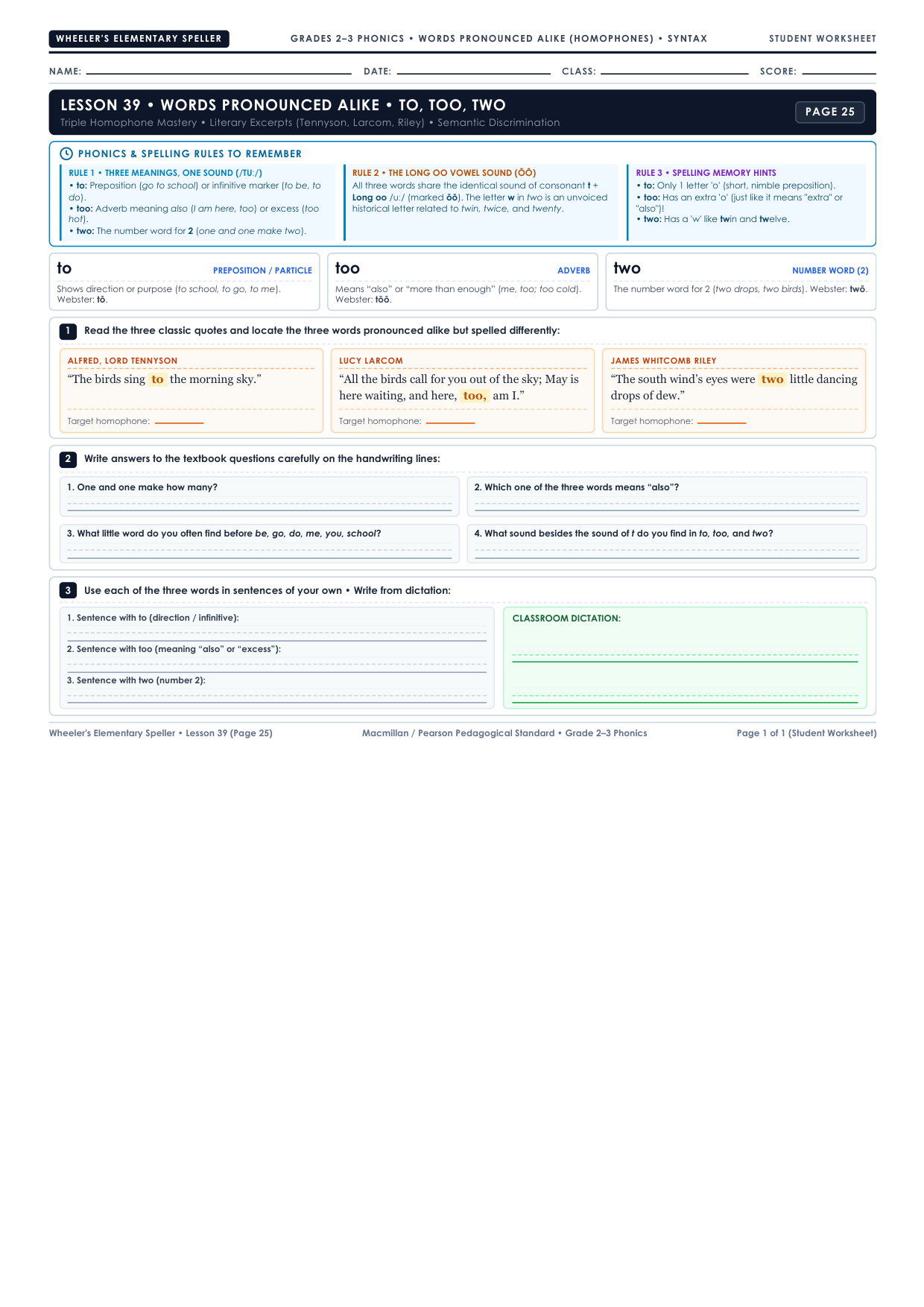
Lesson 39: Words Pronounced Alike • To, Too, Two
Distinguish the triple homophones to, too, and two (/tuː/). Master preposition, adverb, and numeral distinctions with sentence exercises.
Open Student HTML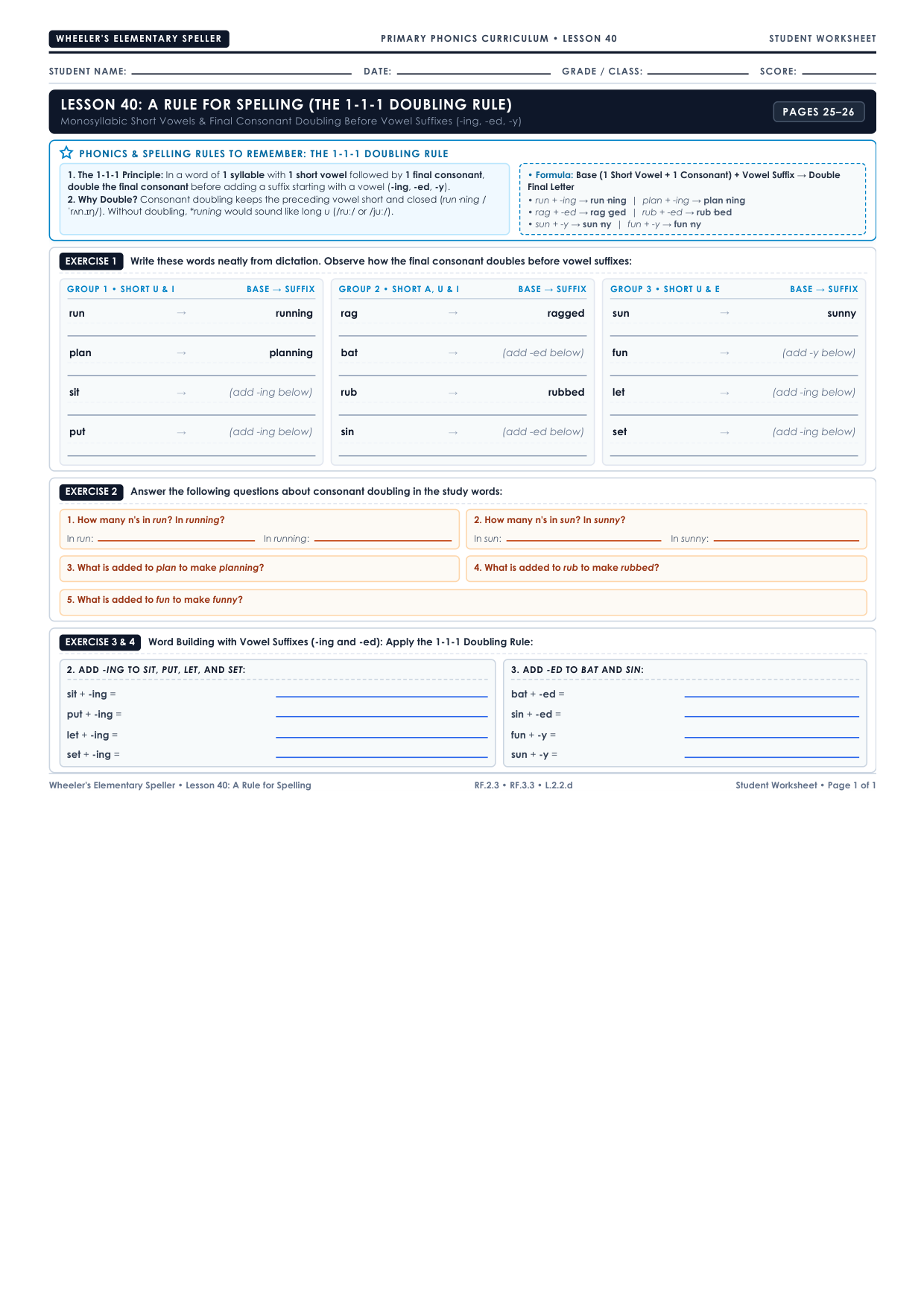
Lesson 40: A Rule for Spelling • Consonant Doubling
Master the 1-1-1 Doubling Rule: double the final consonant in one-syllable base words with one short vowel before vowel suffixes (-ing, -ed, -y).
Open Student HTML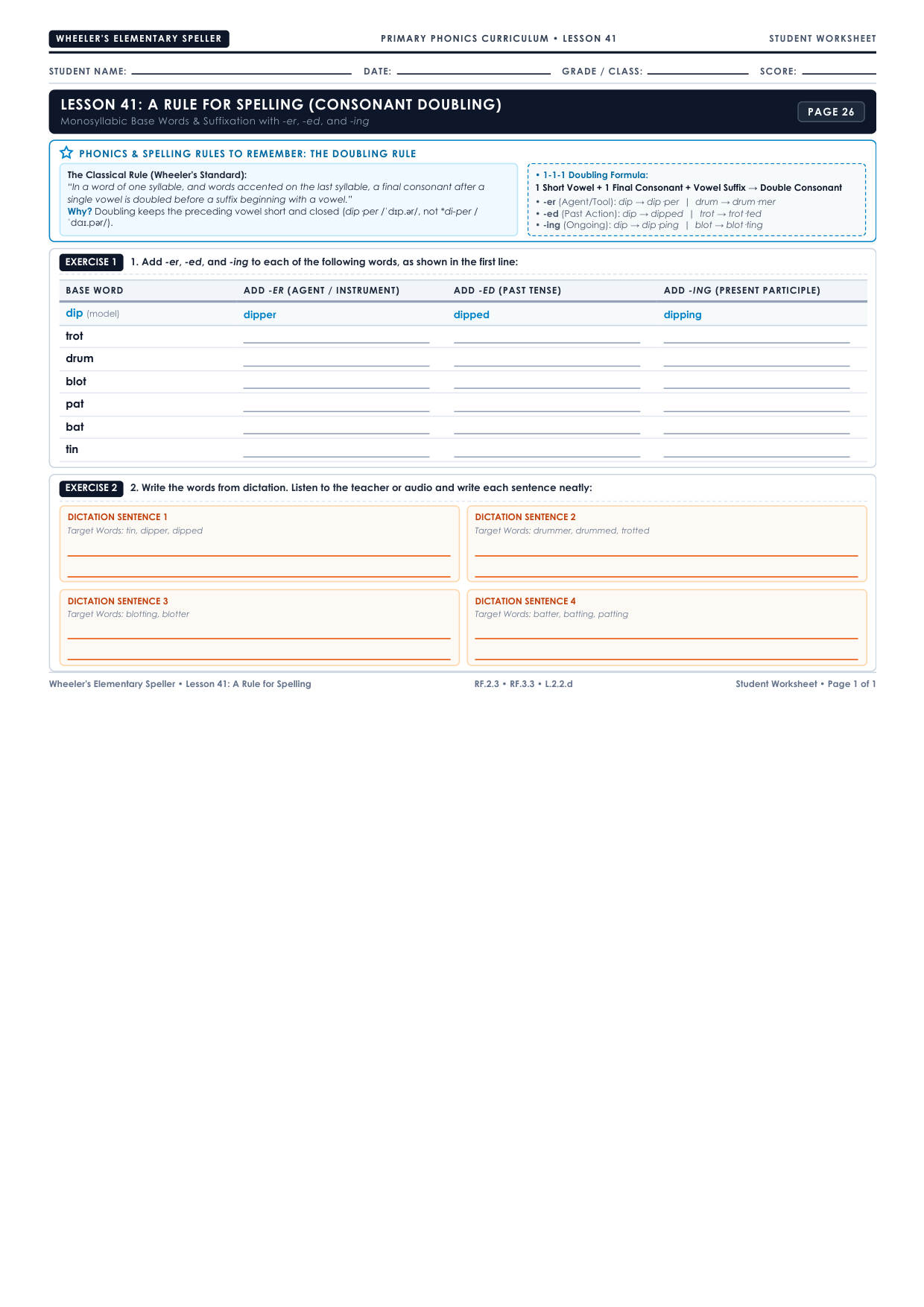
Lesson 41: A Rule for Spelling • Consonant Doubling
Advanced practice with the Consonant Doubling Rule before vowel suffixes -er, -ed, -ing across 7 base words (dip, trot, drum, blot, pat, bat, tin).
Open Student HTML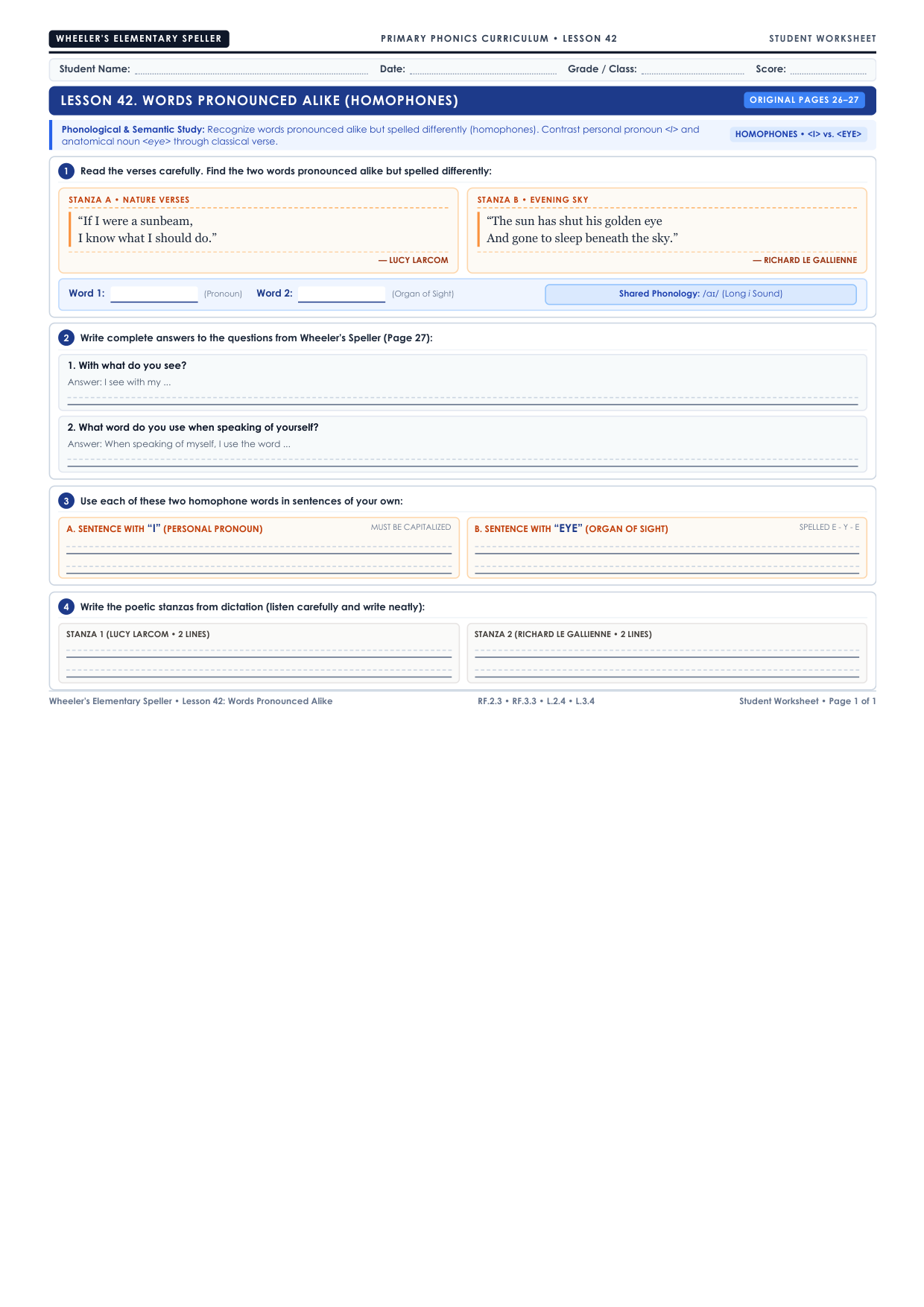
Lesson 42: Homophones • “I” and “eye”
Words pronounced alike but spelled differently (I and eye). Features copywork, literary quotations, and context sentence completion.
Open Student HTML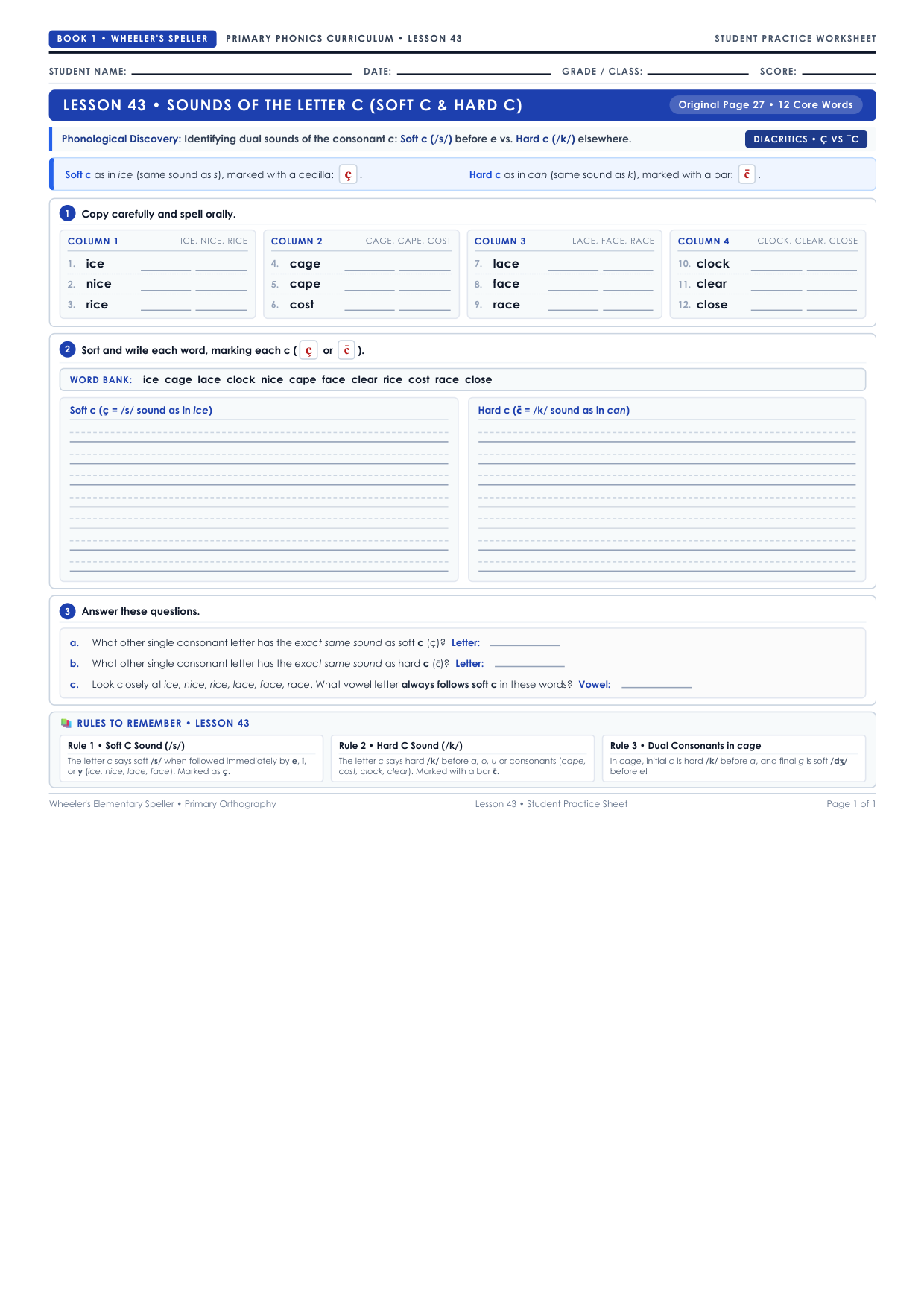
Lesson 43: Dual Sounds of Letter C
Phonological discovery of soft c (/s/, marked ç as in ice, nice, lace) before e versus hard c (/k/, marked c̄ as in cape, cost, clock).
Open Student HTML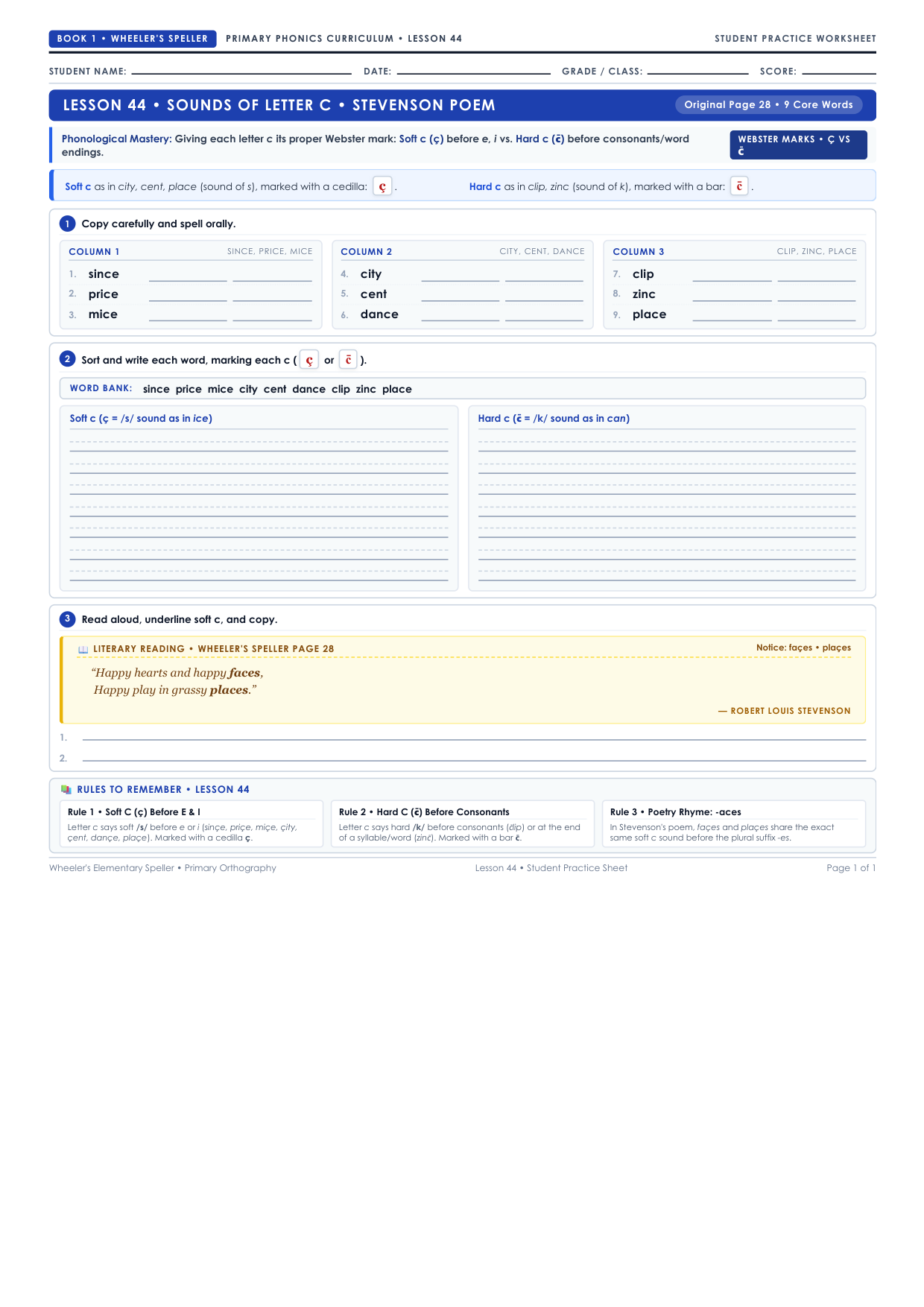
Lesson 44: Proper Mark for C • Stevenson Poem
Assigning proper Webster diacritics (ç vs c̄) to 9 words (since, price, city, clip, zinc, place) and decodable poetry by Robert Louis Stevenson (faces, places).
Open Student HTML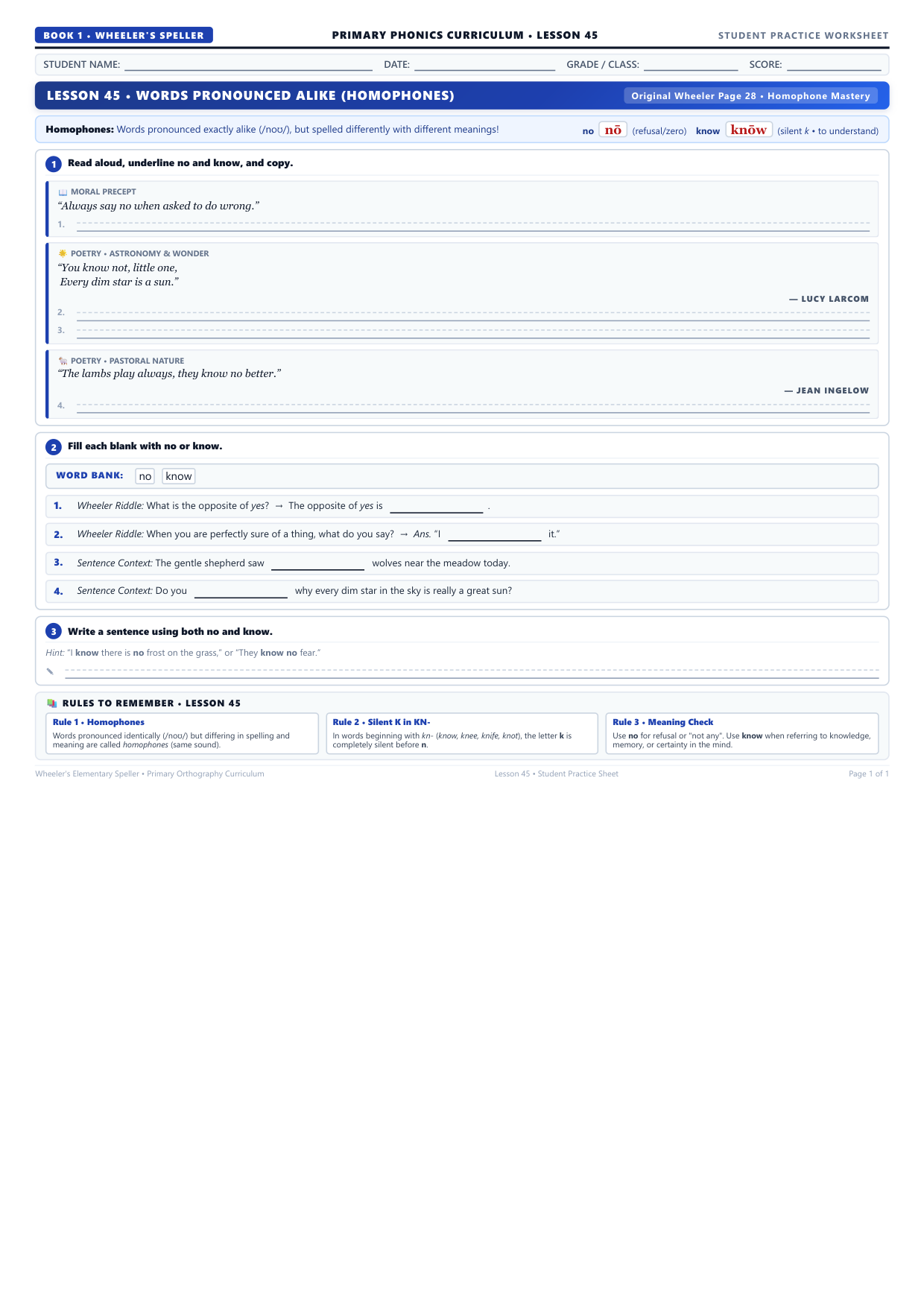
Lesson 45: Words Pronounced Alike • No & Know
Phonological exploration of homophones (/noʊ/): no (nō) vs know (knōw with silent k), featuring classic literature by Lucy Larcom and Jean Ingelow, plus riddle solving.
Open Student HTML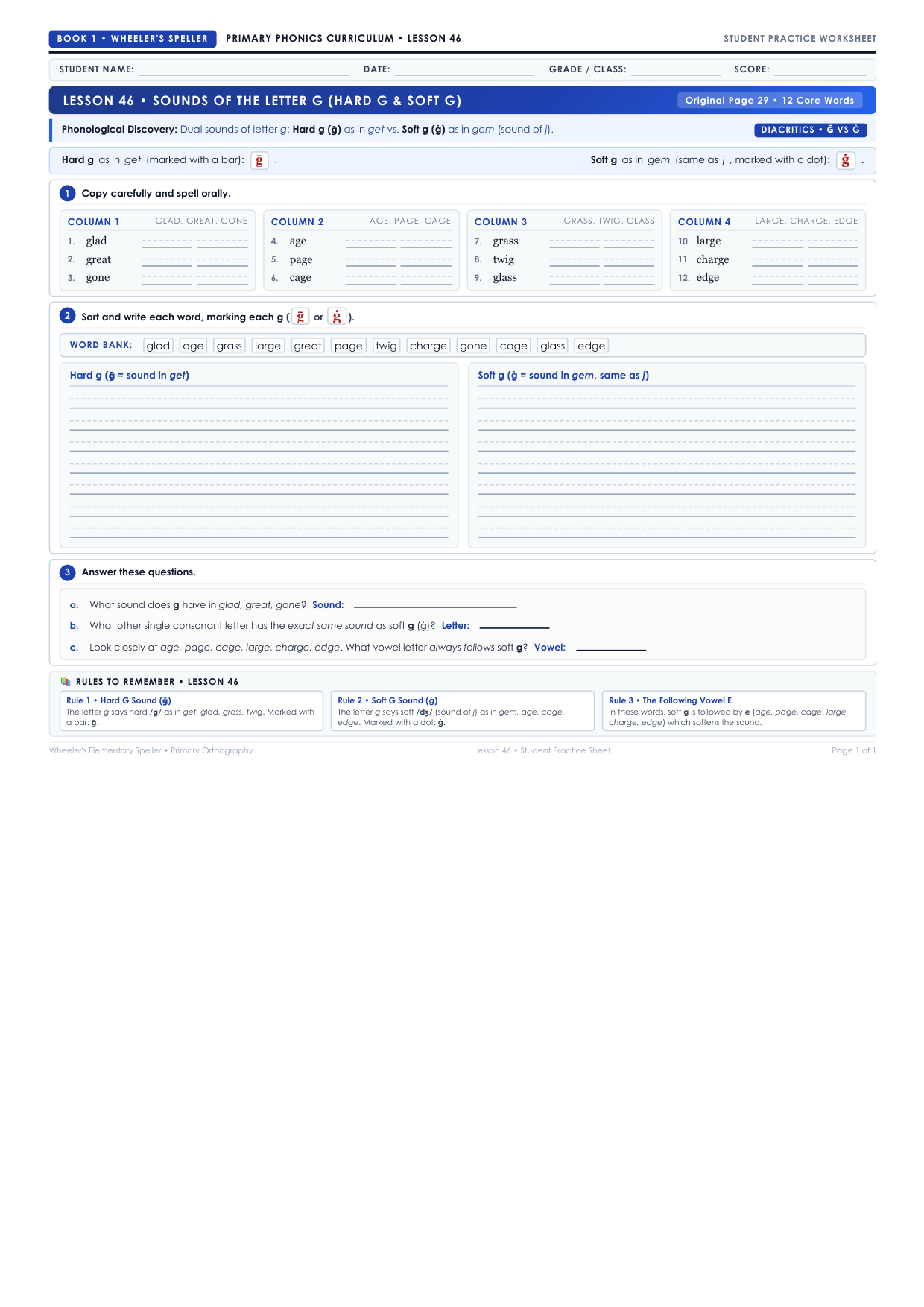
Lesson 46: Sounds of Letter G • ḡ vs ġ
Phonological classification of 12 core words: Hard g (ḡ as in get, glad, grass) vs Soft g (ġ as in gem, age, edge = /dʒ/), with Socratic discovery questions.
Open Student HTML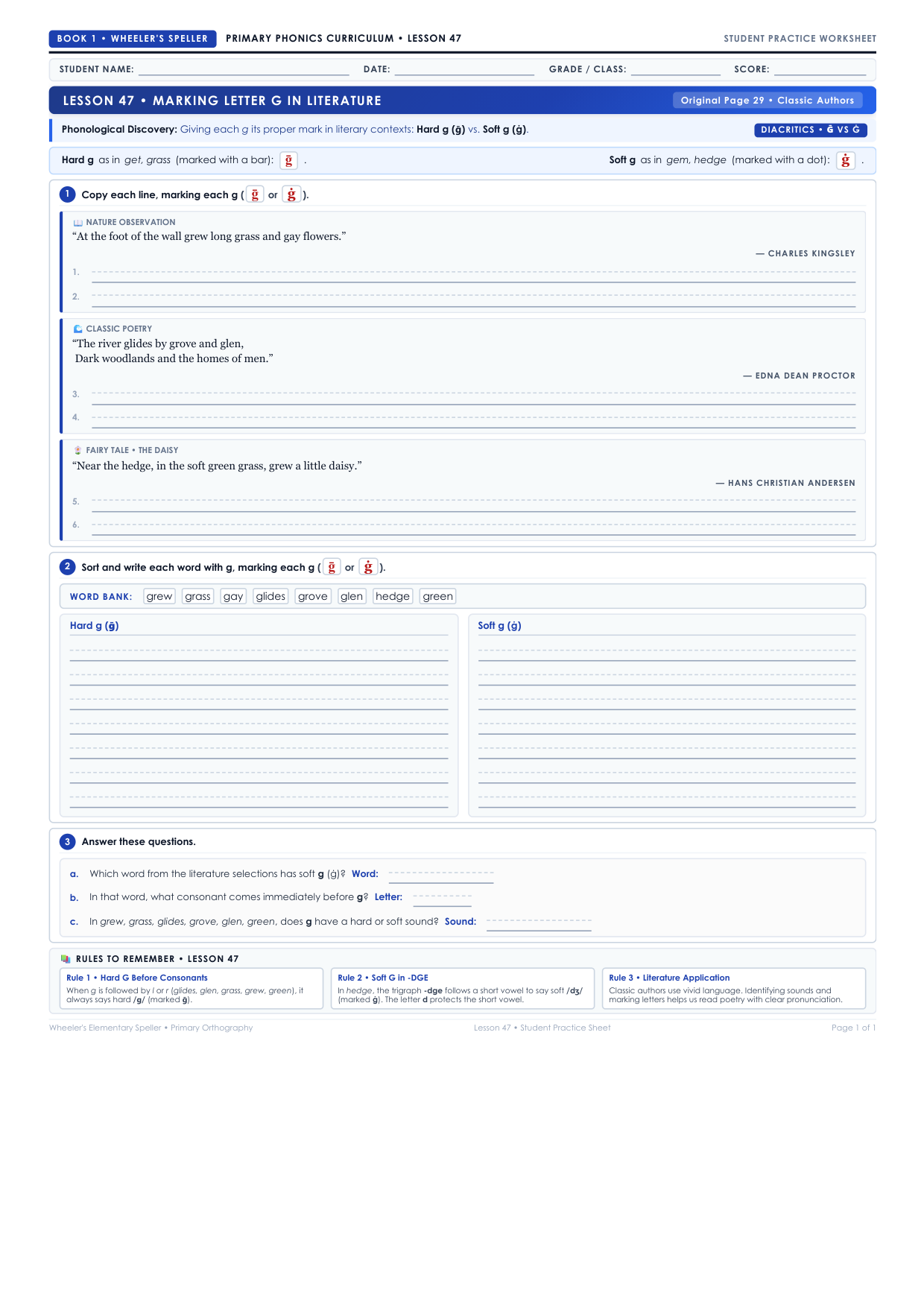
Lesson 47: Marking Letter G in Literature
Phonological marking of g in classic excerpts by Charles Kingsley, Edna Dean Proctor, and Hans Christian Andersen. Classify words with hard g (ḡ) vs soft g (ġ) with handwriting and Socratic discovery questions.
Open Student HTML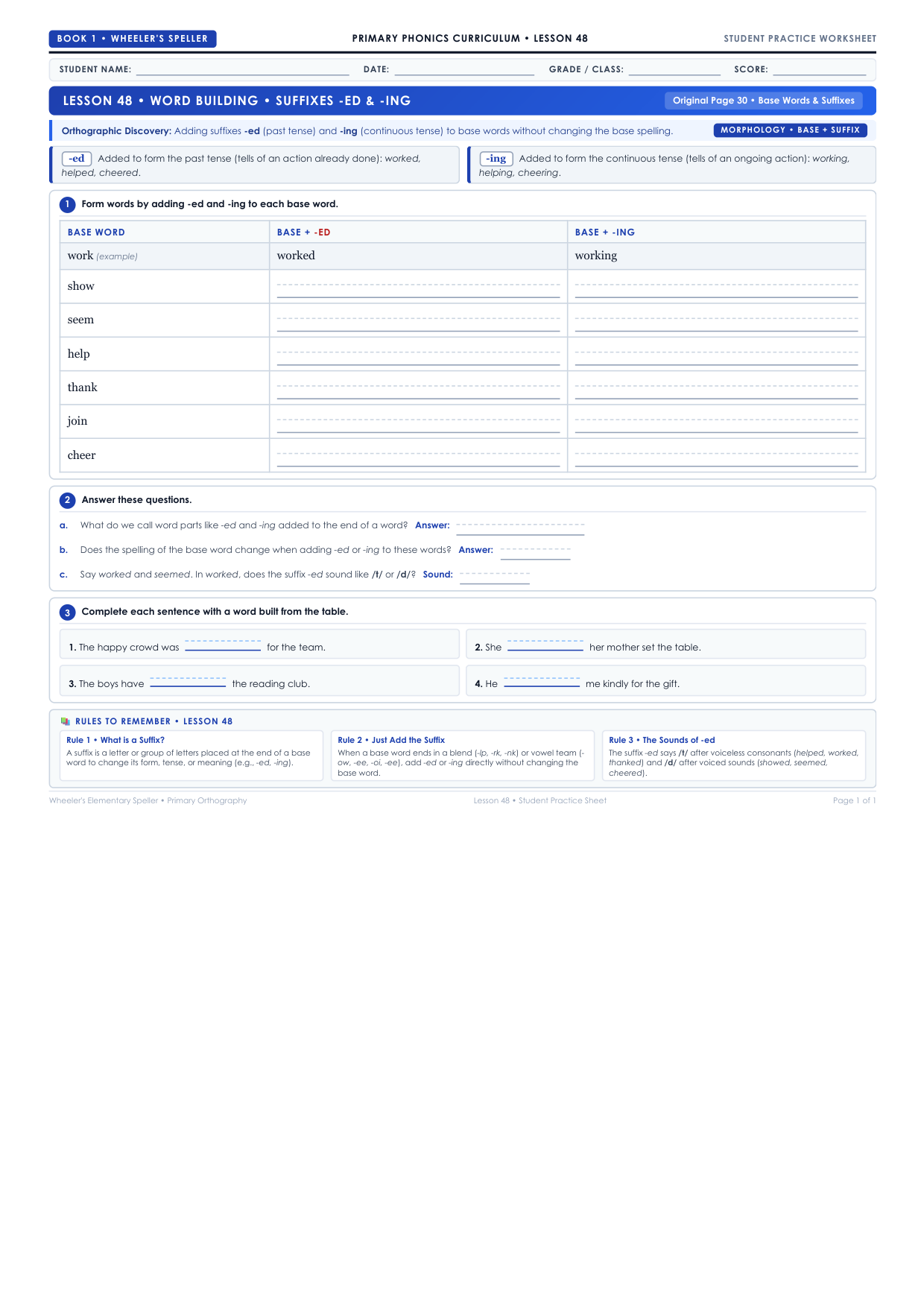
Lesson 48: Word Building • Suffixes -ed & -ing
Morphological construction adding inflections -ed (past tense) and -ing (continuous tense) to 7 regular base words (work, show, seem, help, thank, join, cheer) without changing the base spelling, with handwriting and Socratic discovery questions.
Open Student HTML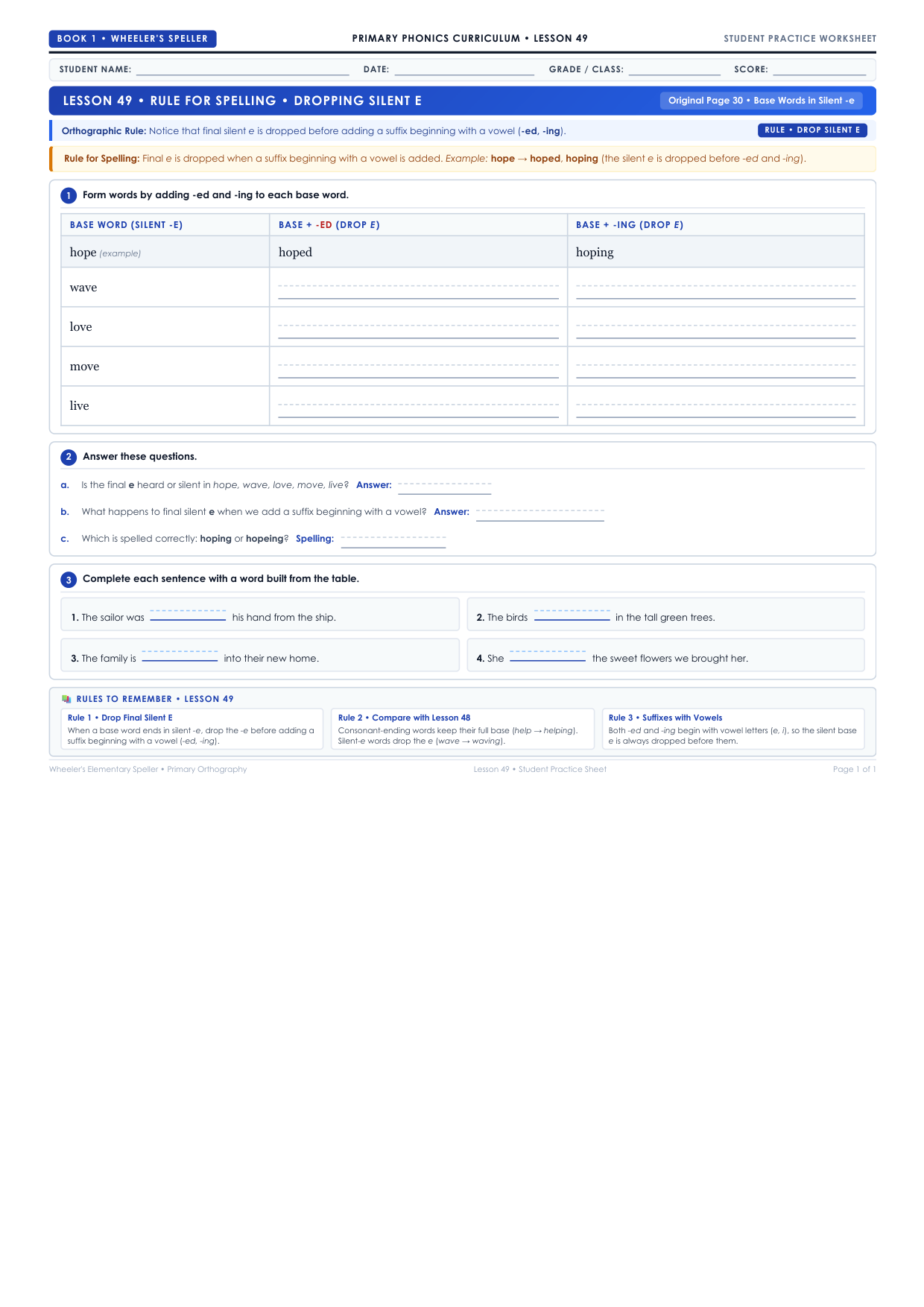
Lesson 49: Rule for Spelling • Dropping Silent E
Orthographic discovery of the drop-e rule when attaching vowel suffixes (-ed and -ing) to 5 core base words (hope, wave, love, move, live), complete with handwriting guidelines and Socratic discovery questions.
Open Student HTML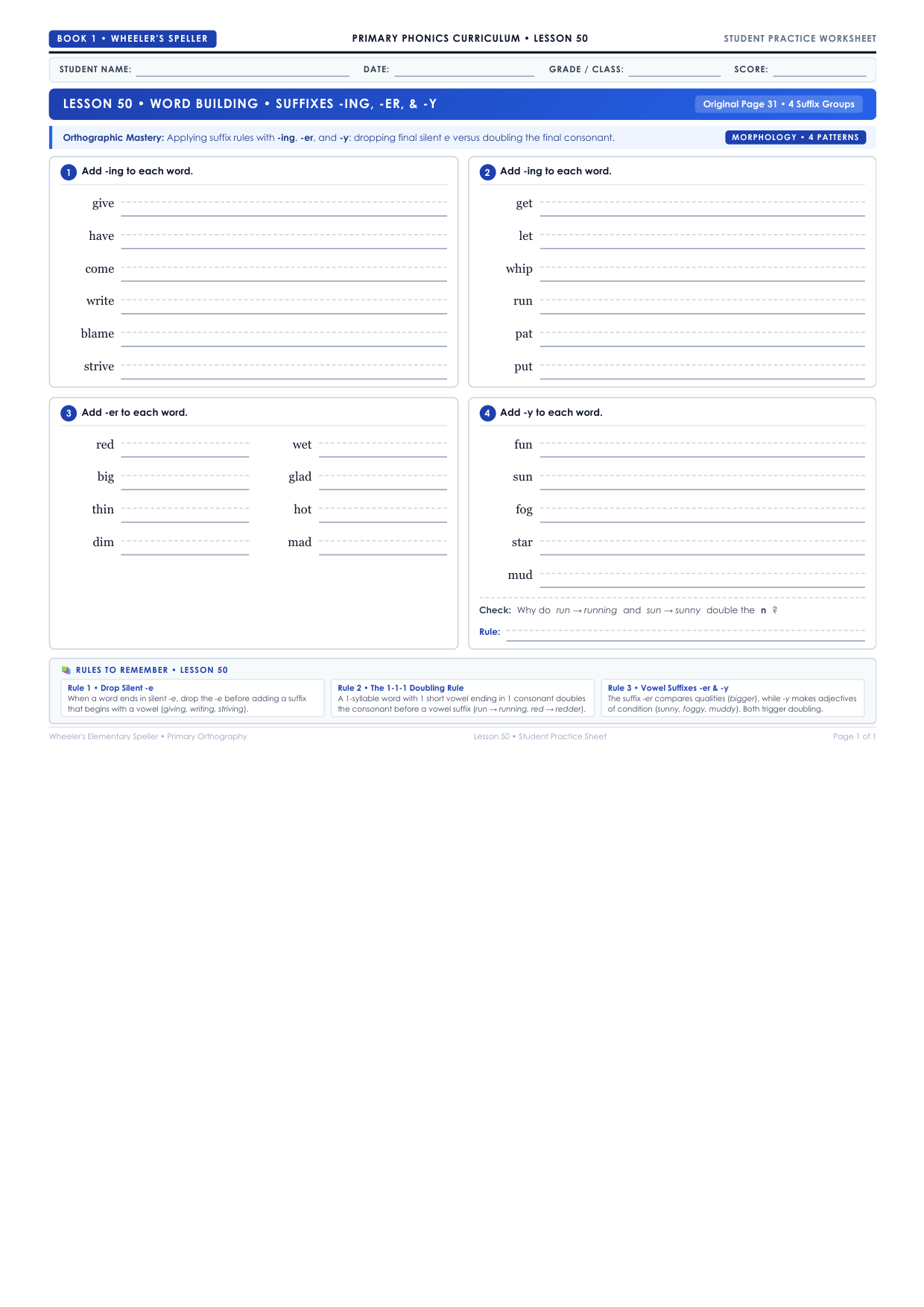
Lesson 50: Word Building • Suffixes -ing, -er, -y
Mastery of 4 morphological patterns across 25 words: dropping final silent e before -ing versus the 1-1-1 consonant doubling rule before vowel suffixes -ing, -er, -y, with handwriting lines and discovery rules.
Open Student HTML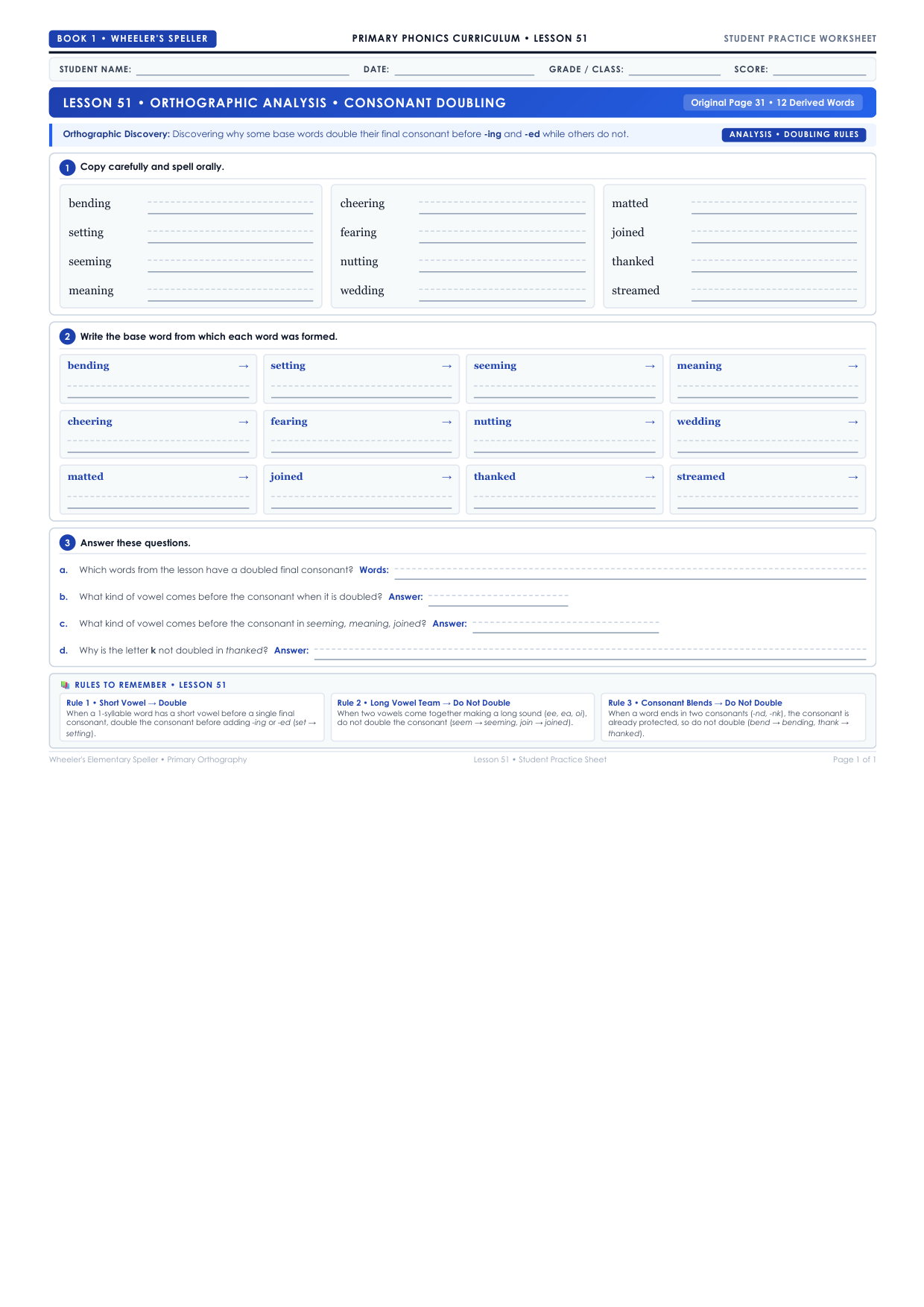
Lesson 51: Orthographic Analysis • Doubling Discovery
Phonological & morphological investigation of 12 words with suffixes -ing and -ed: comparing doubled consonants (setting, wedding, matted, nutting) with undoubled vowel teams and blends (seeming, joined, thanked).
Open Student HTML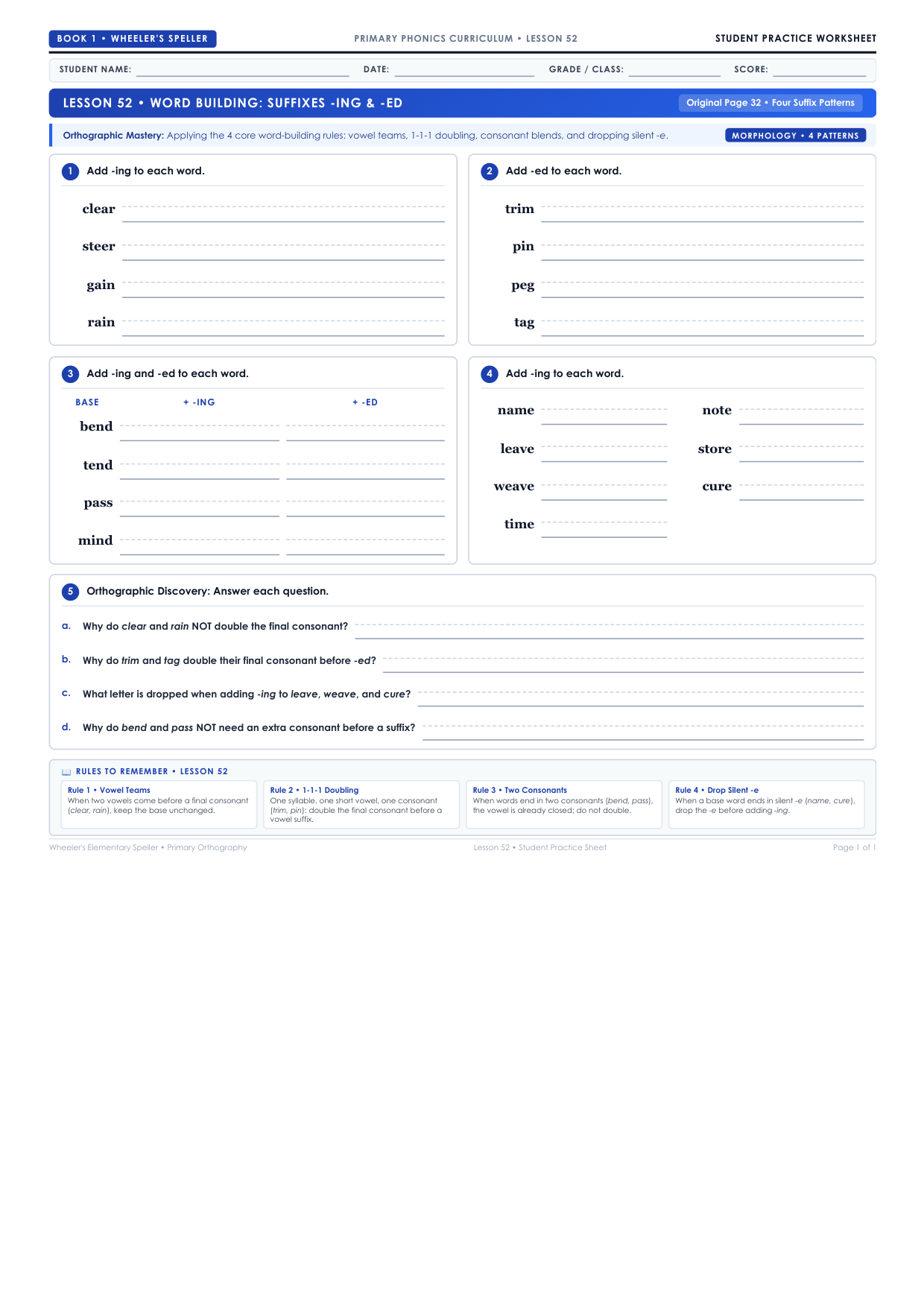
Lesson 52: Word Building • Suffixes -ing & -ed
Comprehensive synthesis of 4 core suffixation rules across 19 words: vowel teams (clear, steer, gain, rain), 1-1-1 CVC doubling (trim, pin, peg, tag), consonant clusters (bend, tend, pass, mind), and silent -e dropping (name, leave, weave, time, note, store, cure).
Open Student HTML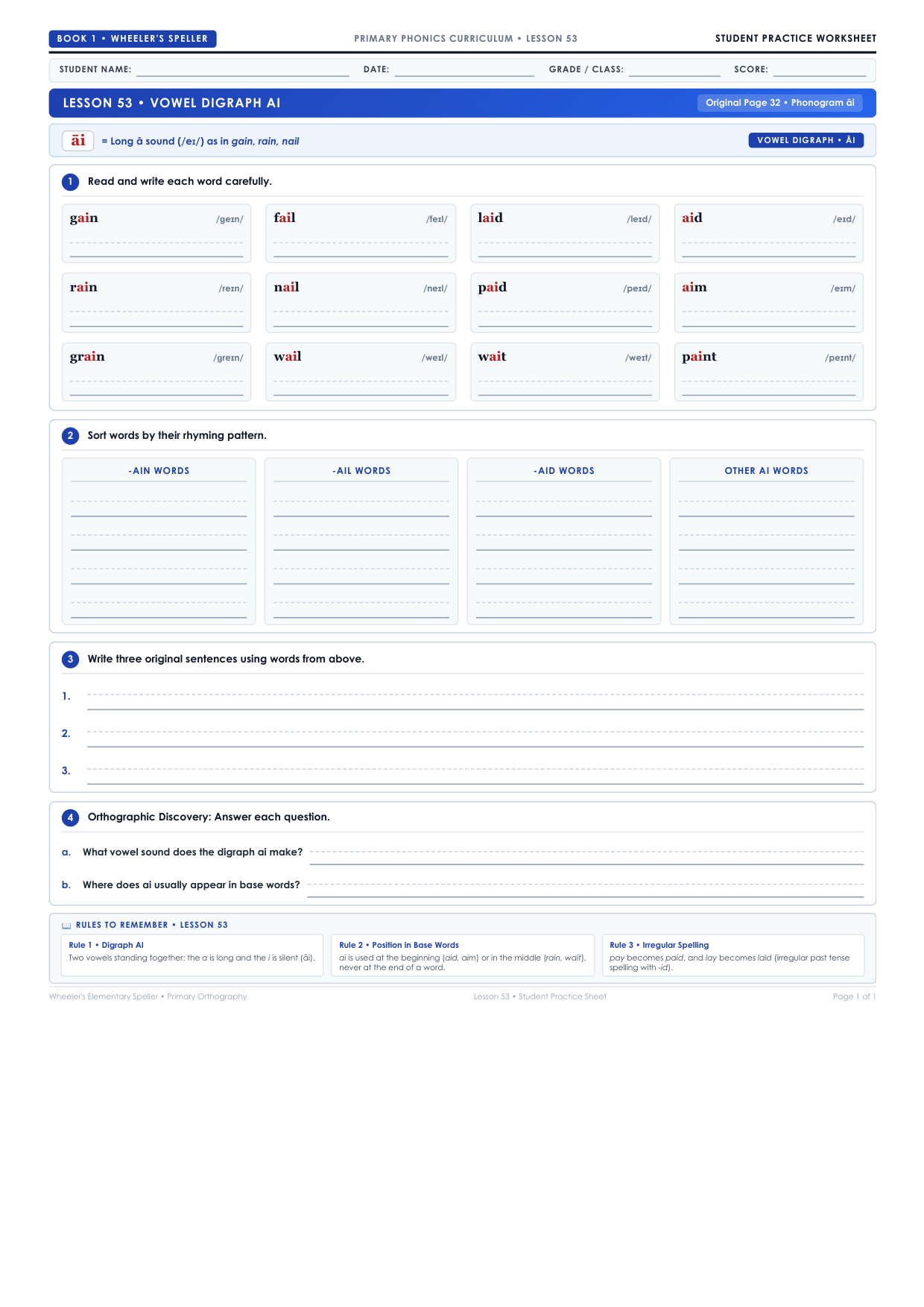
Lesson 53: Vowel Digraph ai (āi = /eɪ/)
Mastery of vowel digraph ai representing long ā (/eɪ/) across 12 target words (gain, fail, laid, aid, rain, nail, paid, aim, grain, wail, wait, paint), word family classification (-ain, -ail, -aid), and original sentence writing.
Open Student HTML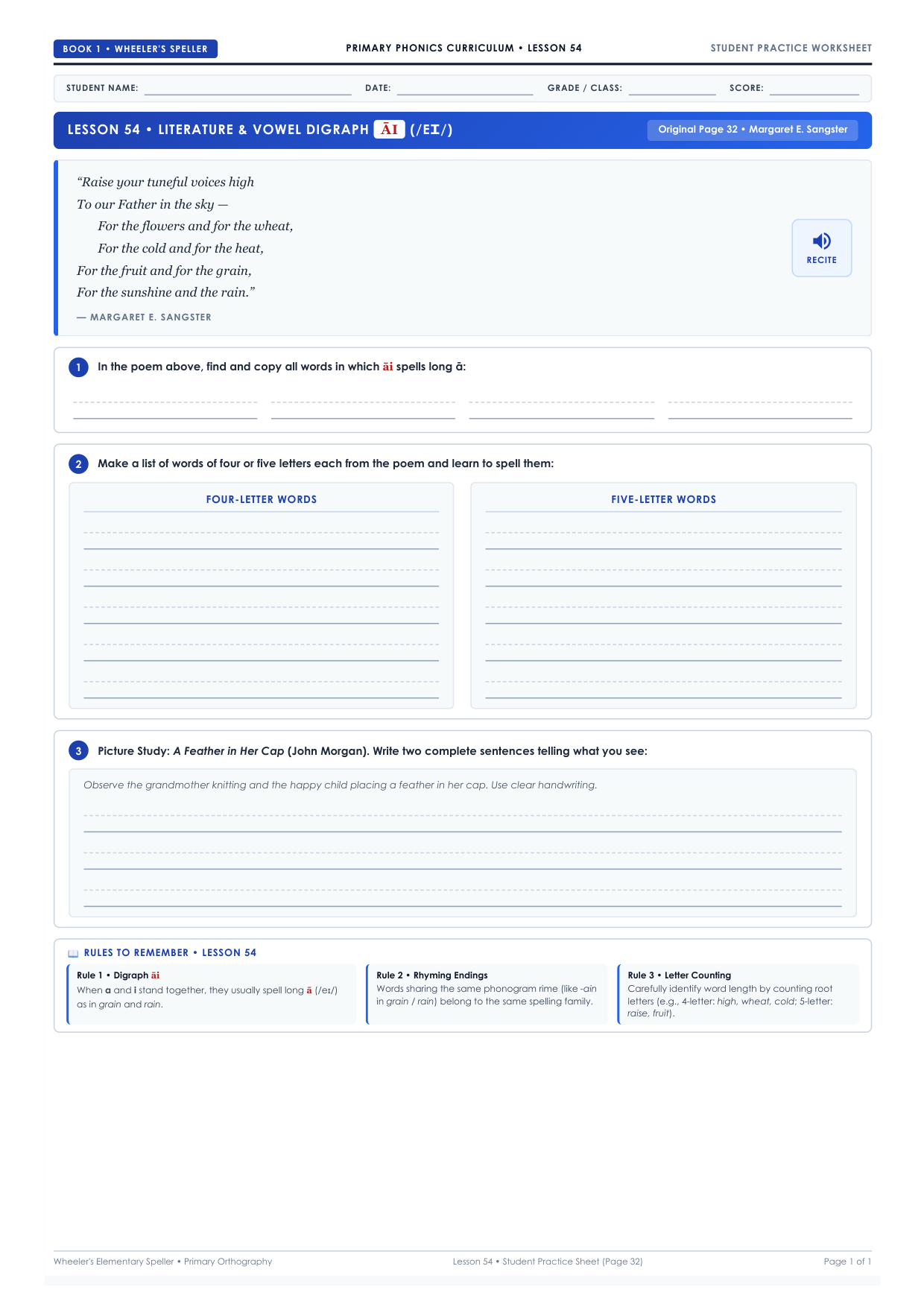
Lesson 54: Literature & Orthographic Hunt
Literary decoding and orthographic analysis of classic poetry by Margaret E. Sangster: locating digraph ai words (Raise, grain, rain), sorting vocabulary by 4-letter and 5-letter lengths, and analyzing vowel digraphs (ea, ui, igh).
Open Student HTML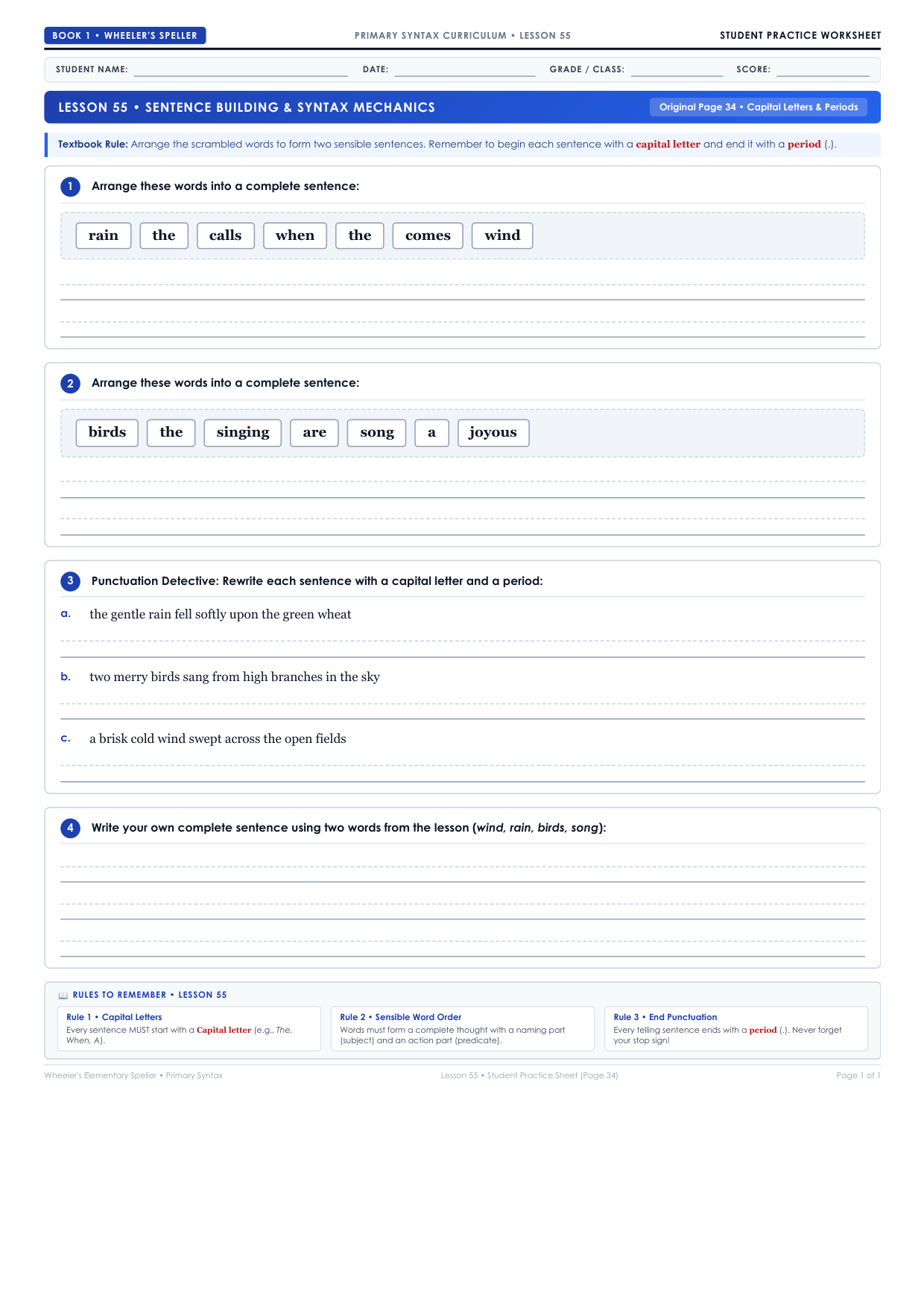
Lesson 55: Sentence Building & Syntax
Sentence unscrambling, capitalization, and end punctuation mechanics based on Wheeler's Speller Page 34. Punctuation detective exercises and independent sentence creation.
Open Student HTML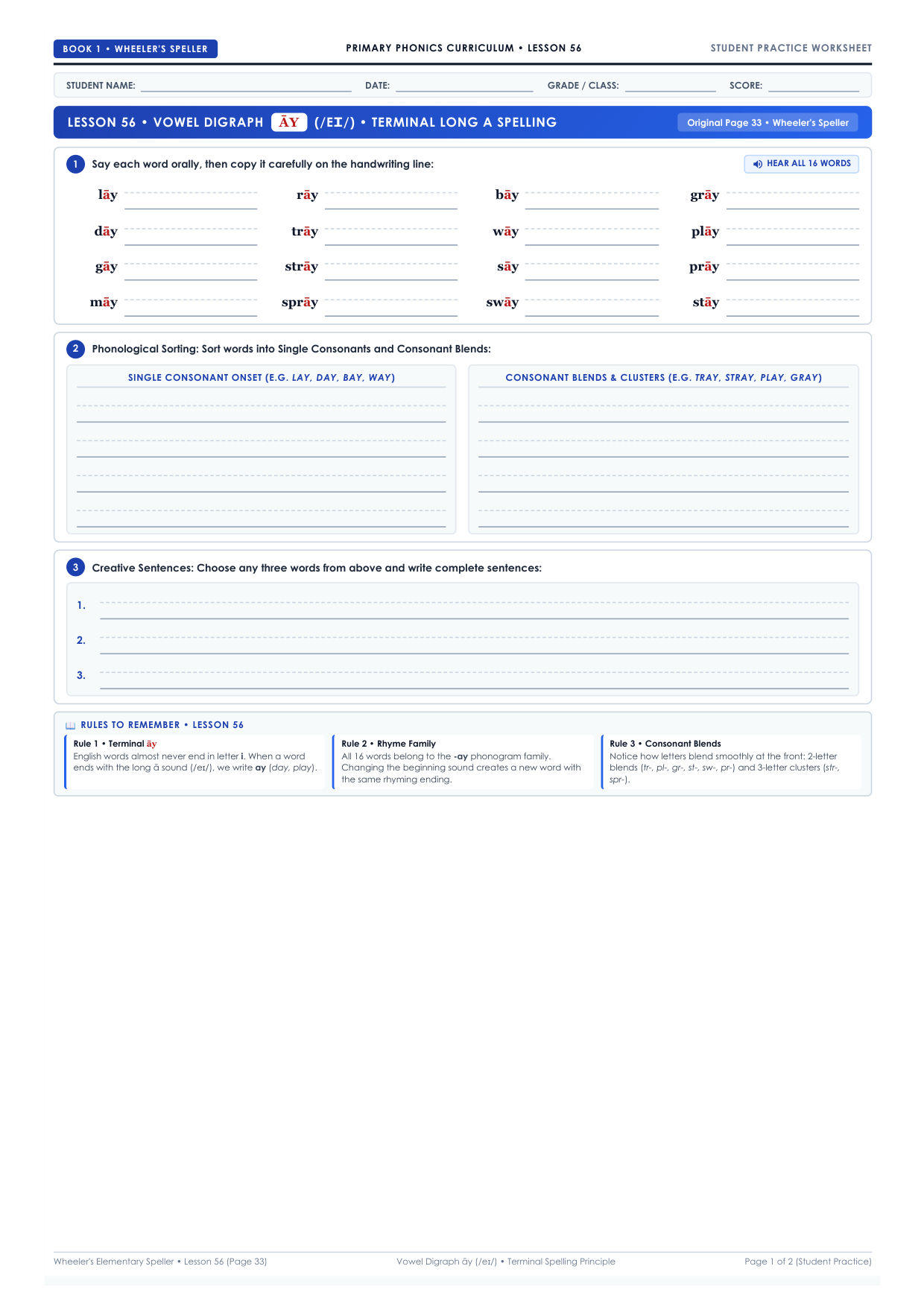
Lesson 56: Vowel Digraph <ay>
16 base words with vowel digraph ay (day, hay, lay, play, spray), onset-rime classification, and creative sentence formation.
Open Student HTML
Lesson 57: Poetry & Orthographic Discovery
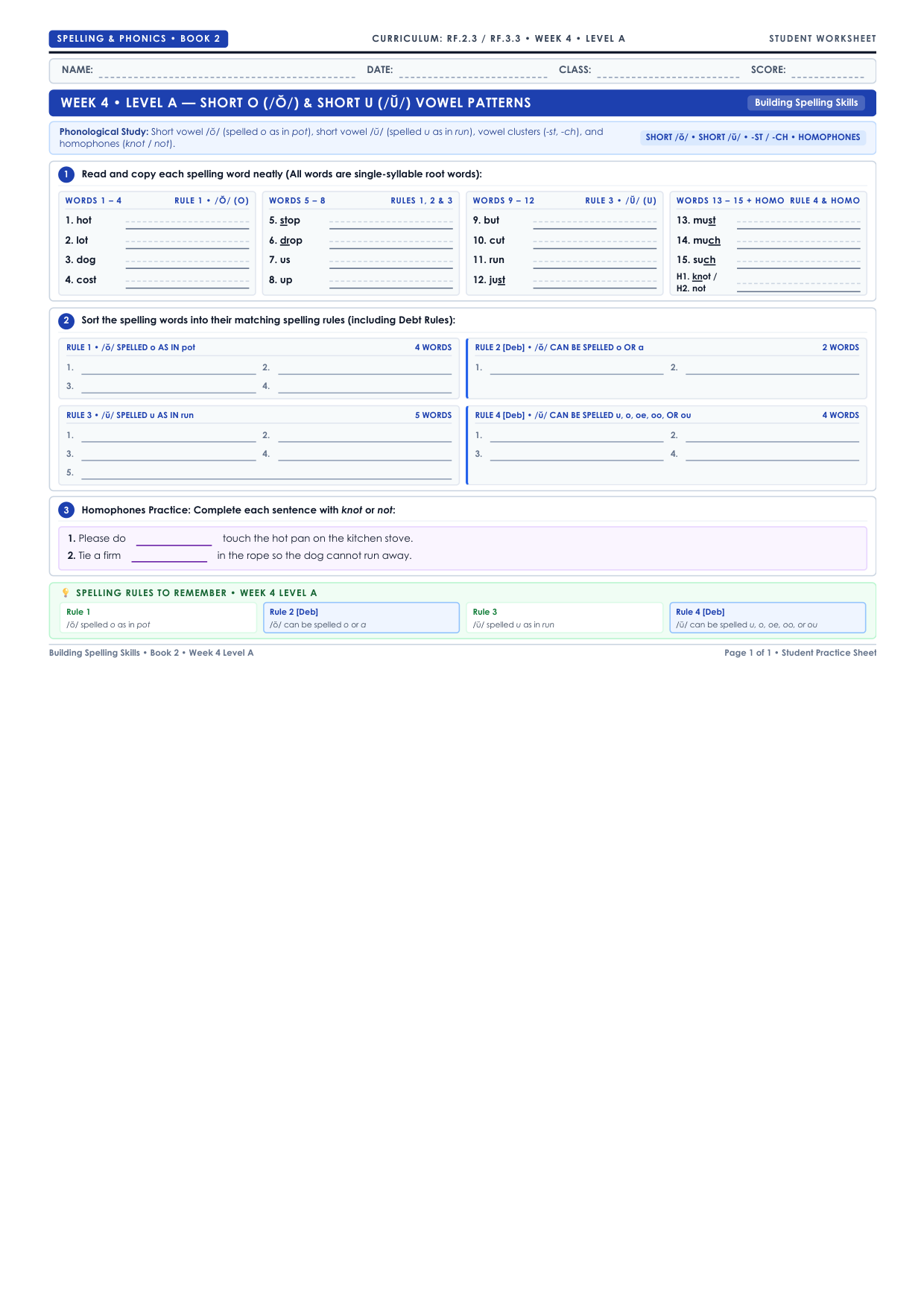
Literature recitations by Philip James Bailey and Eugene Field. Hunting digraph ay words (play, away, spray, way), poetic transcription, and creative writing.
Open Student HTML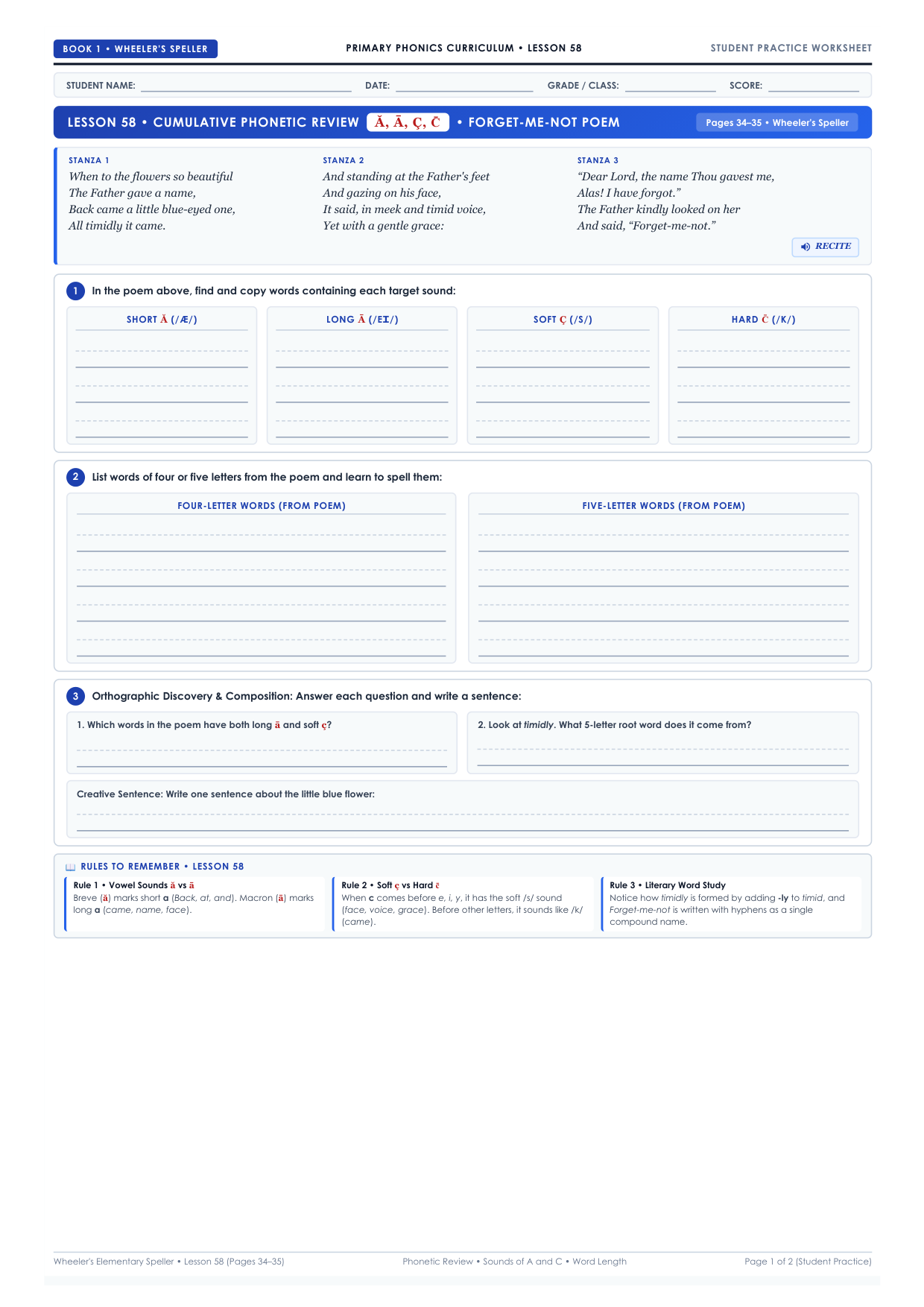
Lesson 58: Long ā & Soft ç Discovery
Three stanzas of "Forget-me-not". Hunting short ă, long ā, soft ç, and hard c, word length classification, and floral poetry appreciation.
Open Student HTML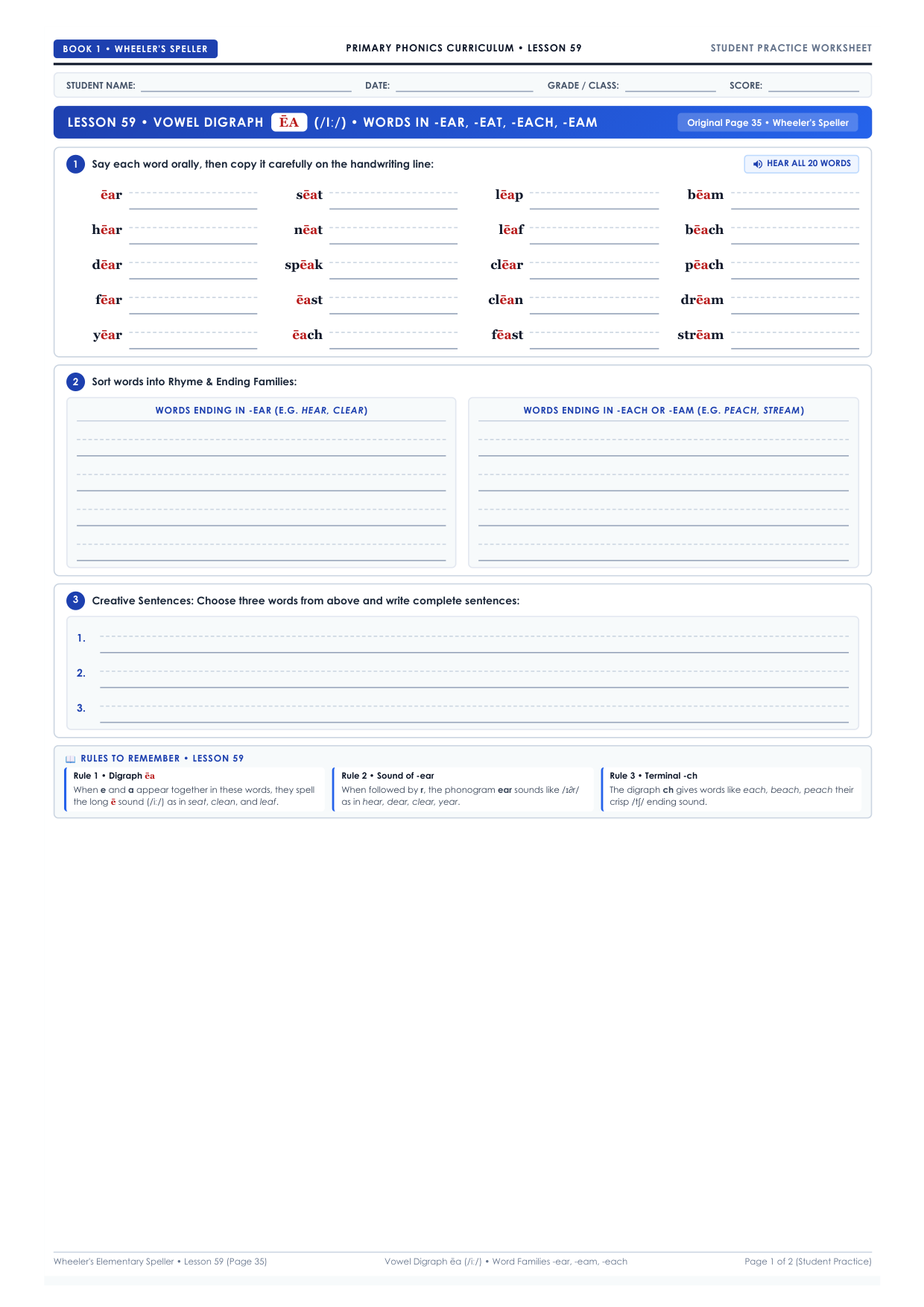
Lesson 59: Vowel Digraph <ea>
20 words with digraph ea (hear, near, speak, wheat, leaves), phonogram family grouping (-ear, -each, -eam), and contextual sentences.
Open Student HTML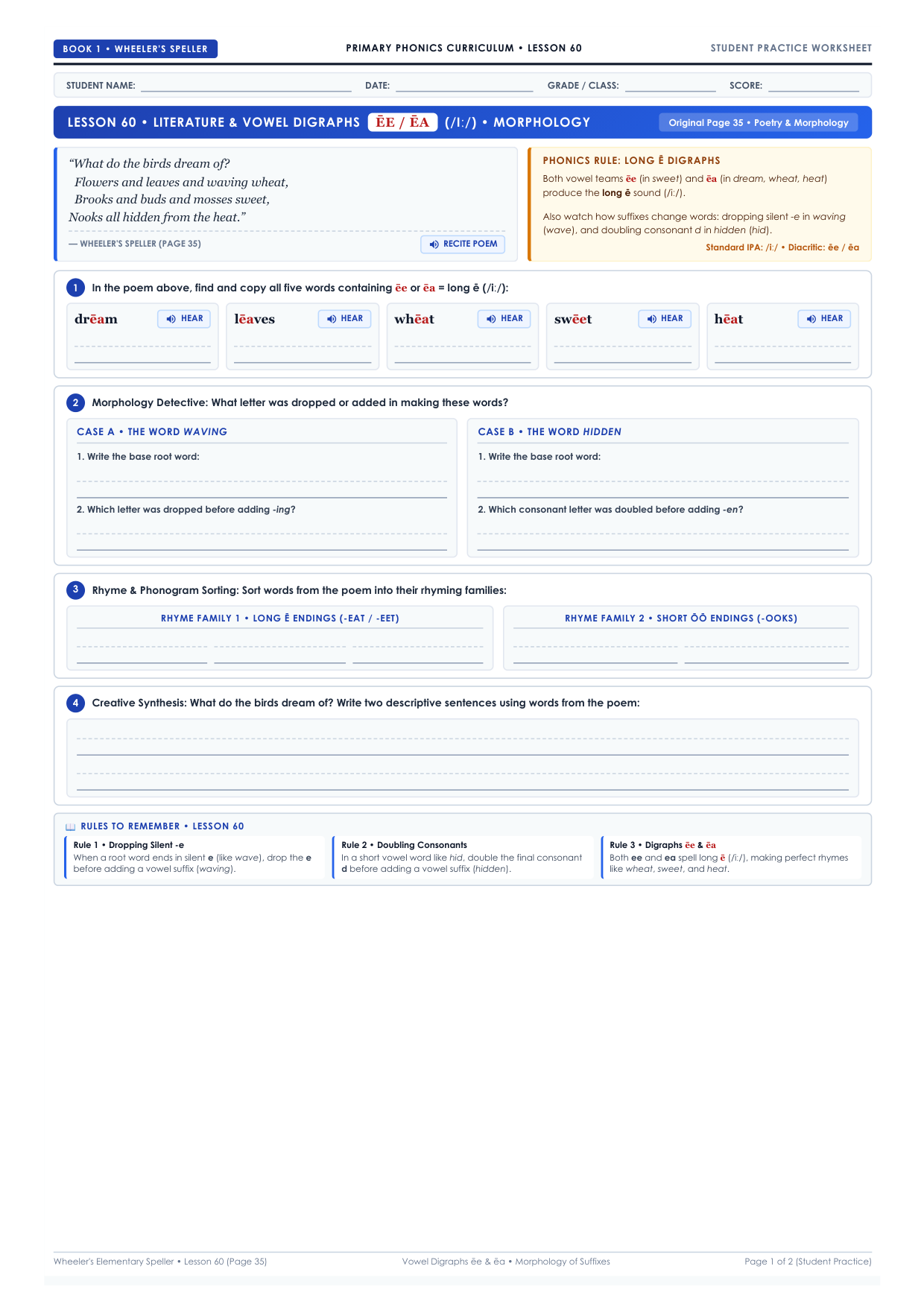
Lesson 60: Literature & Comparative Digraphs
Victorian nature poem of dreaming birds. Comparative analysis of ee versus ea (dream, leaves, wheat, sweet), morphology detective, and creative synthesis.
Open Student HTML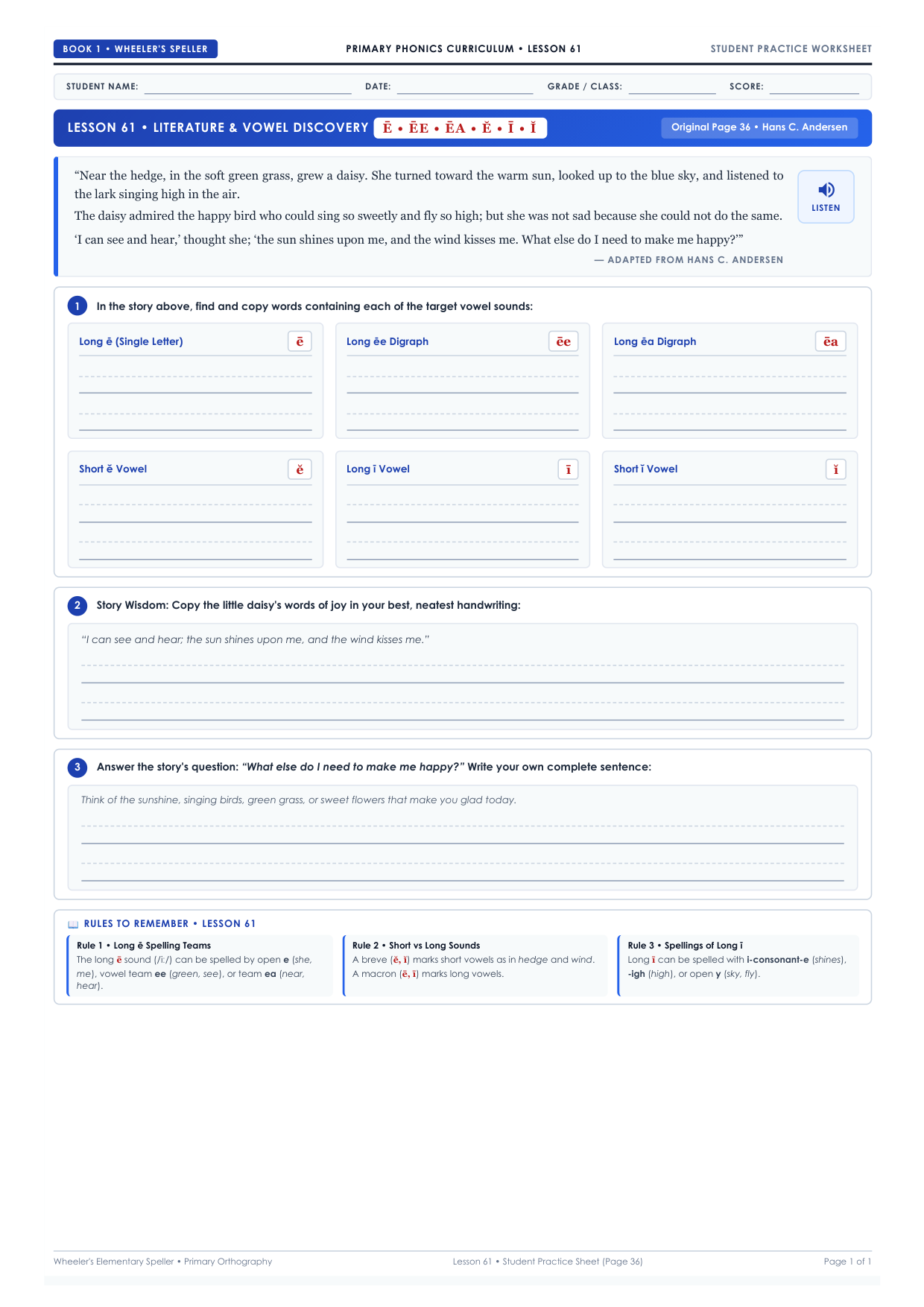
Lesson 61: Literature & Vowel Discovery
Classic daisy fable by Hans Christian Andersen. Hunting 6 phonetic targets (ē, ēe, ēa, ĕ, ī, ĭ), moral wisdom handwriting, and thoughtful reflection.
Open Student HTML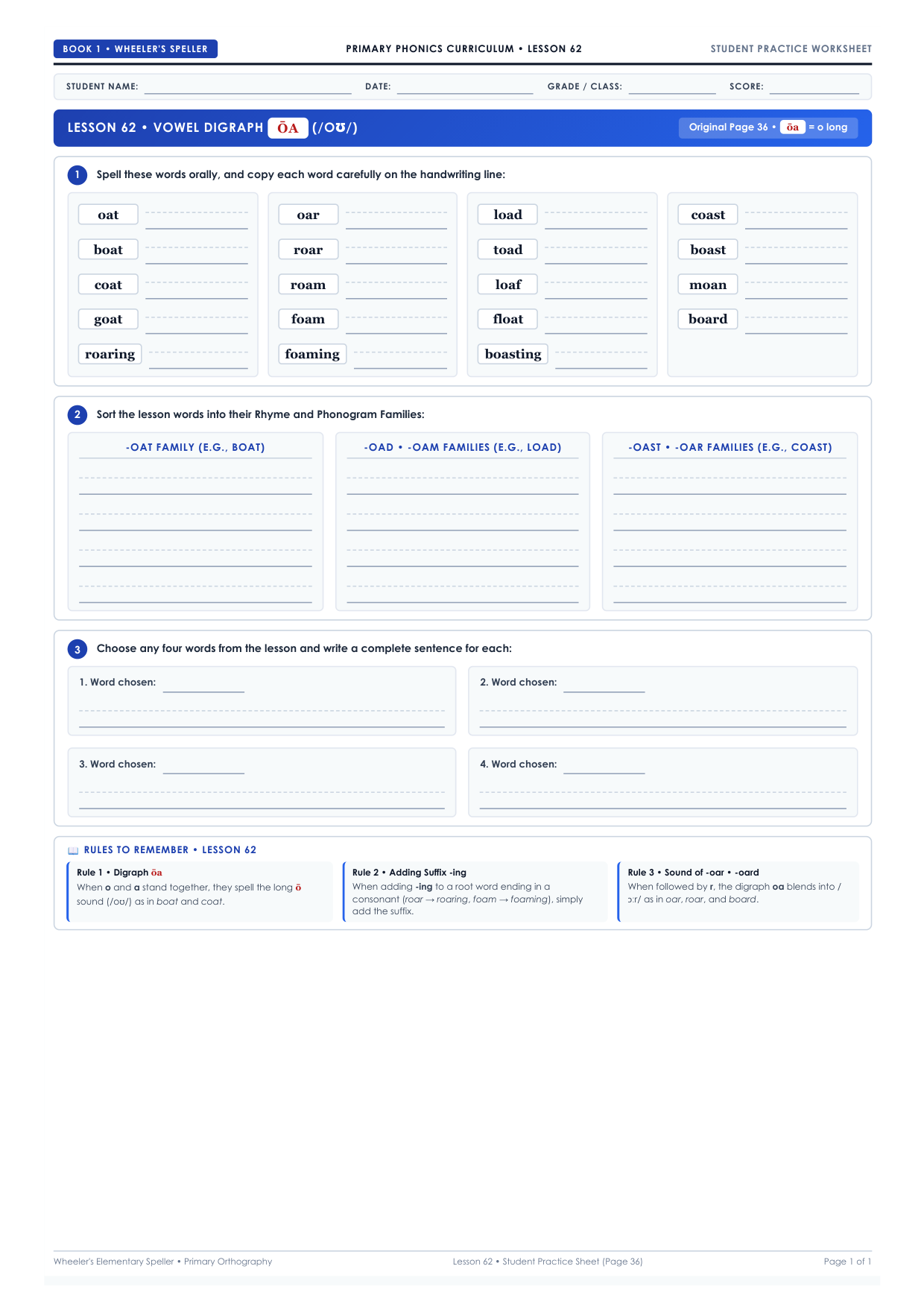
Lesson 62: Vowel Digraph <oa>
16 base words and participles with digraph oa (boat, coat, roar, loaf, float), phonogram sorting, and original sentence composition.
Open Student HTML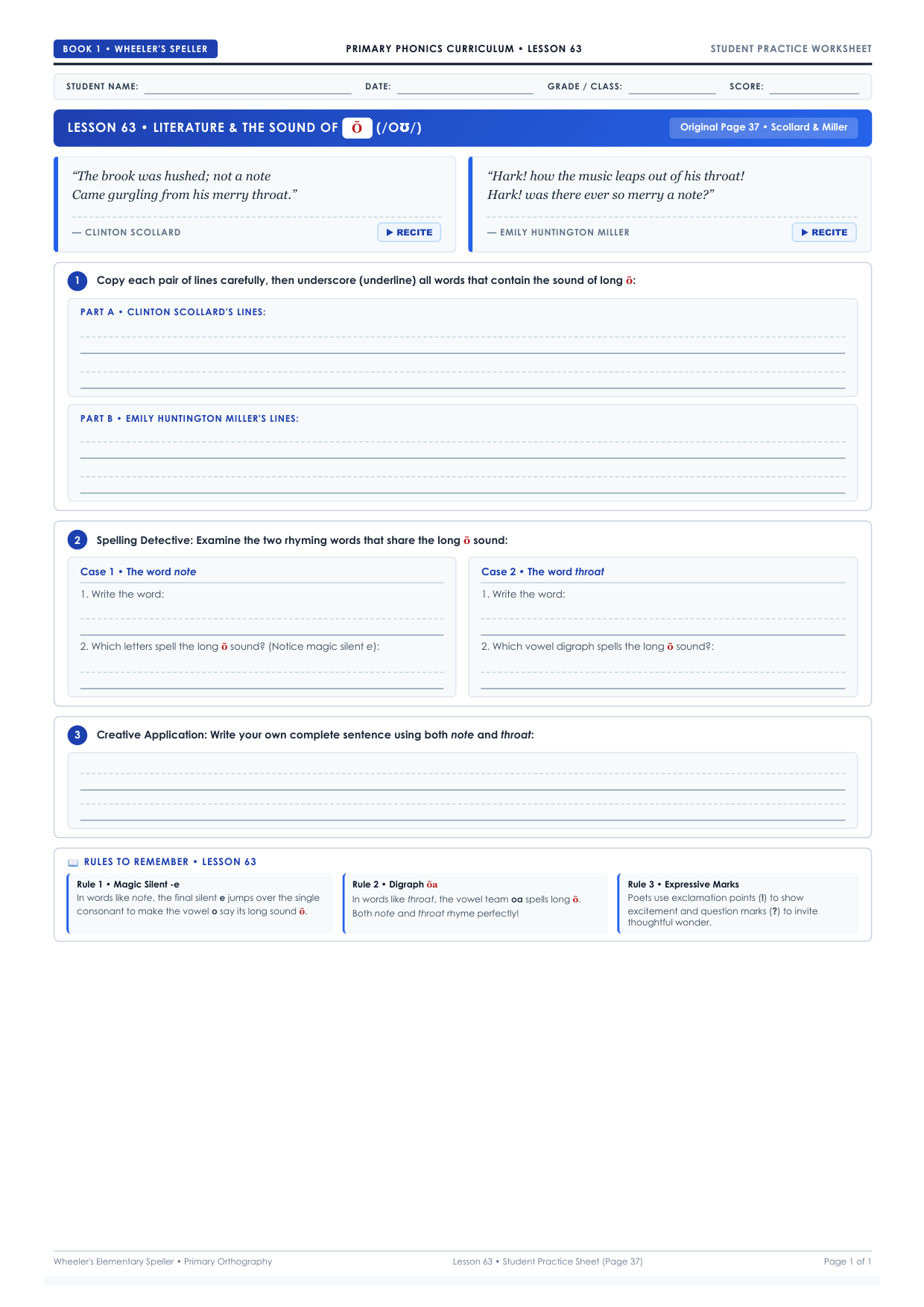
Lesson 63: Literature & Long O Sound
Poetry recitations by Clinton Scollard and Emily Huntington Miller. Examining rhyming spellings of long ō (note magic -e vs throat digraph oa).
Open Student HTML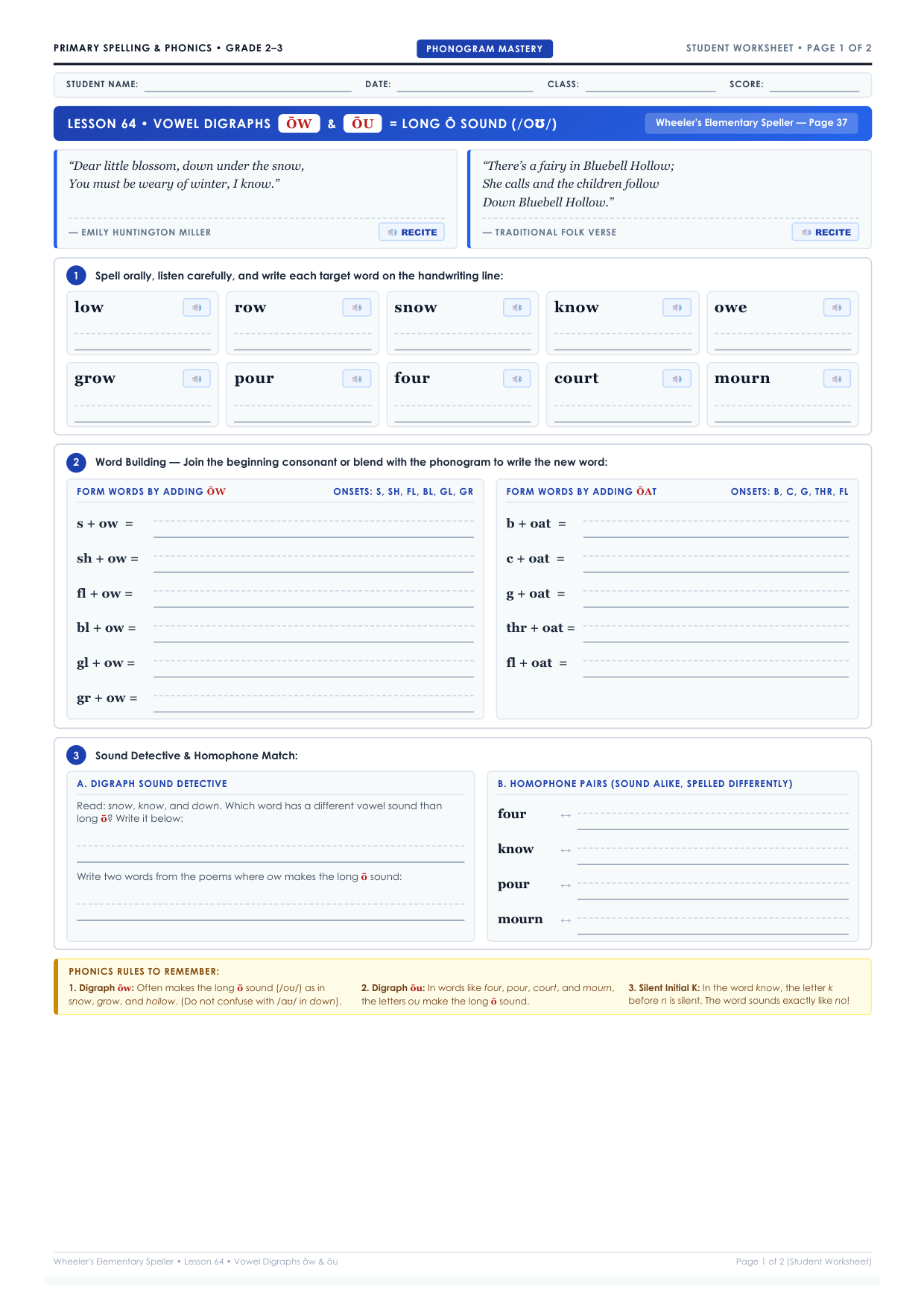
Lesson 64: Homophones Discovery
Homophone mastery with sea / see and meat / meet. Context discrimination, cloze passages, and spelling detective practice.
Open Student HTML
Lesson 69: Long ō & Silent Letters
12 words with long ō spelled ow (blow, crow, grow, know, snow, throw). Silent initial k in know and rhyme family sorting.
Open Student HTML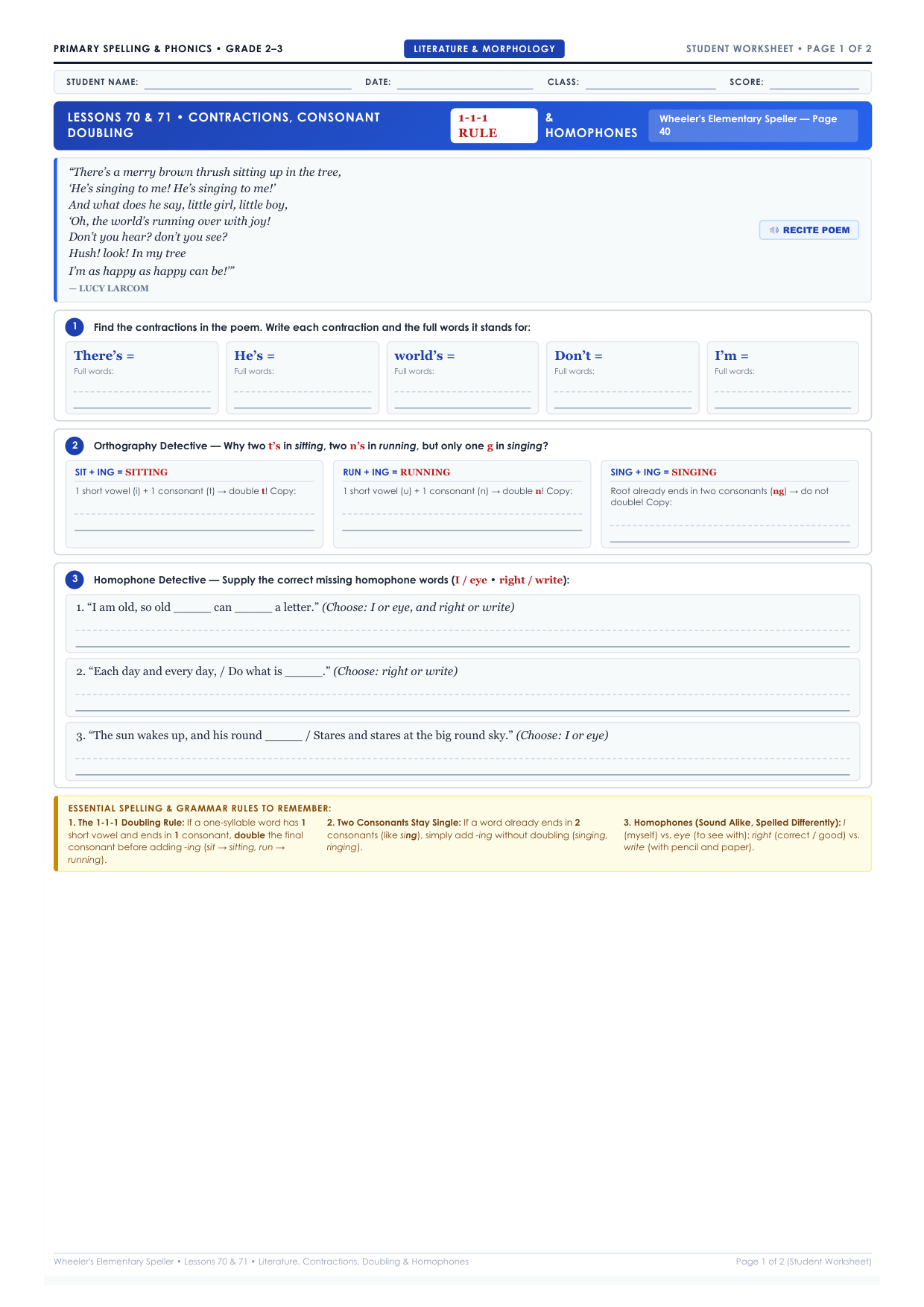
Lesson 70: Literature & Contractions
Lucy Larcom's "The Brown Thrush" with nature lyric, 5 core contractions (There's, He's, world's, Don't, I'm), and the 1-1-1 consonant doubling rule (sitting, running vs. singing).
Open Student HTML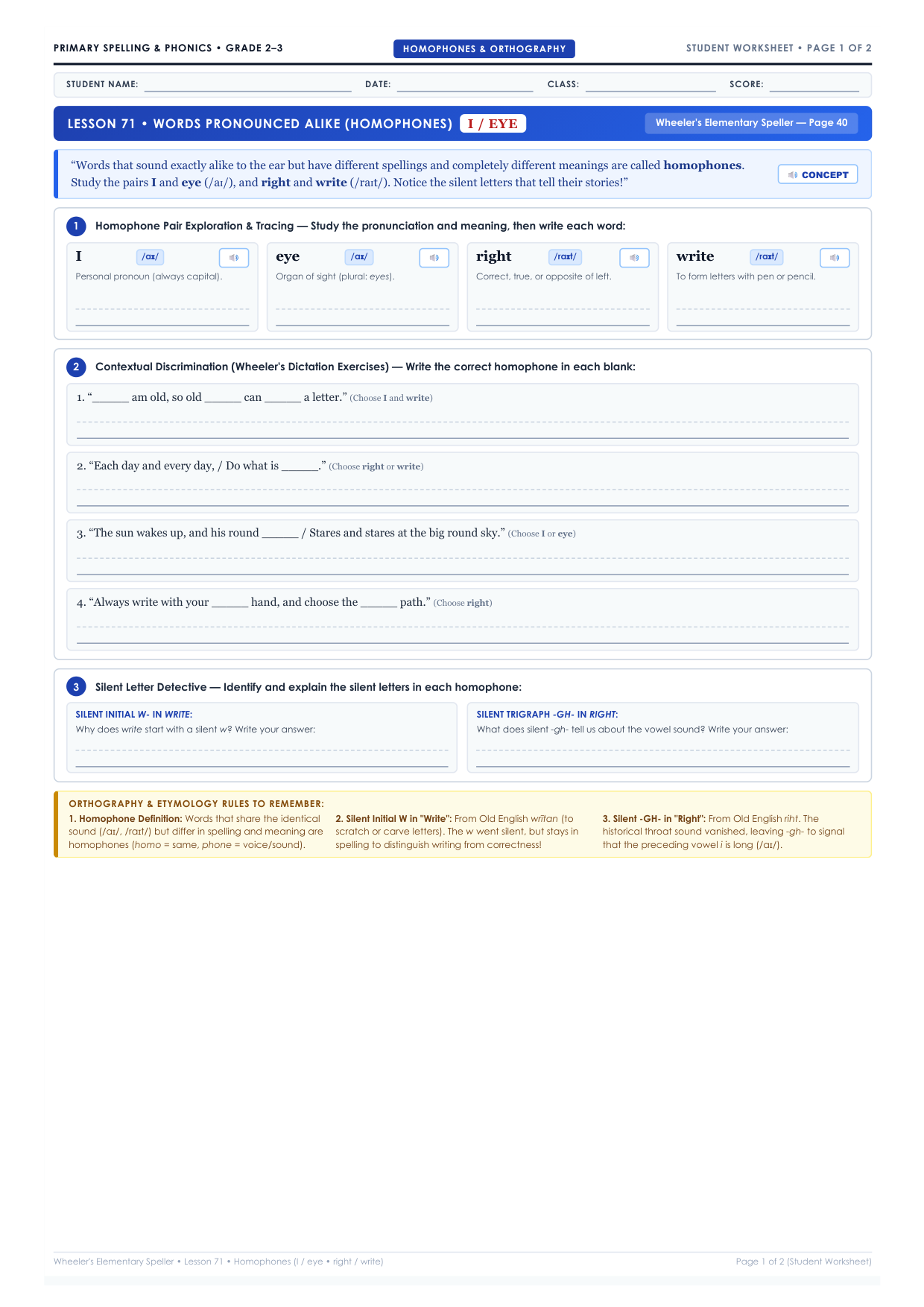
Lesson 71: Homophones Discovery
Discrimination of high-frequency homophone pairs: I vs. eye (personal pronoun vs. organ of sight) and right vs. write (correct/hand direction vs. penning text), with context cloze sentences.
Open Student HTML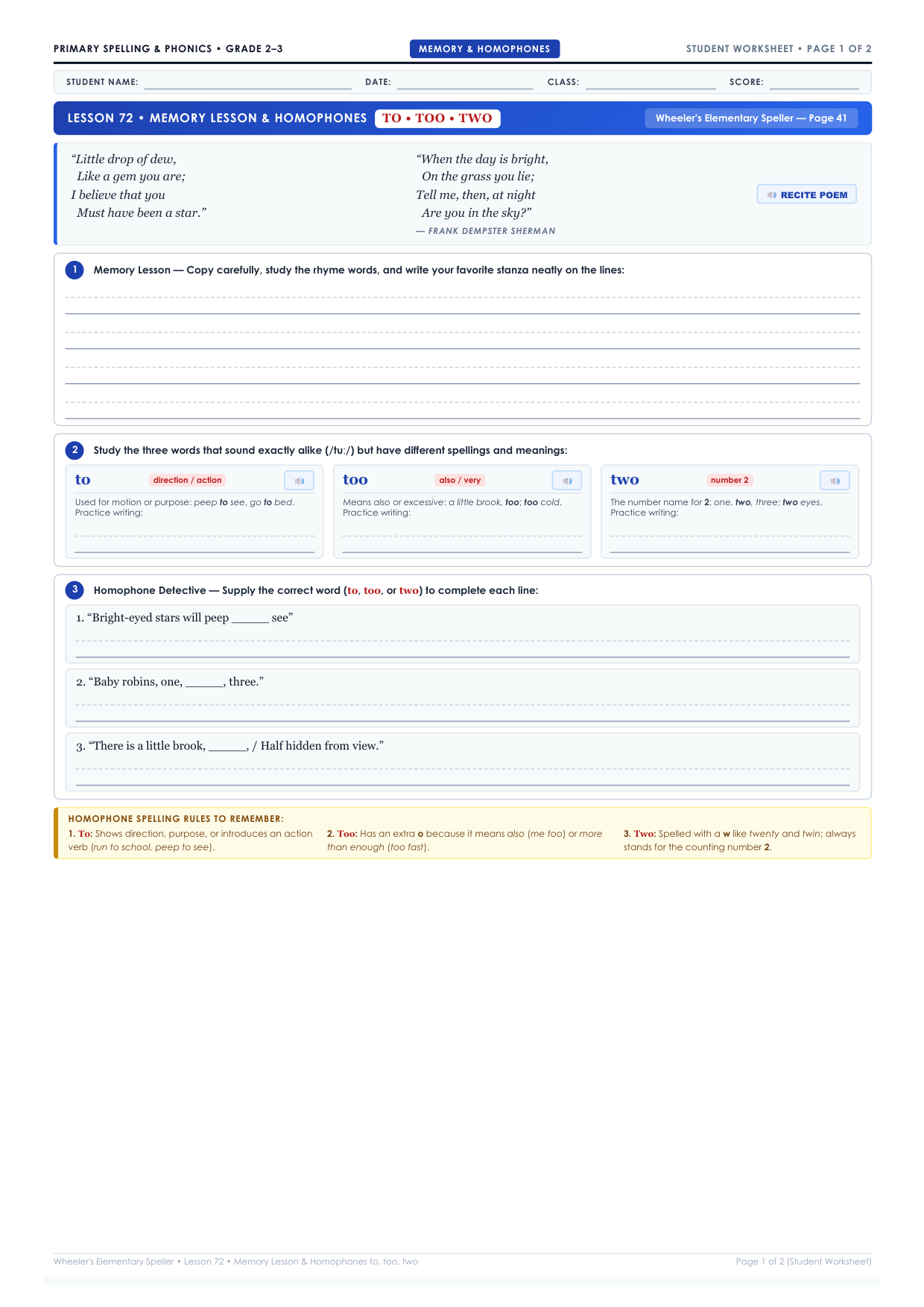
Lesson 72: Digraphs <ow> & <oa> Classification
18 vocabulary words classified by spelling pattern: sorting words with ōw and ōa, with syllable counting and contextual sentences.
Open Student HTML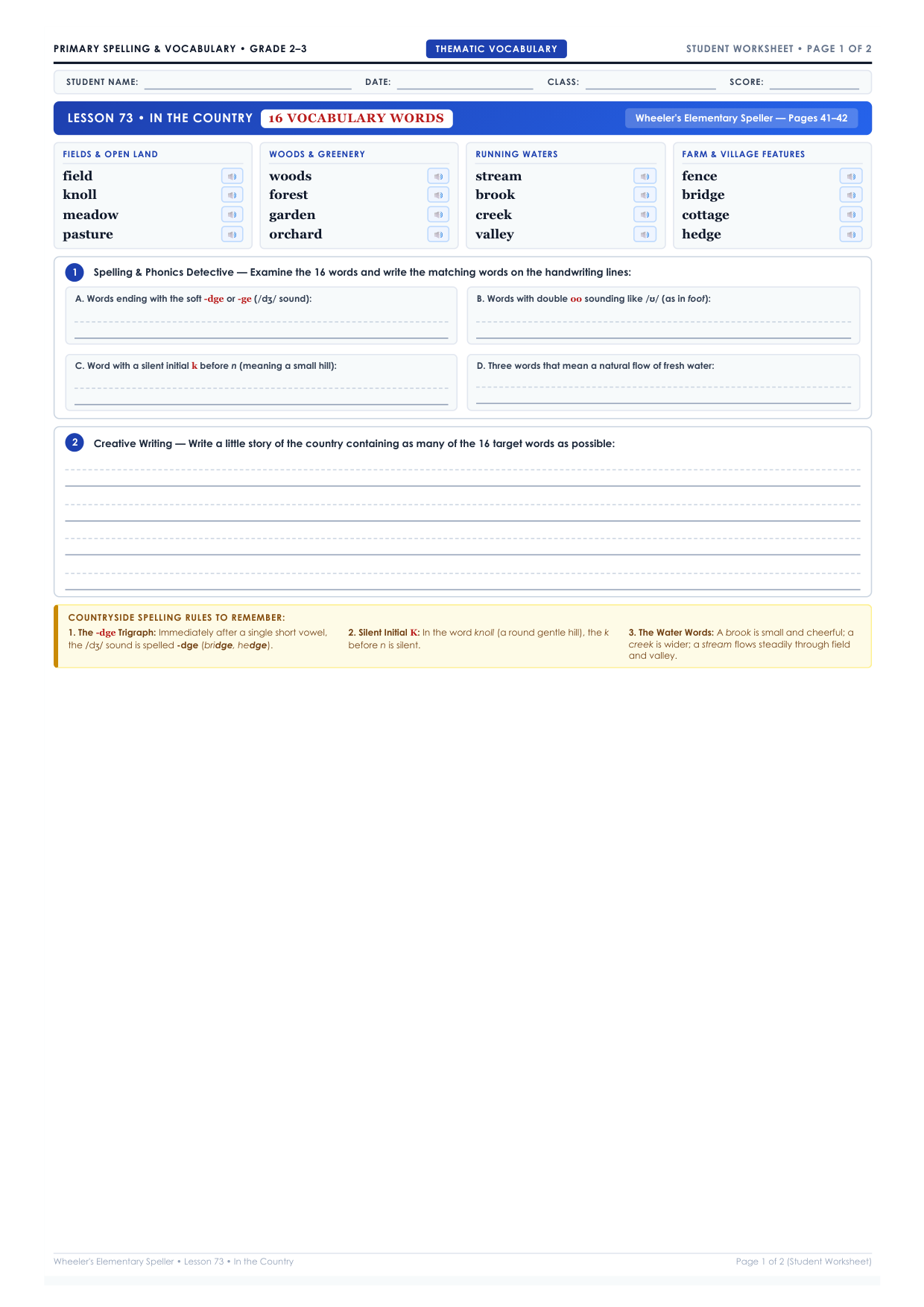
Lesson 73: Literature & Sight Words
Robert Louis Stevenson's classic poetry from A Child's Garden of Verses: reading, transcription, and high-frequency sight word study.
Open Student HTML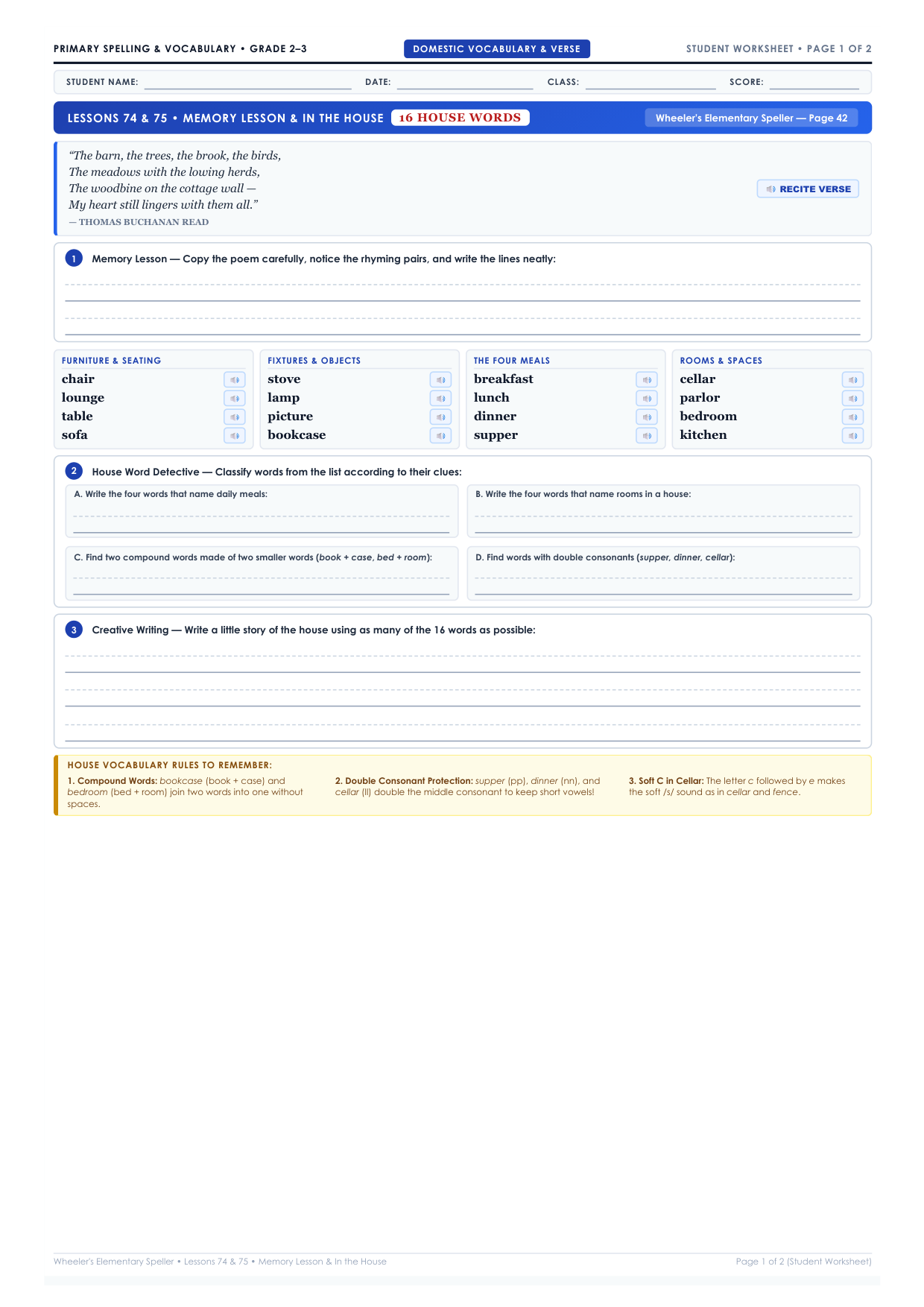
Lesson 74: Memory Lesson & Rhyme Study
Poetry by T. B. Read with complete copywork, rhyming phonograms (-est, -ill), syllable scansion, and memorization exercises.
Open Student HTML
Lesson 75: In the House & Domestic Words
16 domestic household terms (cellar, attic, closet, parlor, pantry, chimney), compound architecture analysis, and architectural storytelling.
Open Student HTML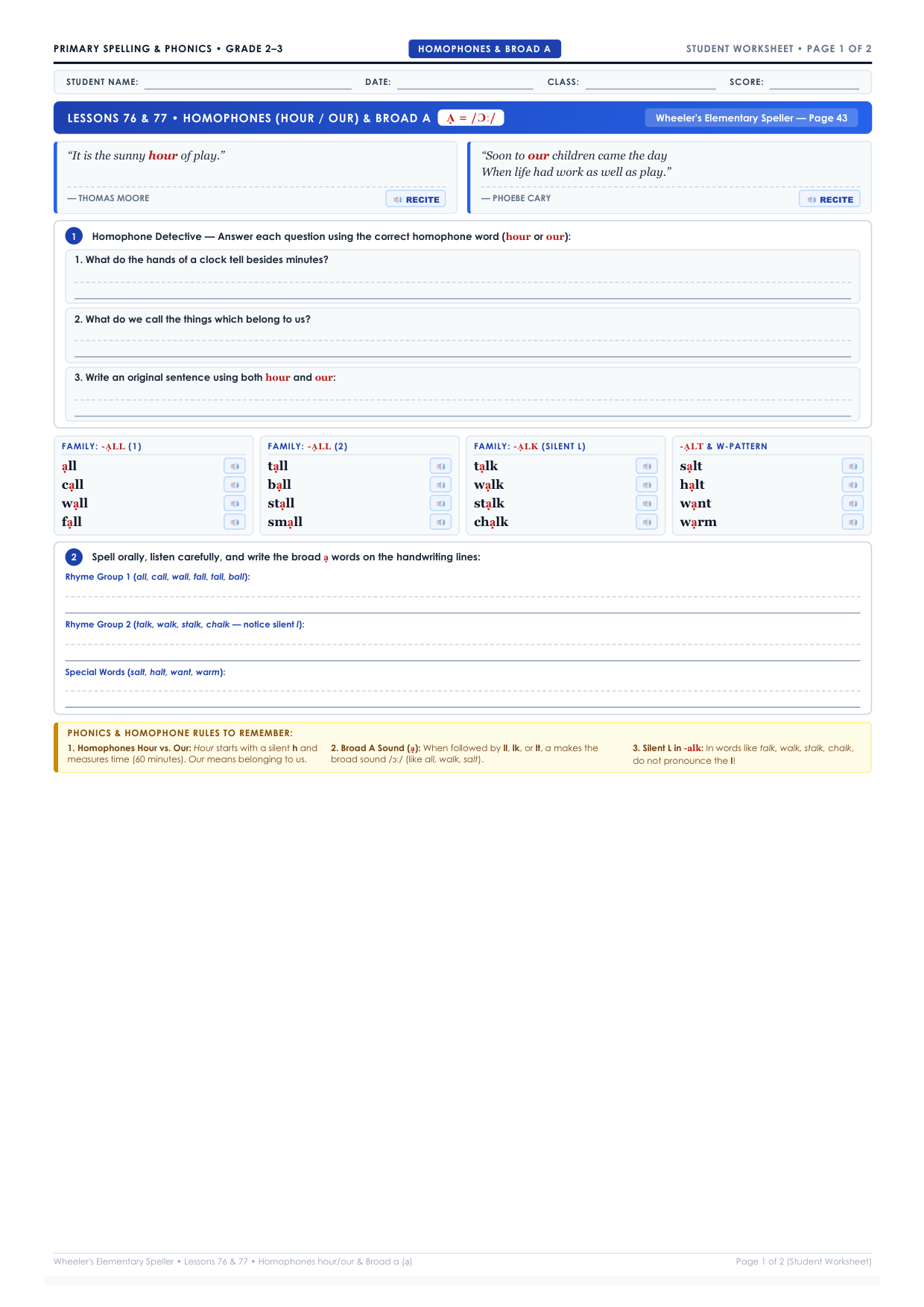
Lesson 76: Homophones: Hour vs. Our
Distinguishing homophones hour and our through Moore and Cary classic poetry, contextual fill-in-the-blanks, and silent h rule analysis.
Open Student HTML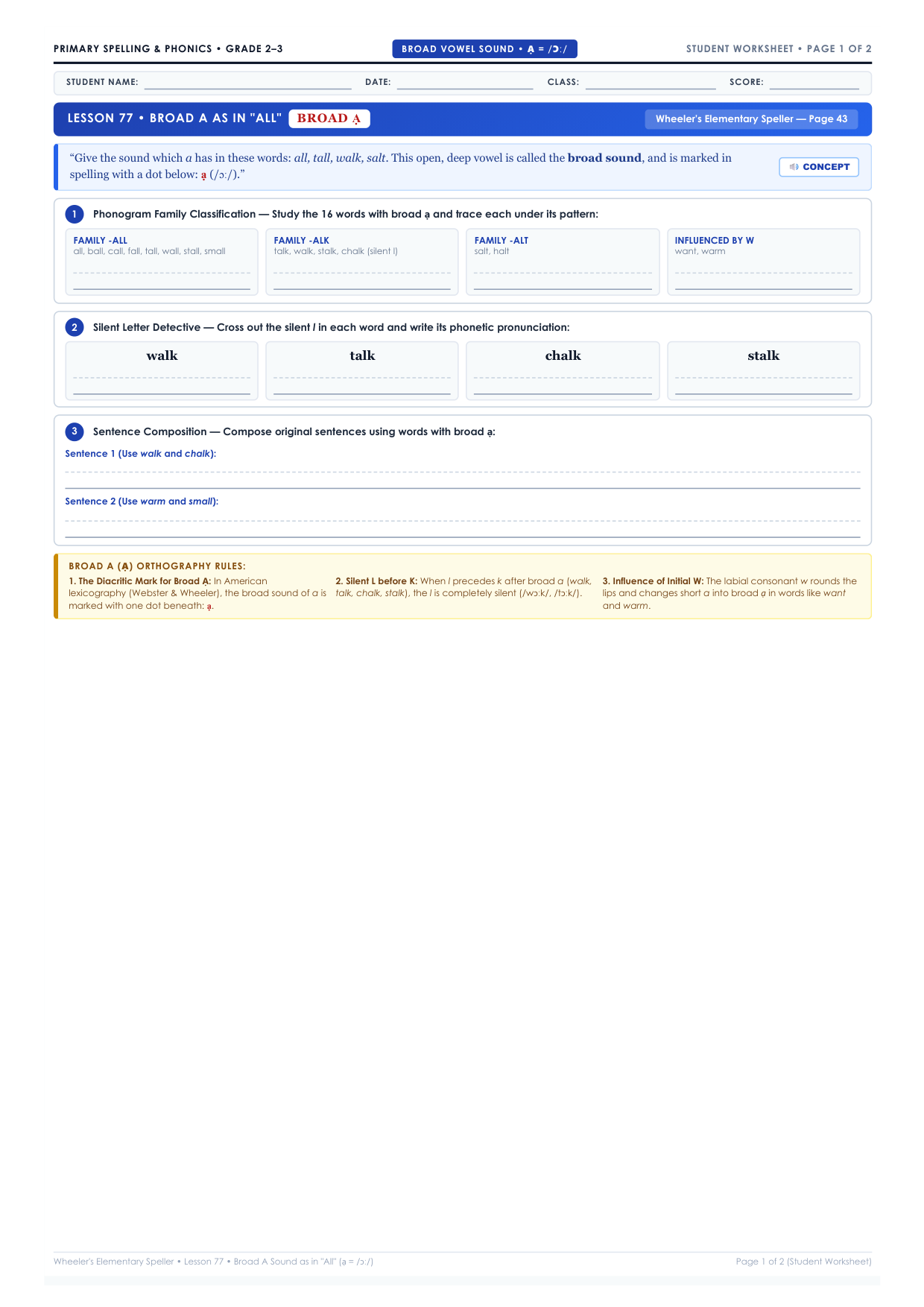
Lesson 77: Broad A Sound as in "All"
16 words featuring the broad sound ạ (all, ball, tall, walk, stalk, chalk, bald, salt, warm, swarm) with silent l analysis and phonogram sorting.
Open Student HTML
Lesson 78: Broad A in Literature & Moral Verse
Cary sisters classic moral poetry, transcription with diacritic broad mark marking, and philosophical vocabulary study.
Open Student HTML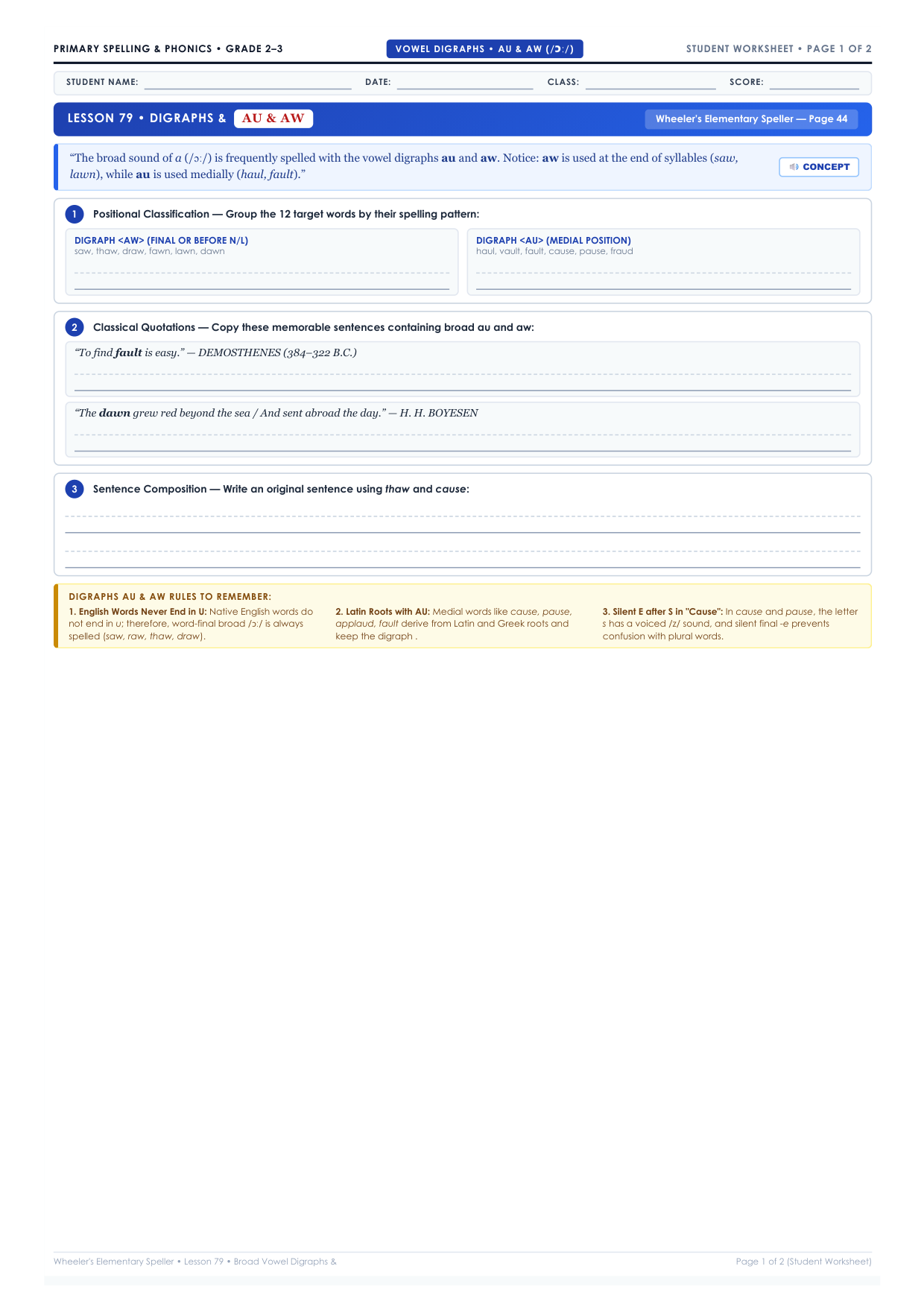
Lesson 79: Digraphs <au> & <aw>
12 broad vowel words spelled with au and aw (claw, straw, crawl, lawn, haul, fault, cause, pause), Demosthenes proverbs, and position rules.
Open Student HTML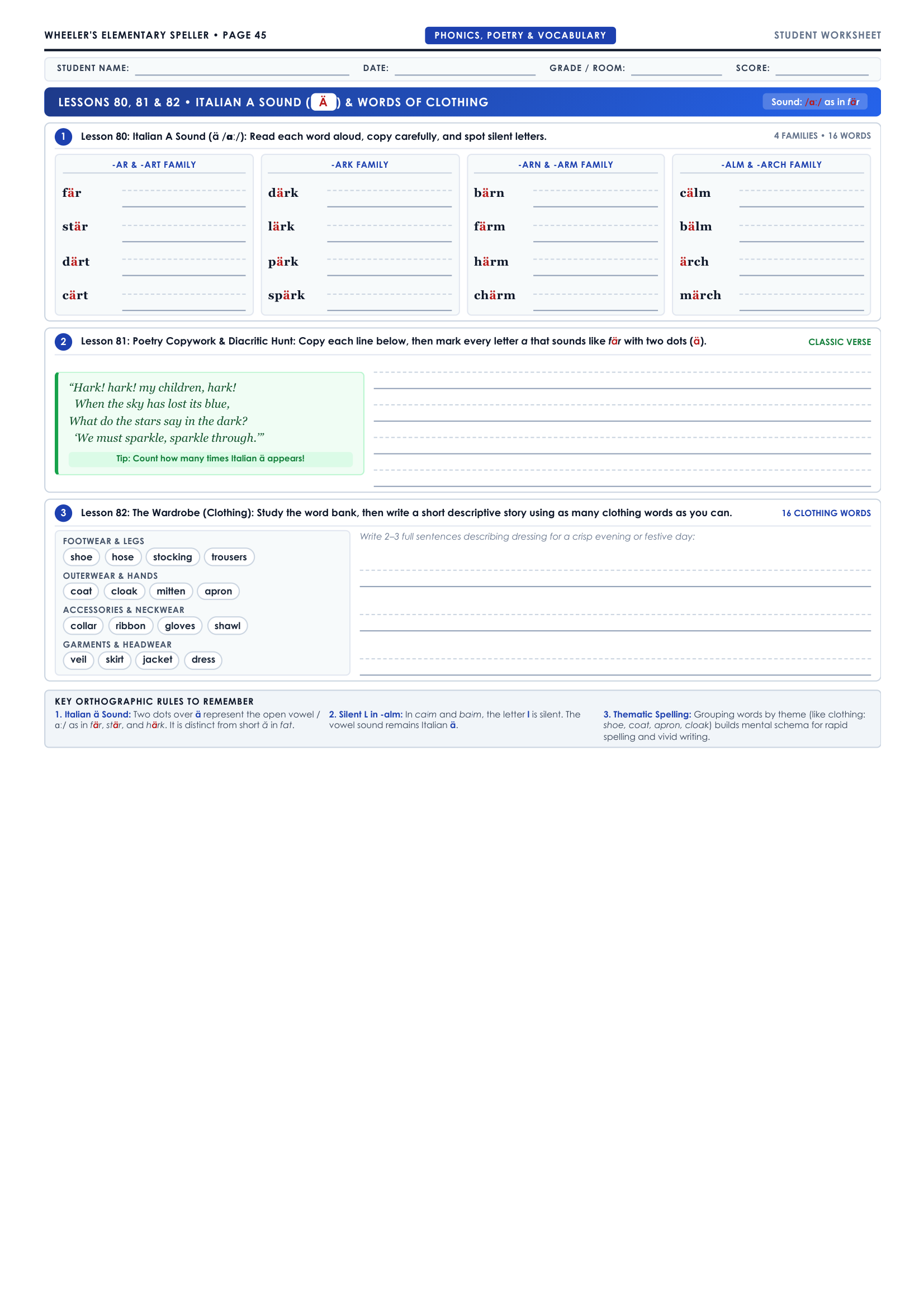
Lesson 80: Italian Ä Sound as in "Far"
16 words featuring Italian ä before r and lm (far, star, dark, park, barn, calm, palm, balm), silent l analysis, and phonogram family sorting.
Open Student HTML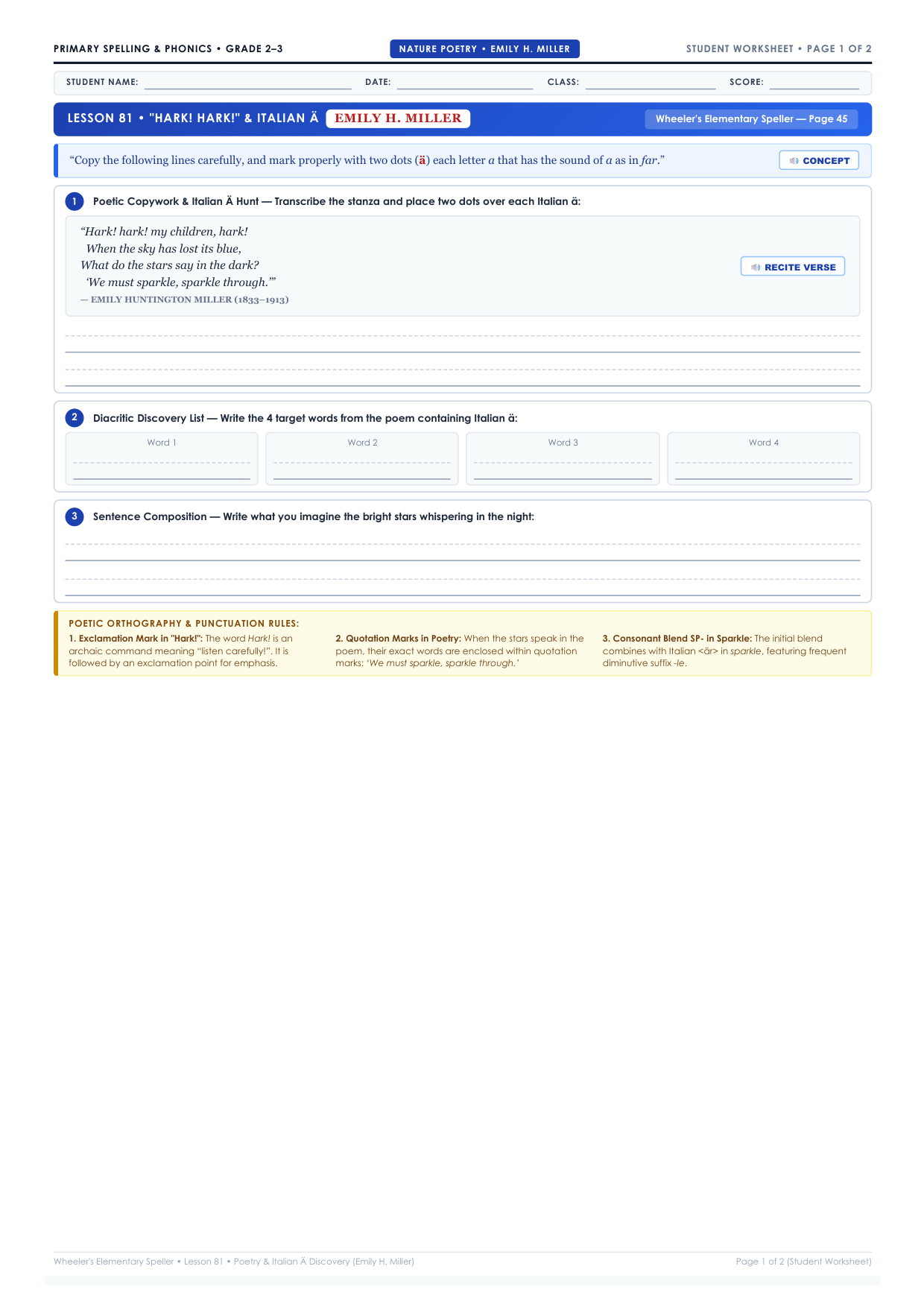
Lesson 81: Classic Poetry: "Hark, Hark! the Lark"
Masterwork verse copywork, diacritic two-dot Italian ä identification, rhyming analysis, and expressive oral reading.
Open Student HTML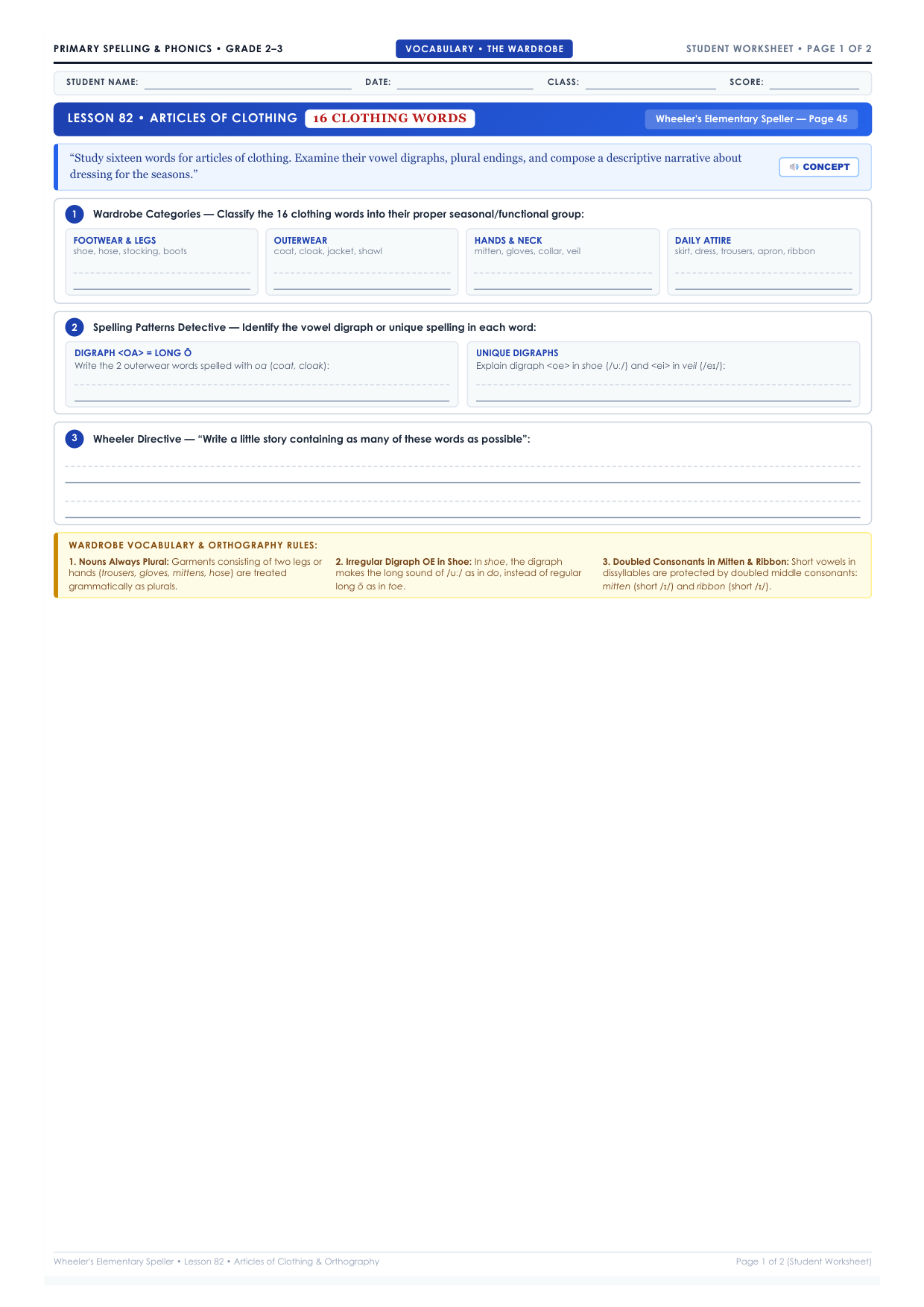
Lesson 82: The Wardrobe & Clothing Vocabulary
16 everyday clothing words (bonnet, collar, jacket, mitten, pocket, slipper, stocking), compound and suffix analysis, and descriptive narrative writing.
Open Student HTML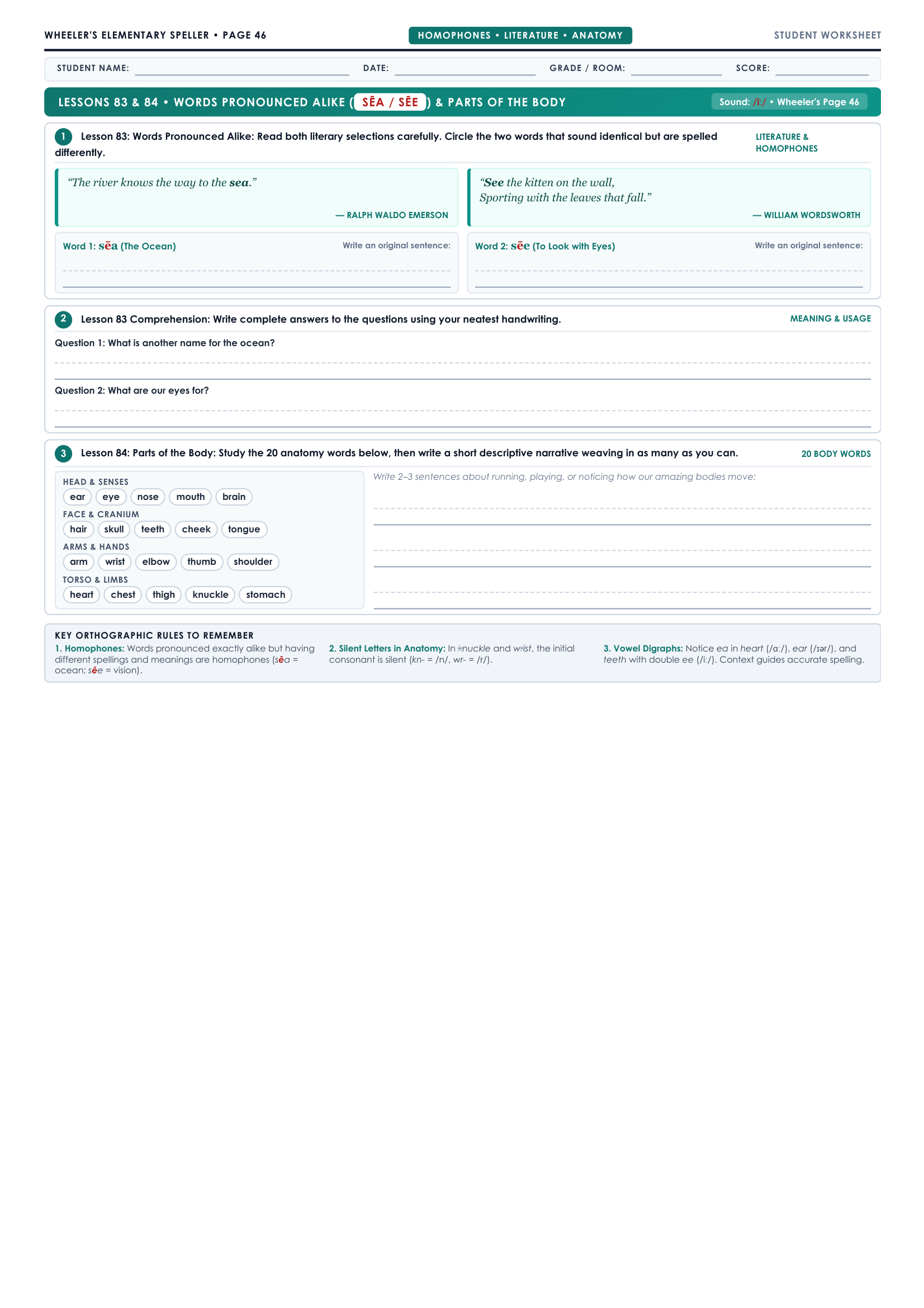
Lesson 83: Homophones: Sea vs. See
Distinguishing sea vs. see through Emerson and Wordsworth verse, sentence discrimination, and vowel digraph rules (ea vs. ee).
Open Student HTML
Lesson 84: Parts of the Body & Anatomy
20 anatomical terms (ankle, elbow, knuckle, shoulder, stomach, tongue, wrist), silent letter analysis, and descriptive physical composition.
Open Student HTML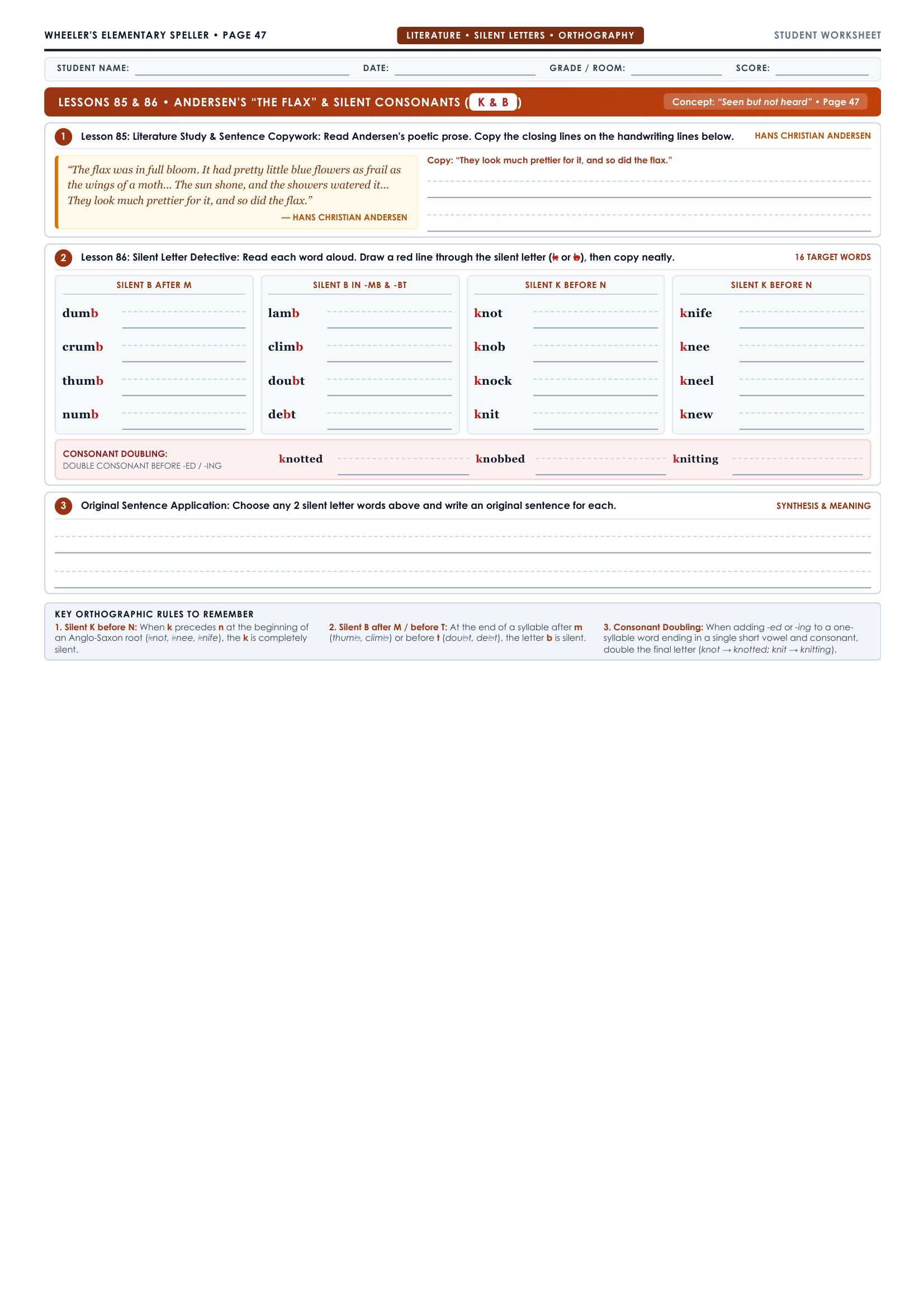
Lesson 85: Hans Christian Andersen's "The Flax"
Literary reading from Andersen's classic story, sentence transcription, vocabulary synthesis, and story summary.
Open Student HTML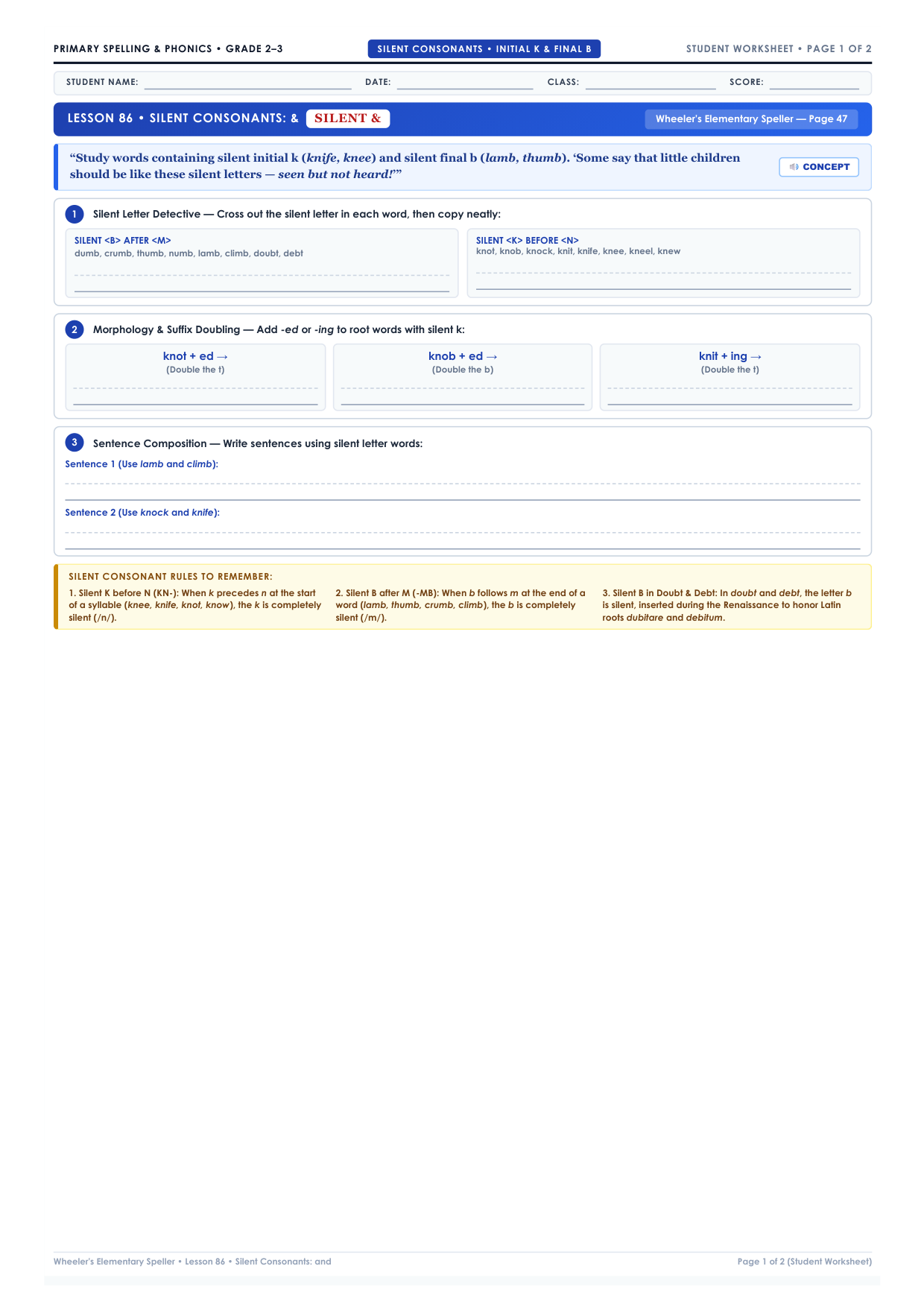
Lesson 86: Silent Consonants: Initial <k> & Final <b>
19 silent letter words (comb, thumb, dumb, climb, lamb, knee, knife, knot, knit, knitting), consonant cluster etymology, and rule application.
Open Student HTML
Lesson 87: “Little Jack Frost” & Morphology
Classic 3-stanza winter poem with Socratic inquiry on consonant doubling (tripped vs. spreading) and 5-letter vs. 6-letter word classification.
Open Student HTML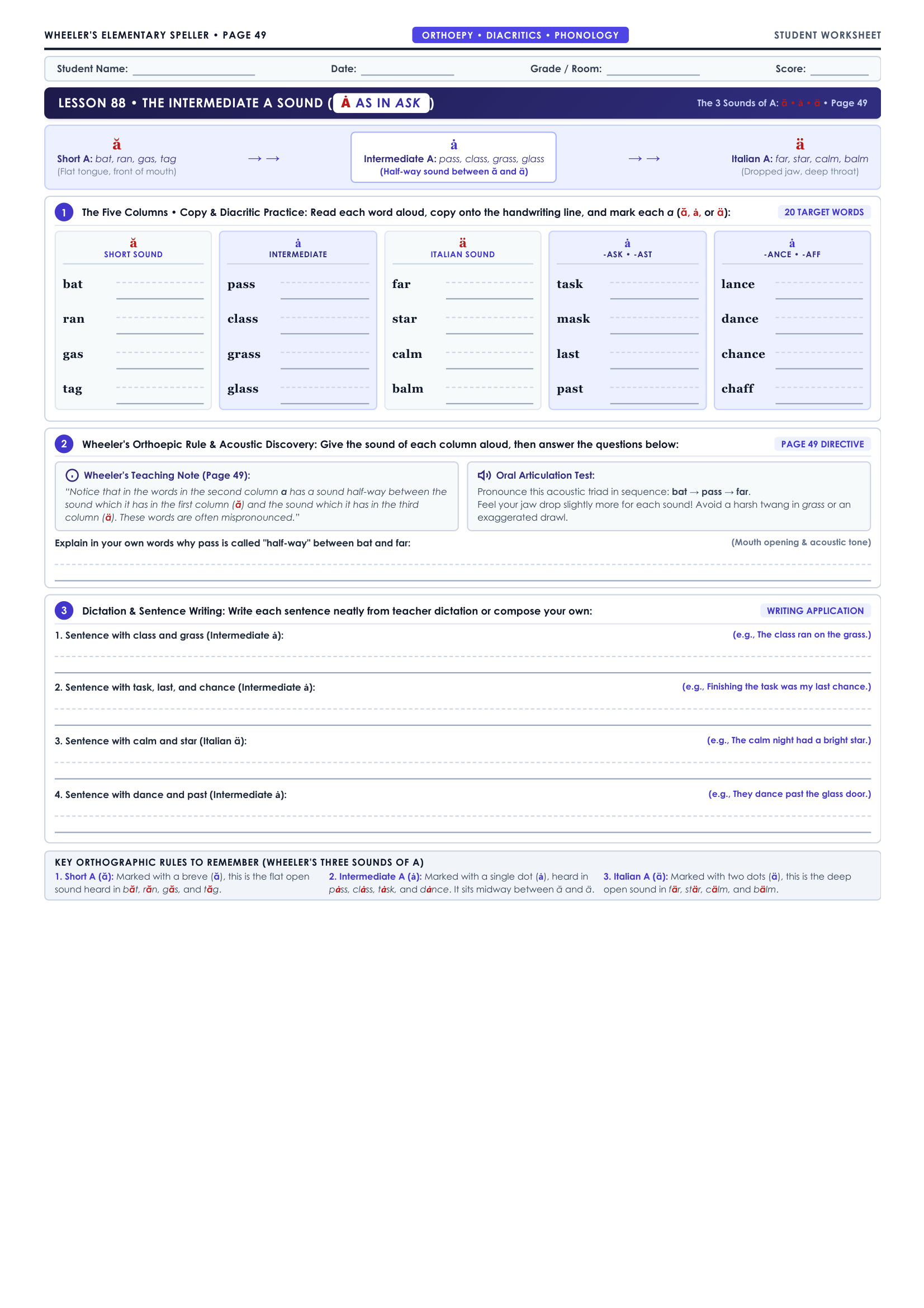
Lesson 88: Intermediate A Sound (á)
Acoustic comparison of short ă (/æ/), Italian ä (/αː/), and intermediate &adot (/αː/ shorter). Features 20 words across 5 phonetic columns with orthoepy guide.
Open Student HTML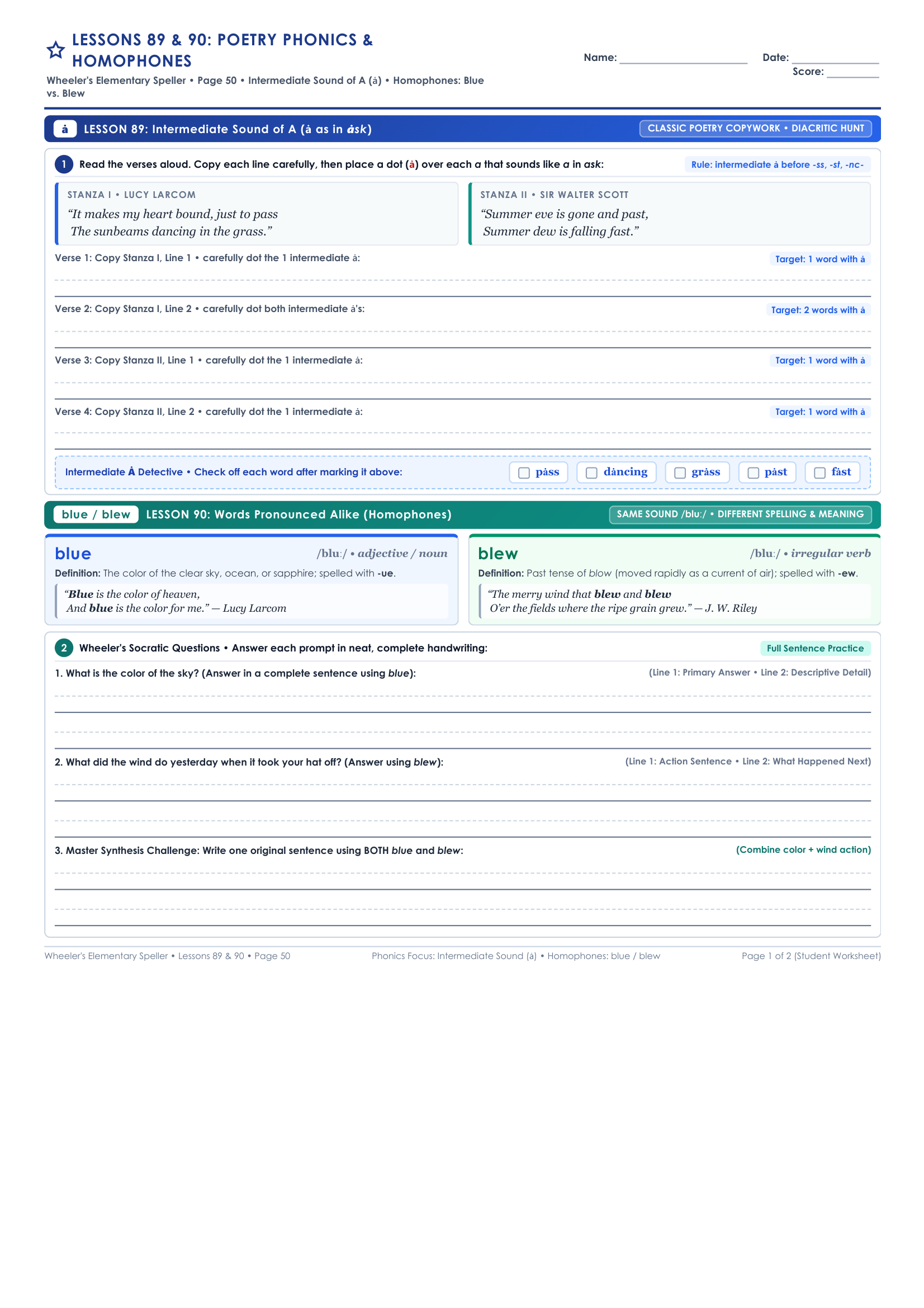
Lesson 89: Intermediate A Sound in Poetry
Lucy Larcom and Sir Walter Scott classic poetry, complete copywork, diacritic marking of intermediate ȧ (pass, dancing, grass, past, fast), and vowel contrast study.
Open Student HTML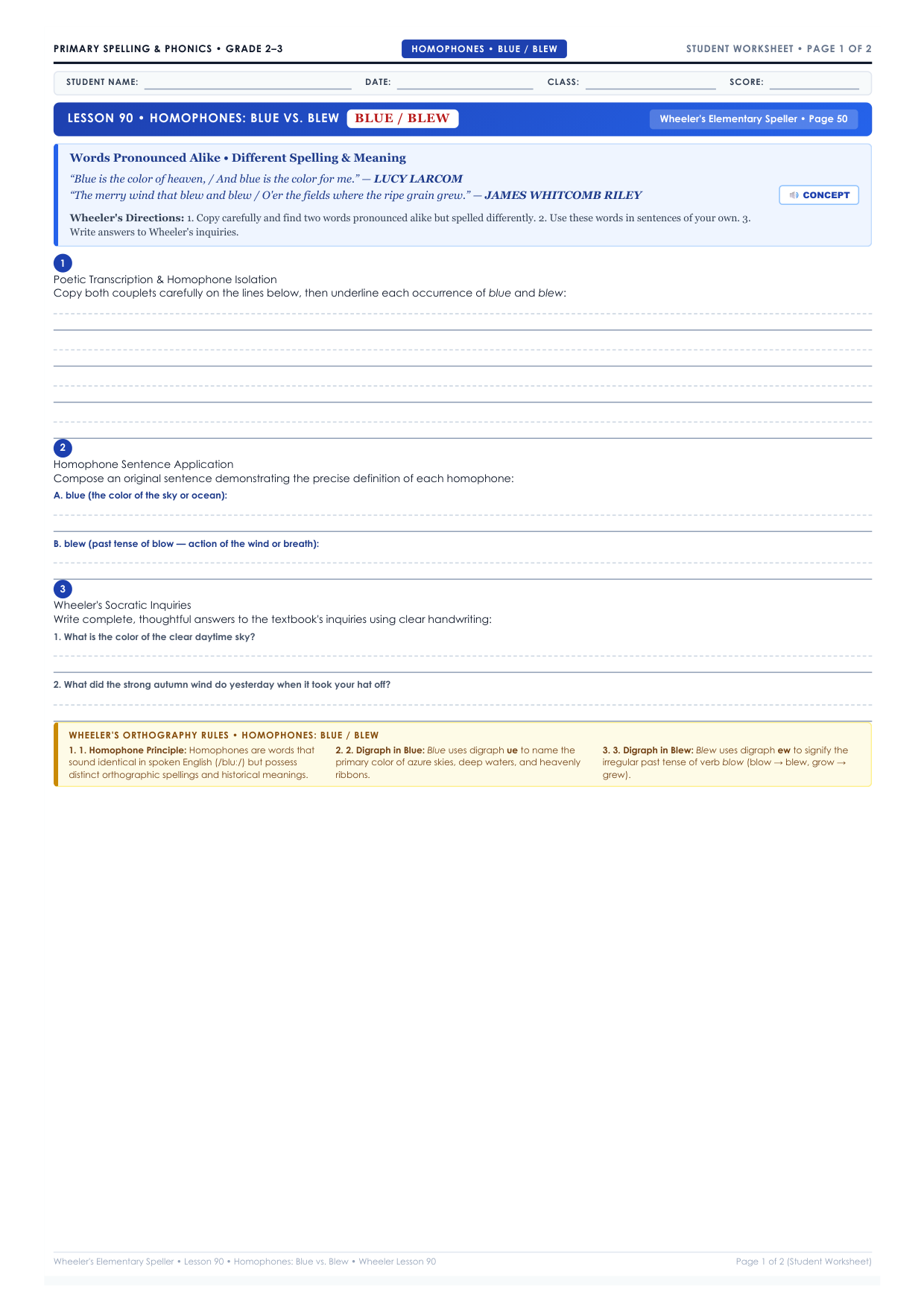
Lesson 90: Homophones: Blue vs. Blew
Distinguish homophones blue and blew through Lucy Larcom and James Whitcomb Riley literature, contextual sentence writing, and Socratic phonic inquiries.
Open Student HTML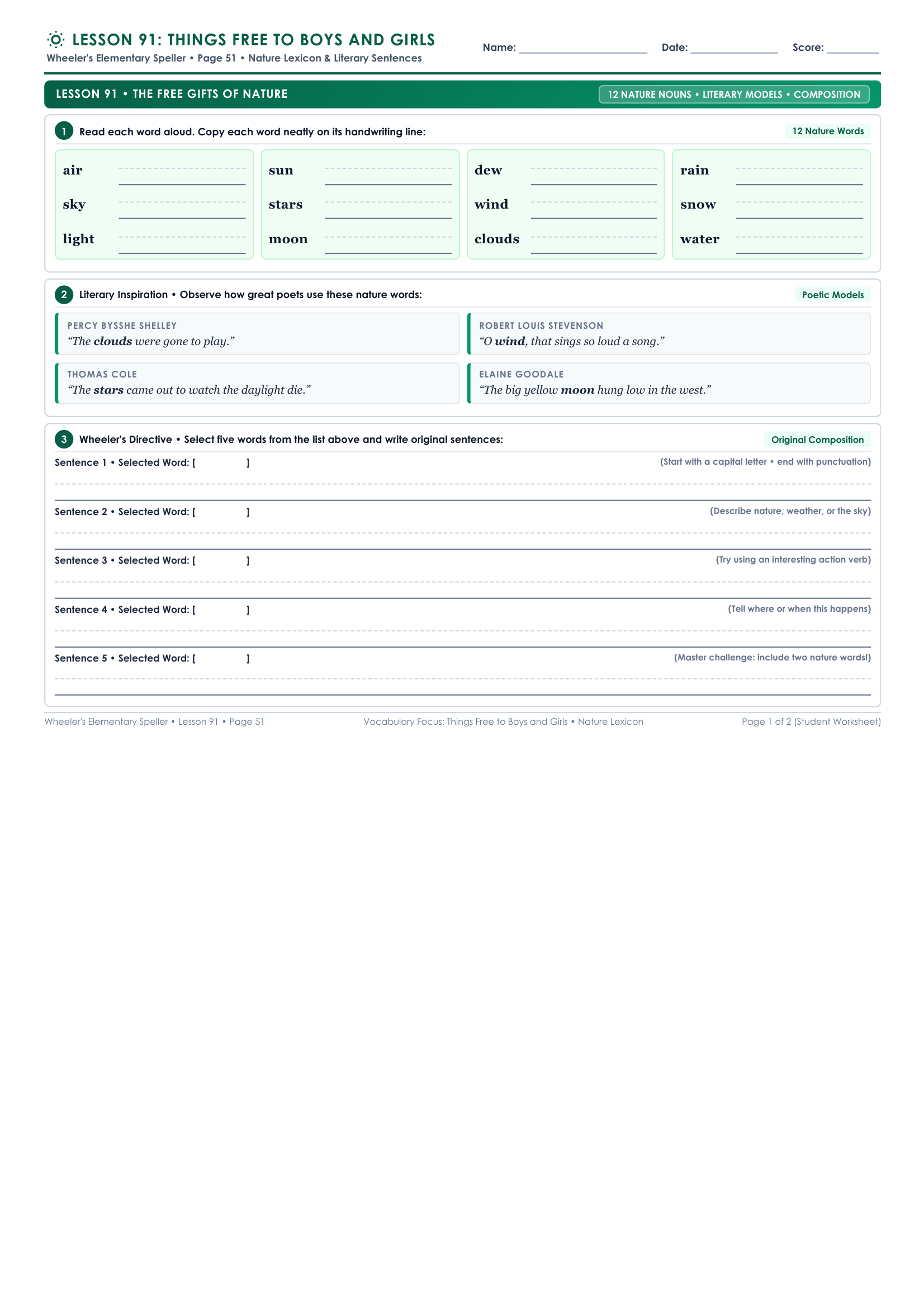
Lesson 91: Things Free to Boys and Girls
Explore 12 essential nature words across four classical literary models (Shelley, Stevenson, Cole, Goodale), coupled with original student sentence composition and Wheeler’s 1901 nature study philosophy.
Open Student HTML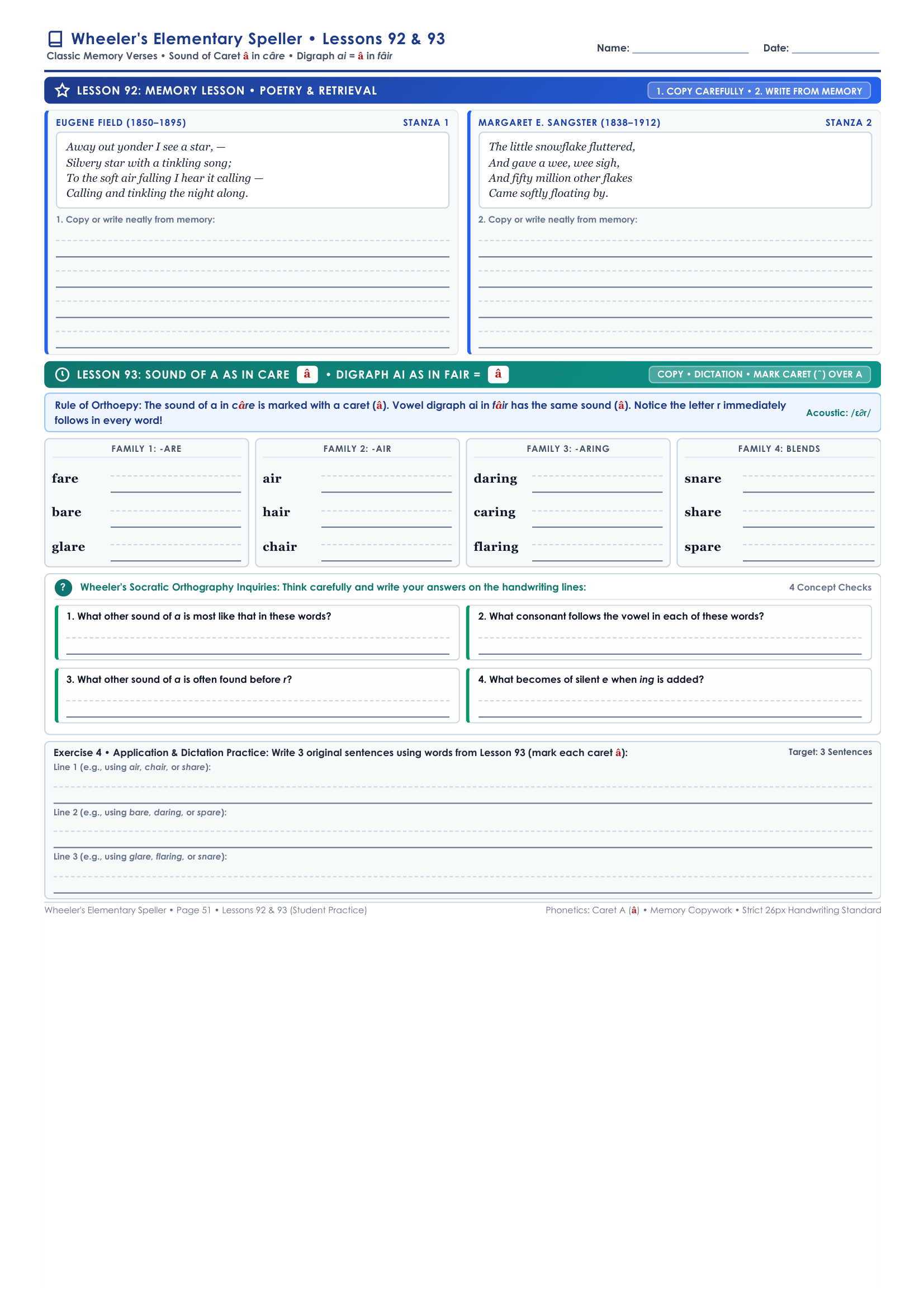
Lesson 92: Memory Lesson & Classic Poetry
American poets Eugene Field and Margaret E. Sangster, structured stanza copywork, rhyme scansion (star/afar, song/long, sigh/by), and memorization retrieval practice.
Open Student HTML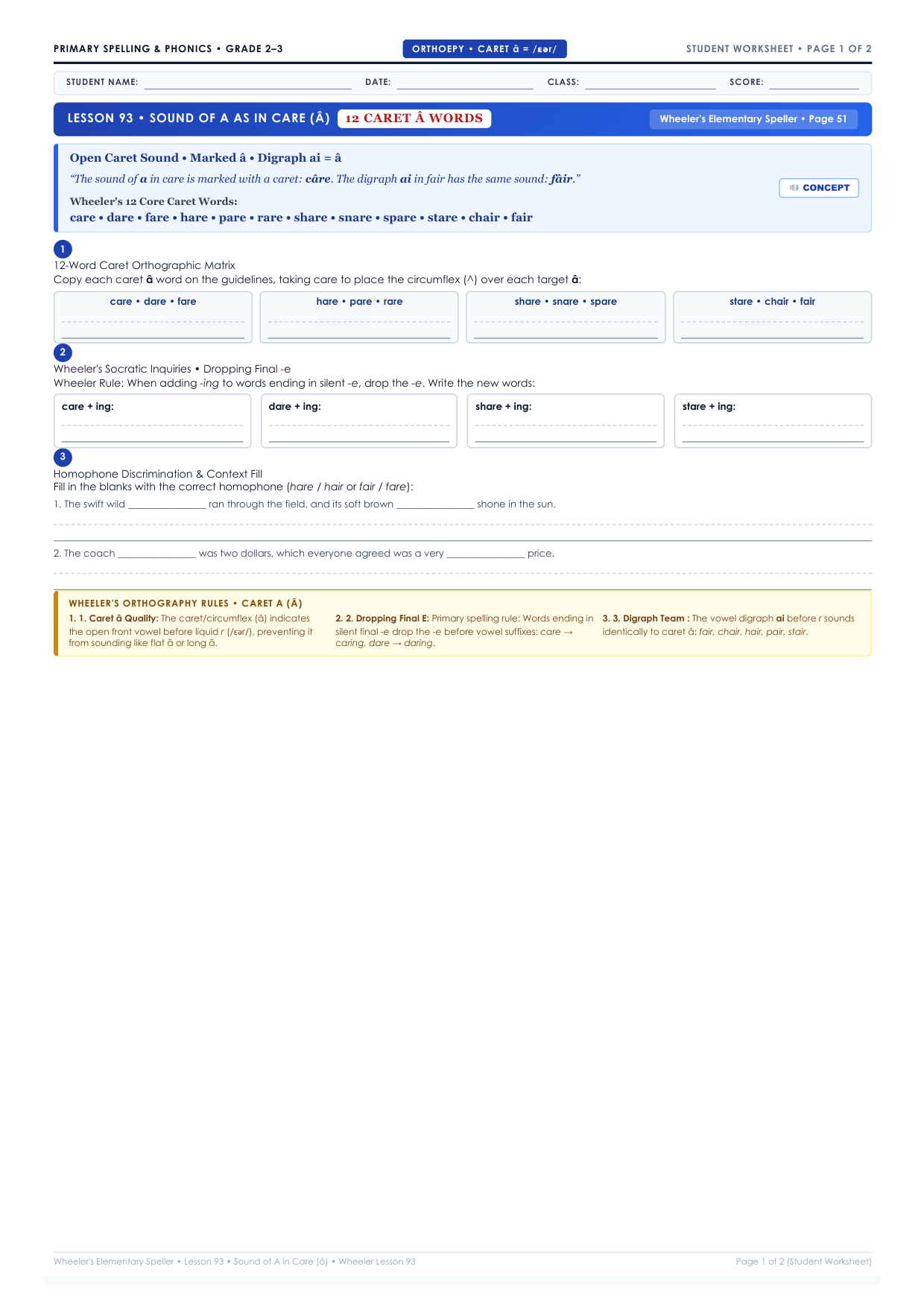
Lesson 93: Sound of A as in Care (â)
12 open caret words (care, dare, fare, hare, pare, rare, share, snare, spare, stare, chair, fair), dropping silent -e before -ing, and homophone discrimination.
Open Student HTML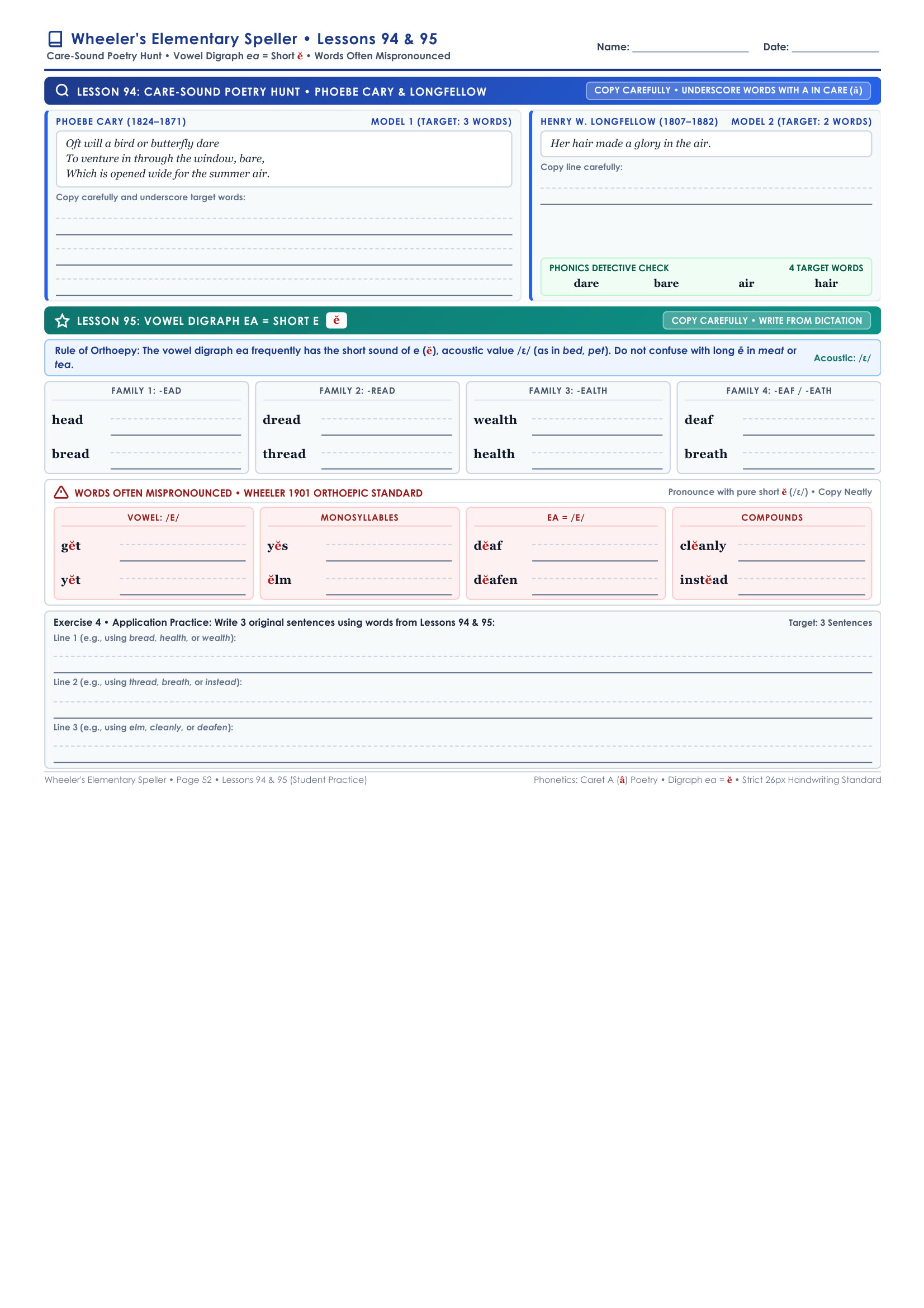
Lesson 94: Care-Sound Poetry Hunt
Phoebe Cary and Henry Wadsworth Longfellow verse, searching for caret â in context (share, spare, care, declare), and multisyllabic rhythm analysis.
Open Student HTML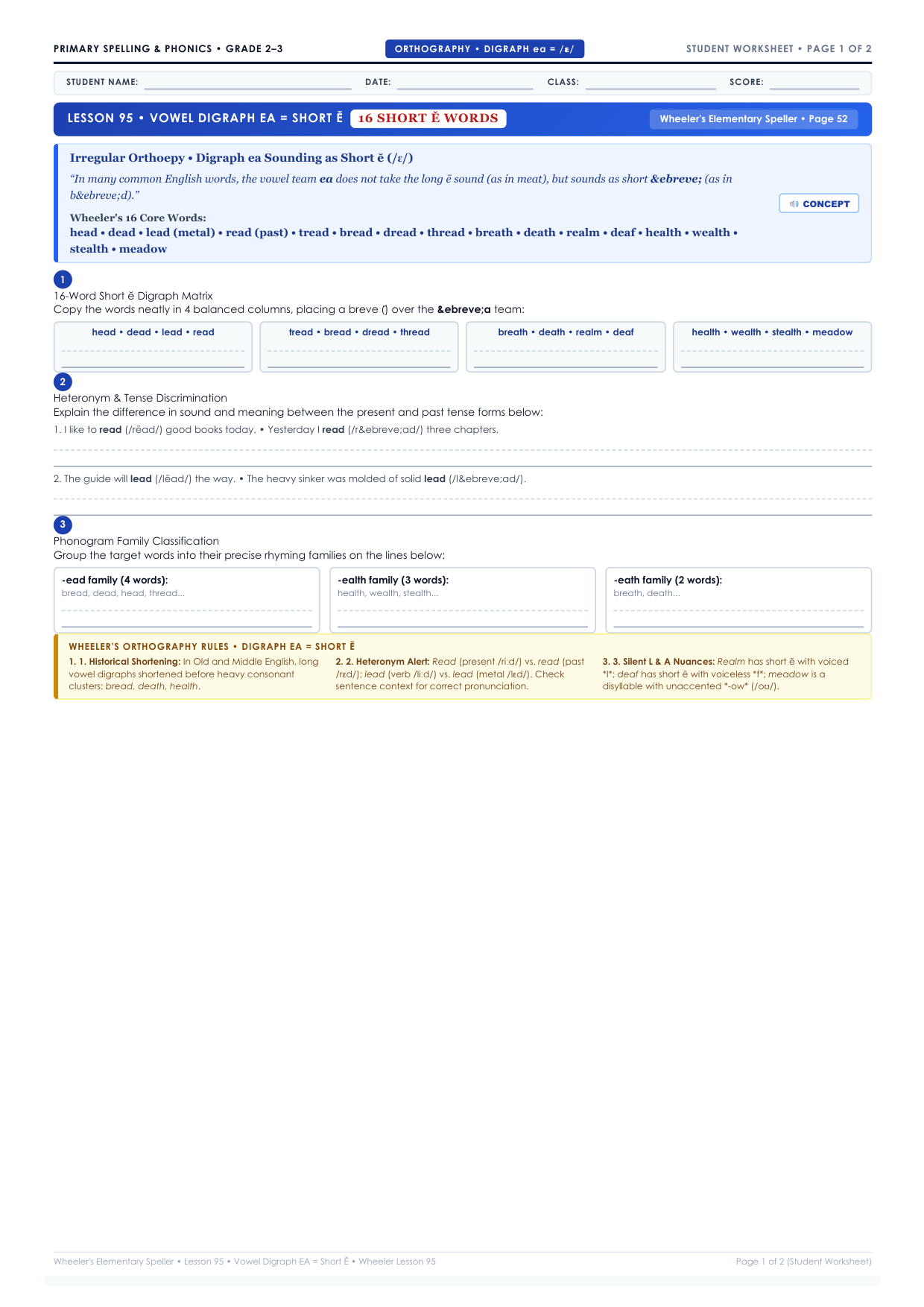
Lesson 95: Vowel Digraph EA = Short Ě
16 short ĕ digraph words (head, dead, bread, thread, breath, death, realm, health, wealth, meadow), heteronym study (read, lead), and word families.
Open Student HTML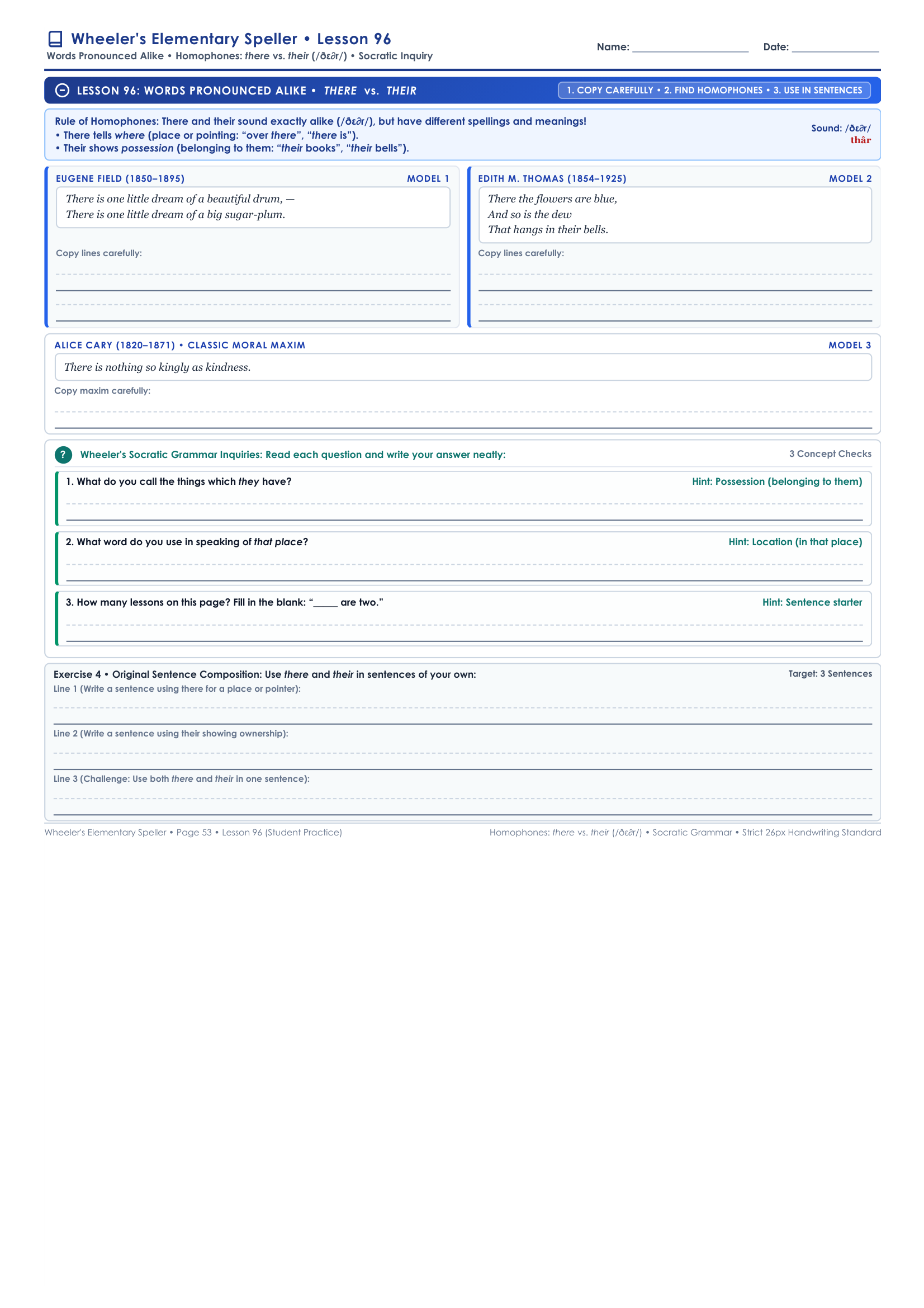
Lesson 96: Words Pronounced Alike
Mastering homophones there vs. their (/ðε∂r/) across poetry by Eugene Field, Edith M. Thomas, and Alice Cary, featuring Wheeler’s 3 Socratic grammar inquiries and sentence synthesis.
Open Student HTML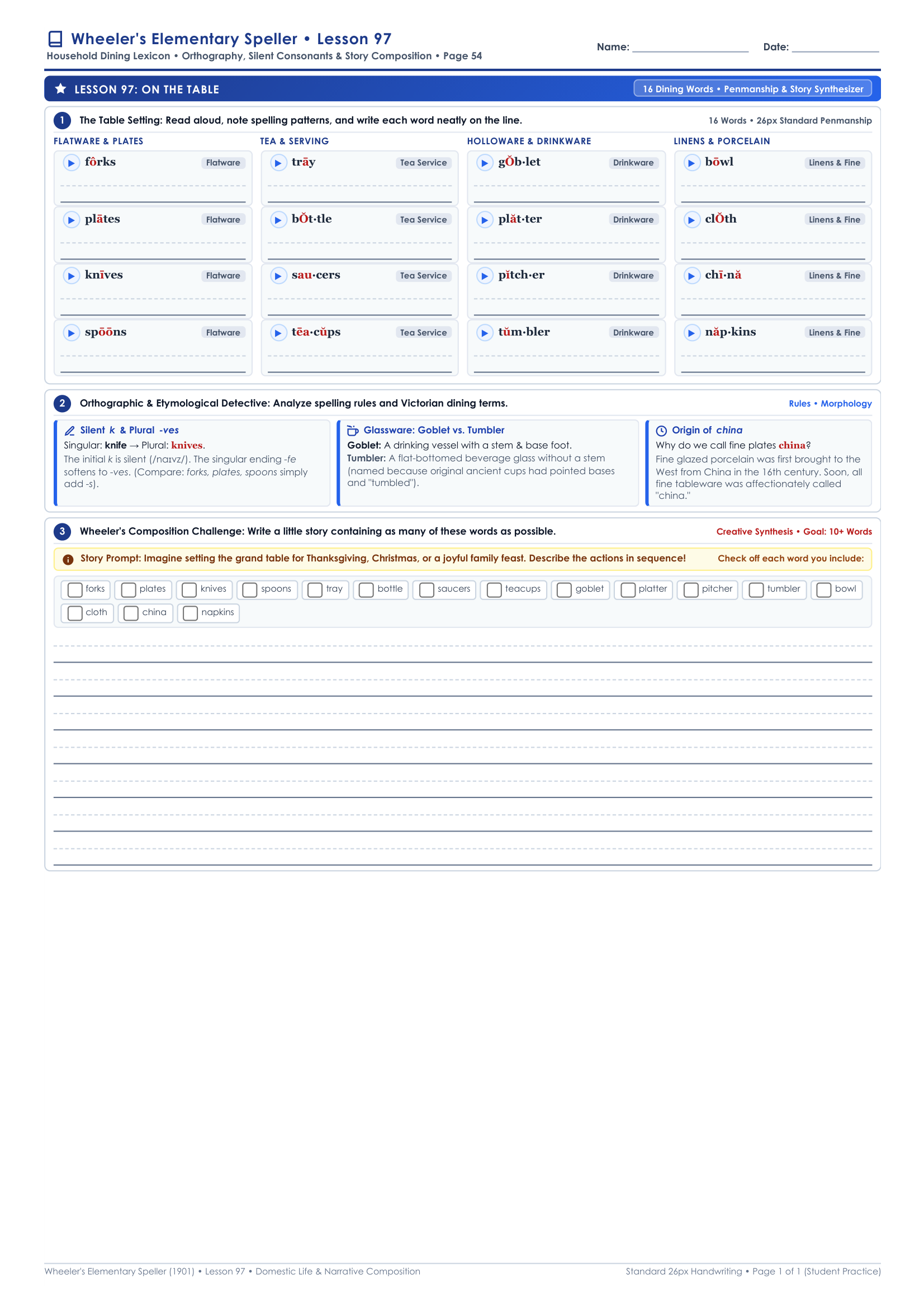
Lesson 97: On the Table • Dining Lexicon
16 essential dining room vocabulary words (forks, plates, knives, spoons, goblet, tumbler, pitcher, china) across 4 categories with silent k rules, 26px handwriting, and Wheeler’s classic narrative story composition challenge.
Open Student HTML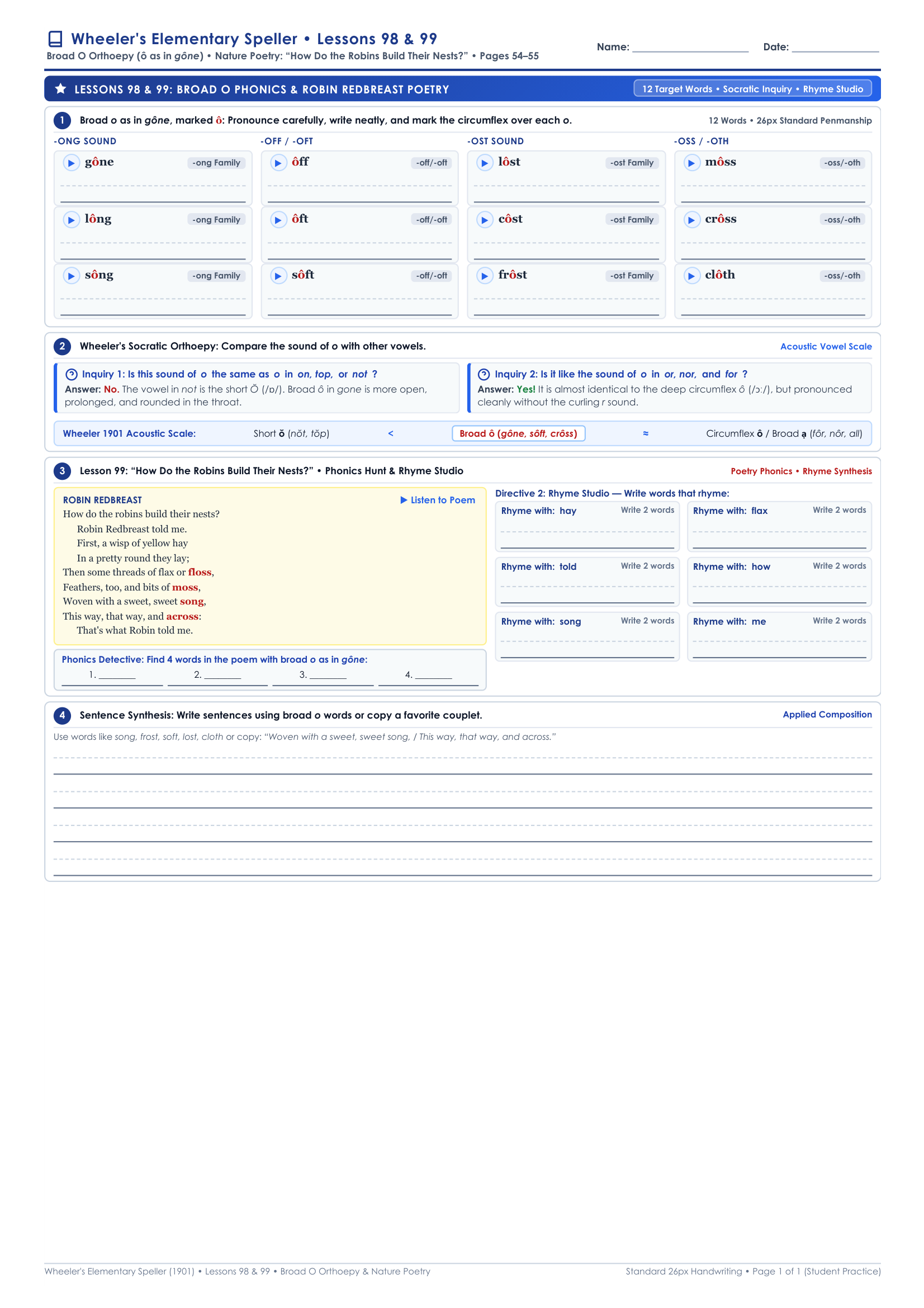
Lesson 98: Broad O as in Gone (ô)
12 broad ô words (gone, off, lost, moss, long, oft, cost, cross, song, soft, frost, cloth), Socratic orthoepy contrast with short ŏ, and consonant environments.
Open Student HTML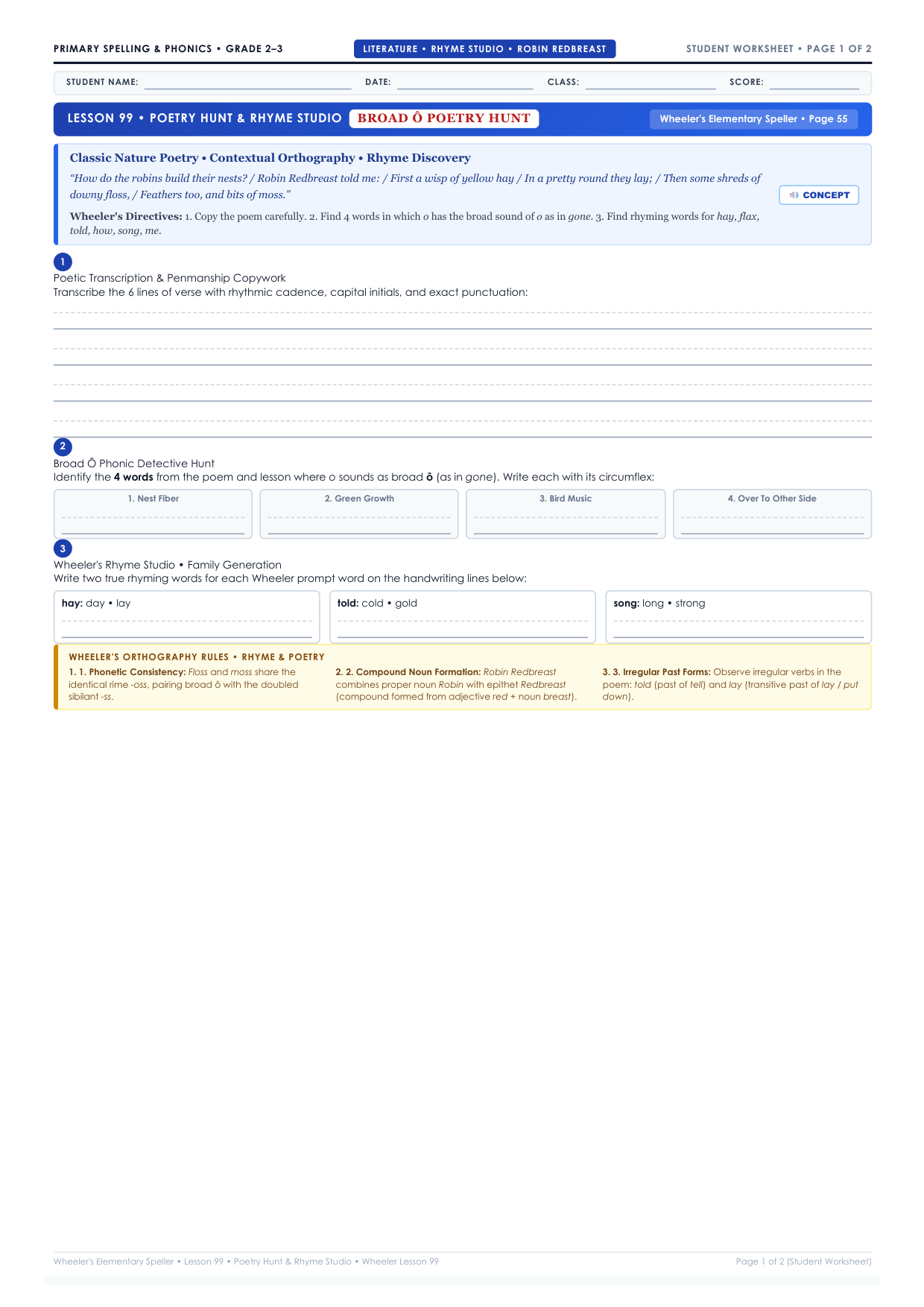
Lesson 99: Poetry Hunt & Rhyme Studio
Classic nature verse (How do the robins build their nests?), broad ô detection (floss, moss, song, across), and Wheeler's rhyme family generation.
Open Student HTML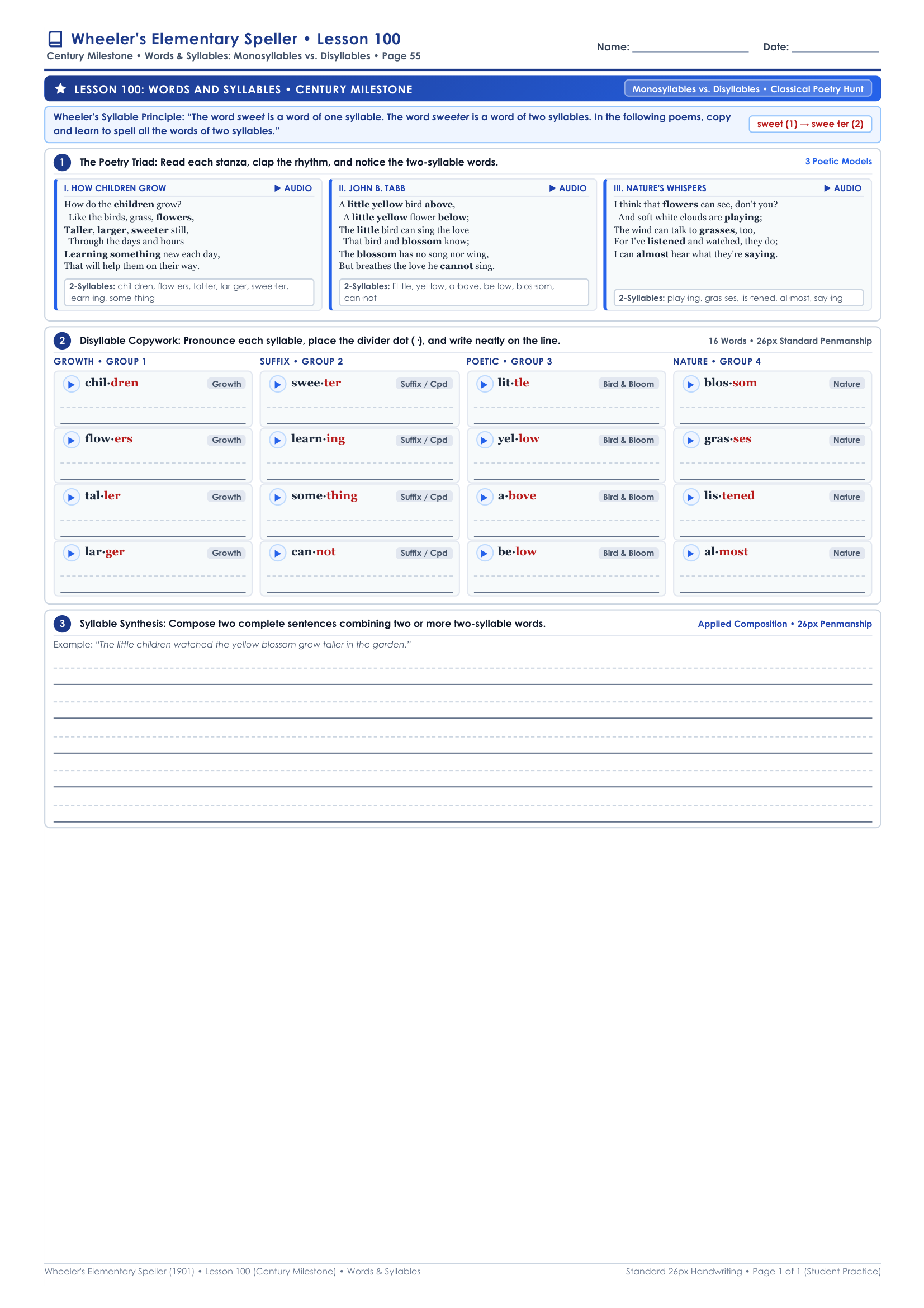
Lesson 100: Words & Syllables • Disyllables
Century milestone exploring monosyllables vs. disyllables across 3 classical nature poems (including John B. Tabb), with 16 core two-syllable words (children, flowers, sweeter, yellow, blossom) and 26px sentence composition.
Open Student HTML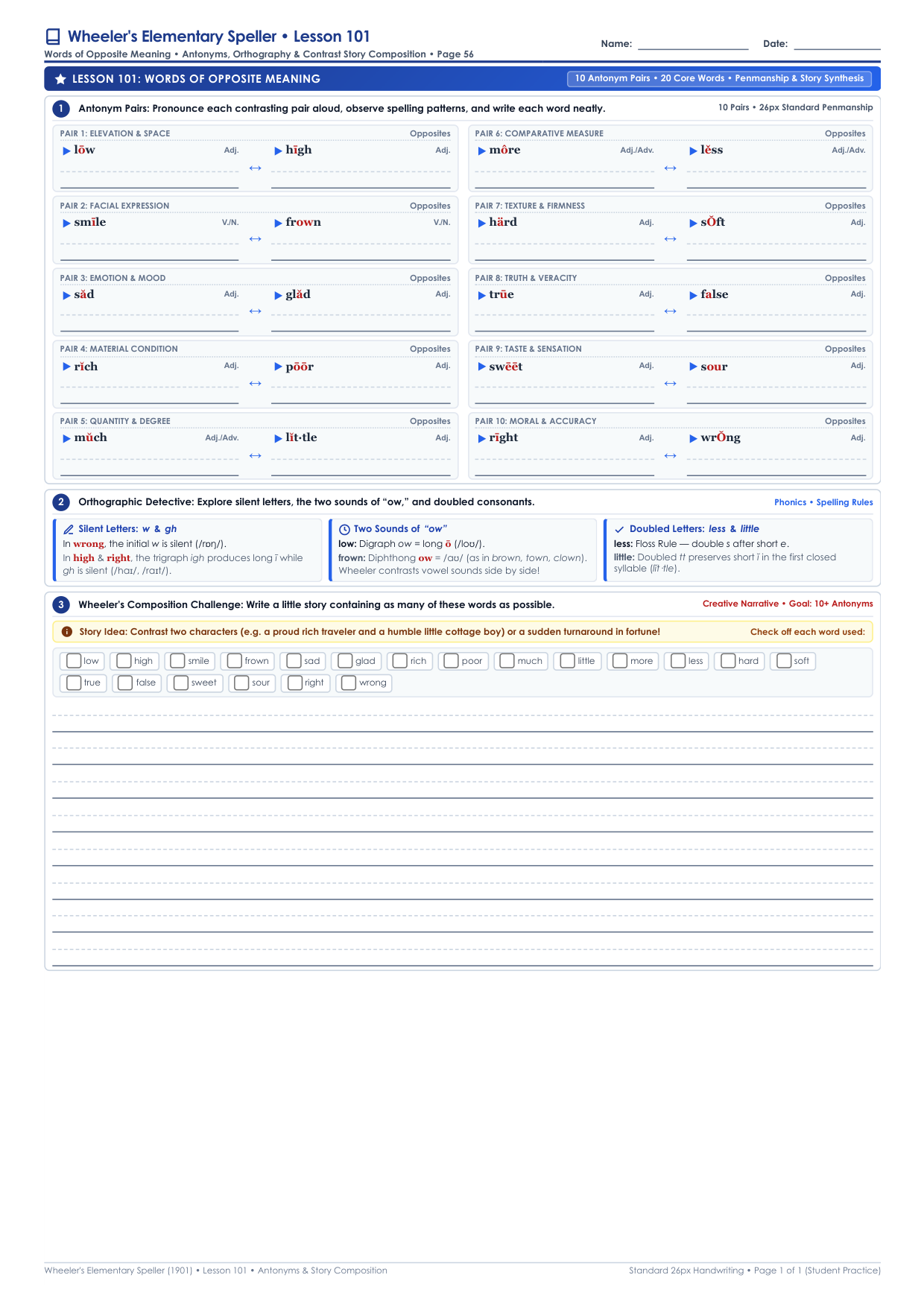
Lesson 101: Words of Opposite Meaning
10 classic antonym pairs (20 core words: low/high, smile/frown, sad/glad, rich/poor, much/little, hard/soft, true/false, right/wrong) with silent letters, vowel phonics, and Wheeler’s creative contrast story challenge.
Open Student HTML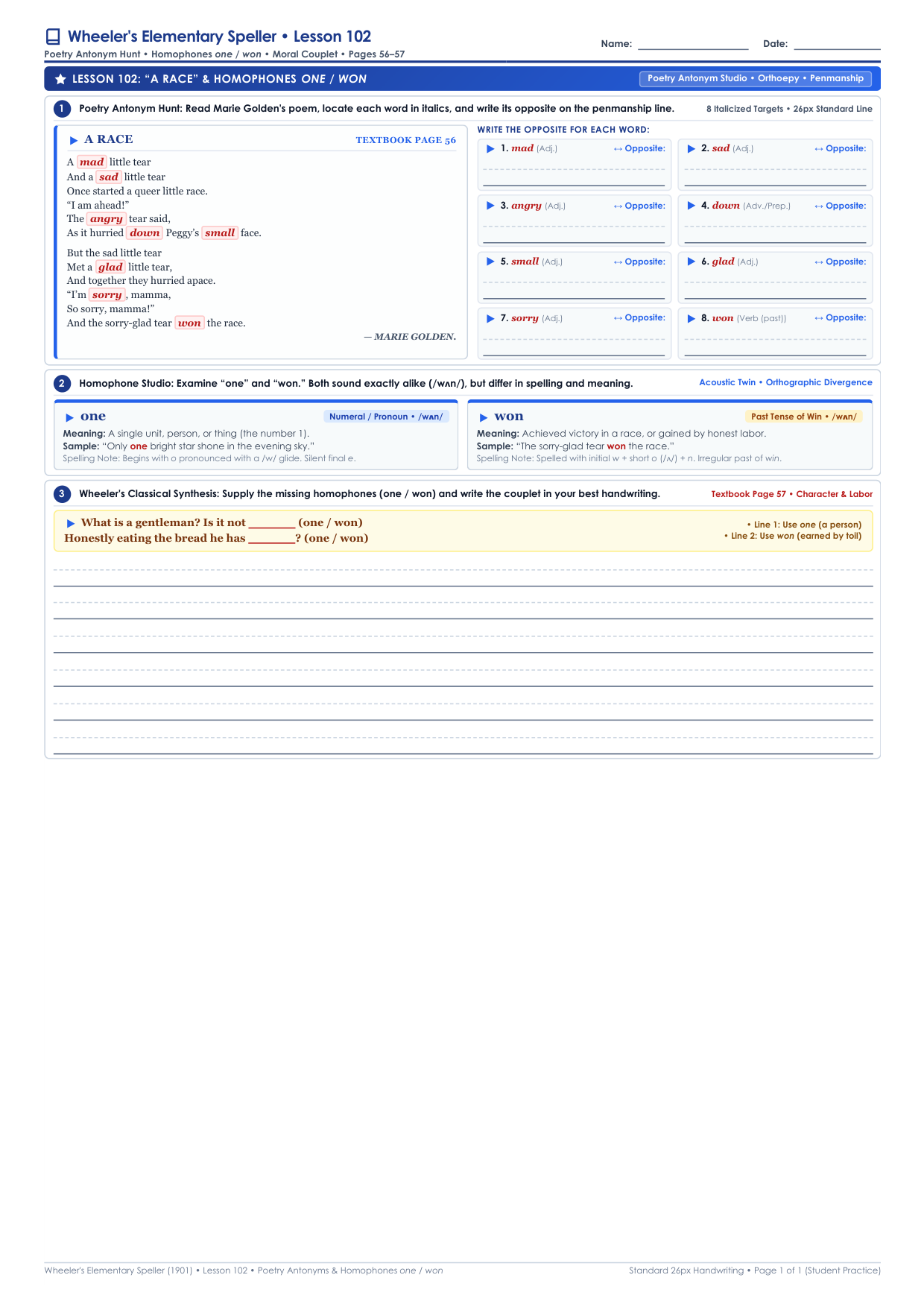
Lesson 102: “A Race” & Homophones one / won
Marie Golden’s poignant poem “A Race” paired with an 8-word antonym hunt (mad, sad, angry, down, small, glad, sorry, won), homophone analysis of acoustic twins one / won (/wʌn/), and Wheeler’s moral gentleman couplet.
Open Student HTML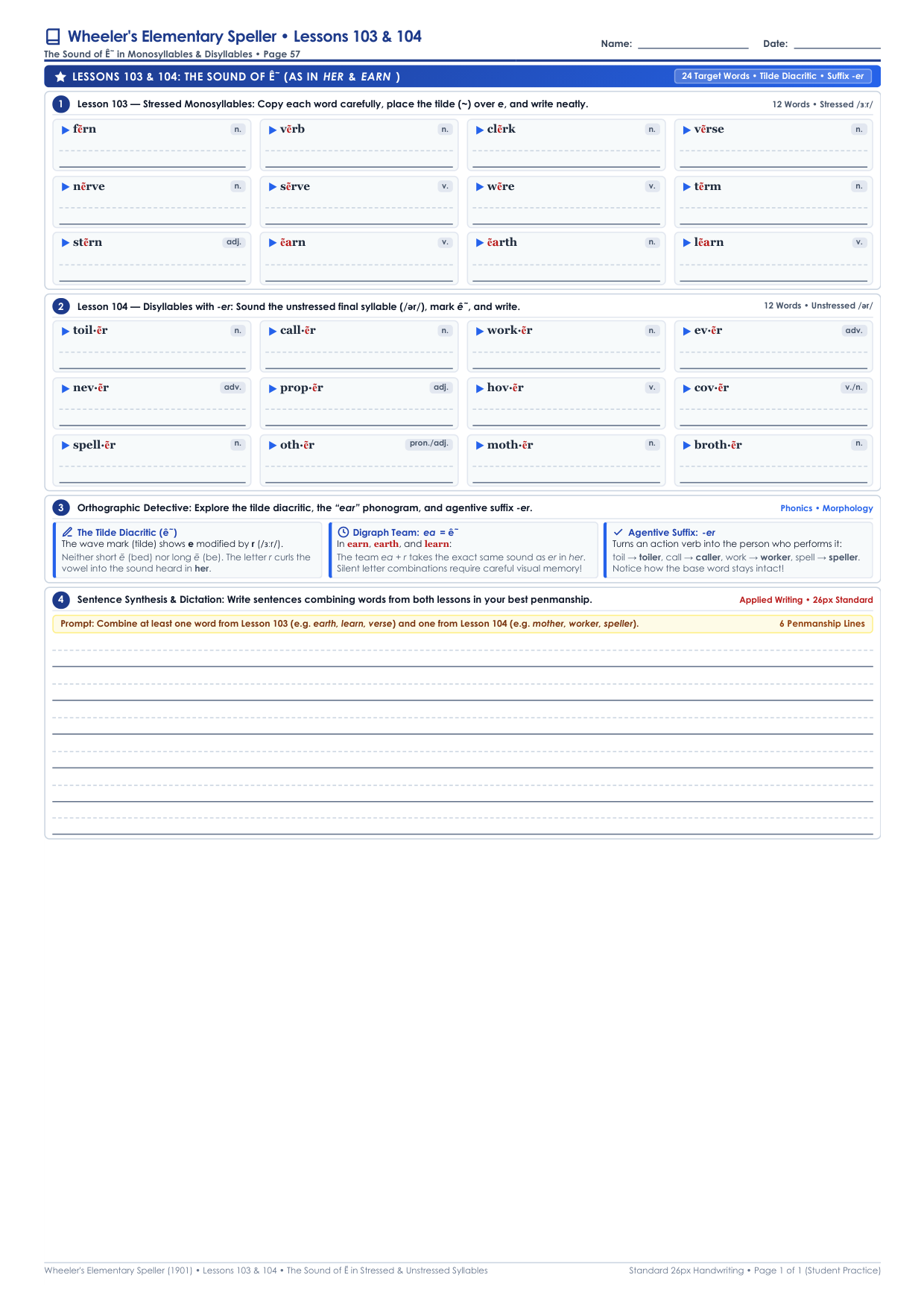
Lesson 103: The Sound of E as in Her (ẽ)
12 tilde ẽ monosyllables (fern, verse, were, earn, verb, nerve, term, earth, clerk, serve, stern, learn), digraph ea = ẽ, and terminal consonant guard rules.
Open Student HTML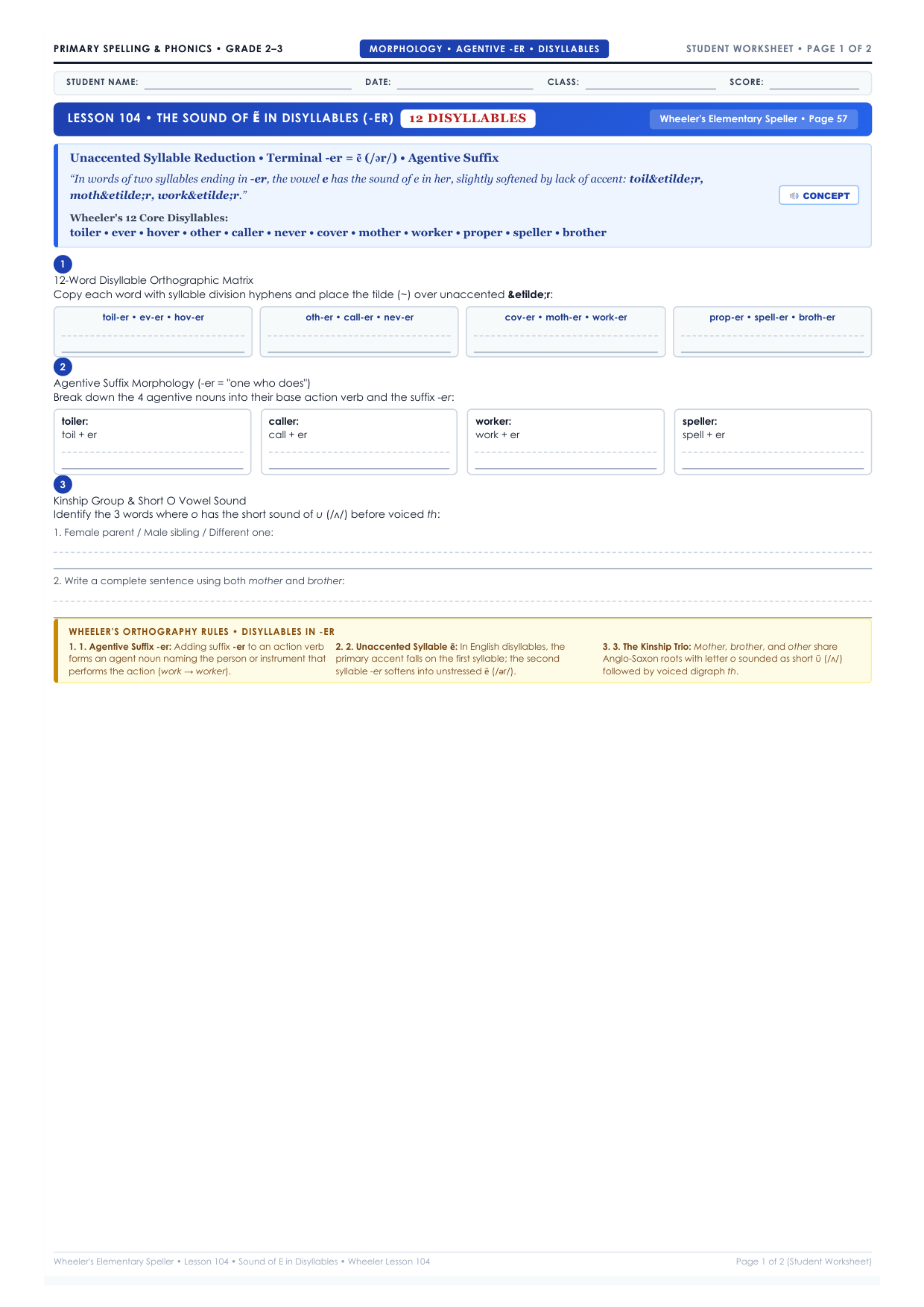
Lesson 104: The Sound of Ẽ in Disyllables (-er)
12 disyllables ending in unaccented -er (toiler, caller, worker, speller, mother, brother, other), agentive suffix analysis, and kinship group pronunciation.
Open Student HTML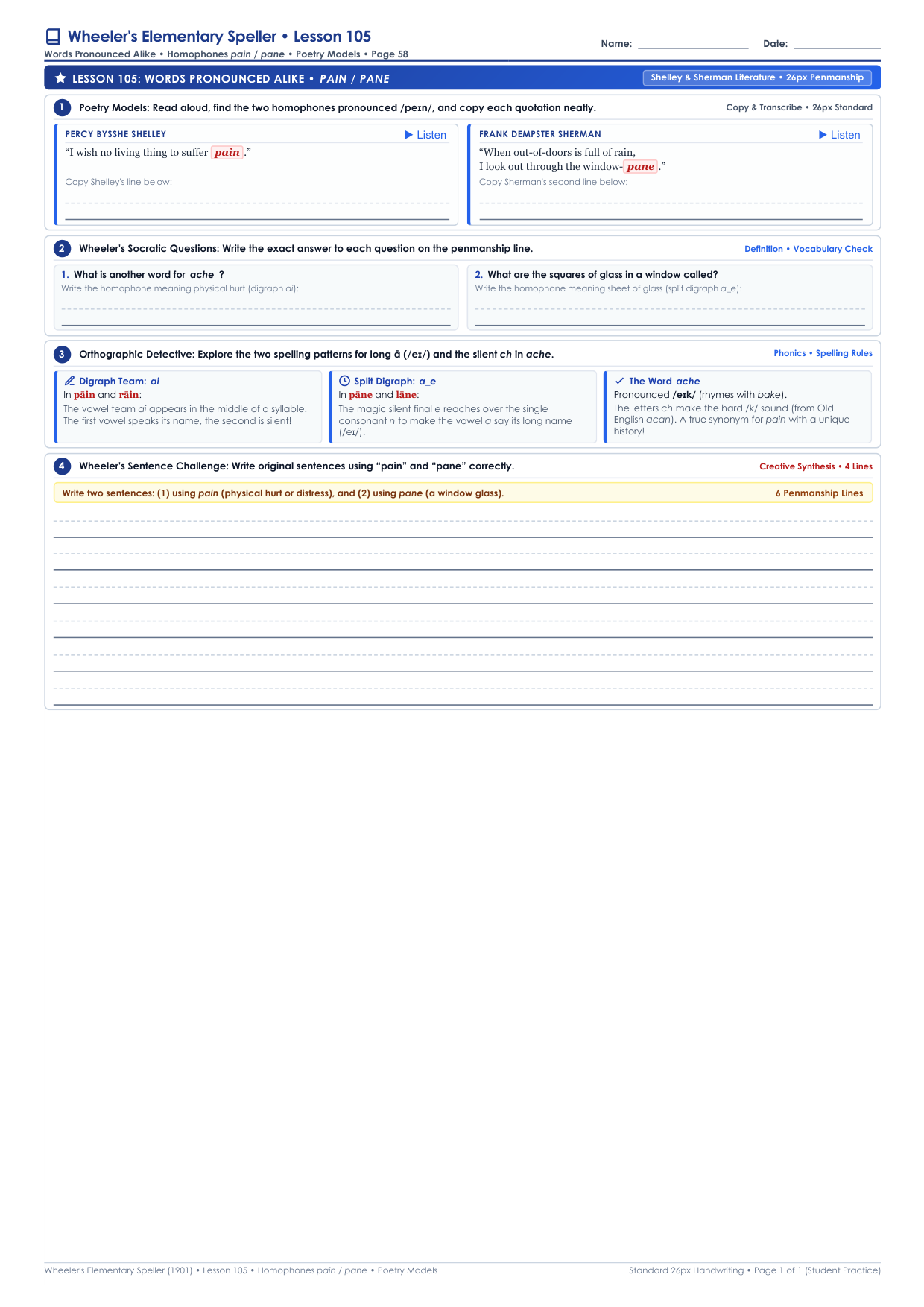
Lesson 105: Homophones Pain & Pane
Orthographic and semantic mastery of homophones pain (/peɪn/, physical ache) and pane (/peɪn/, window plate) featuring literary quotations from Percy B. Shelley and Frank Dempster Sherman with Socratic context synthesis.
Open Student HTML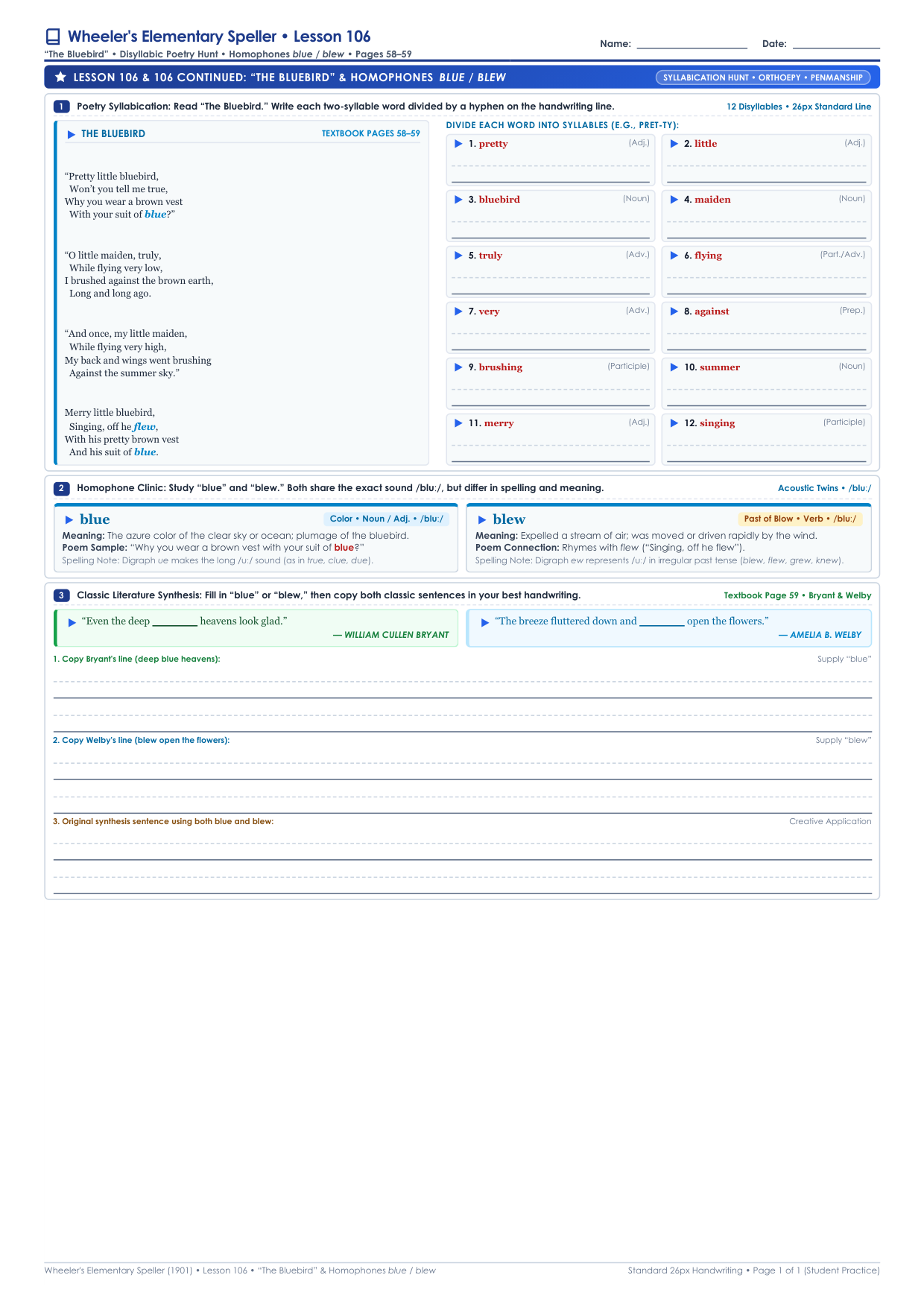
Lesson 106: “The Bluebird” & Homophones Blue / Blew
Nature lyric study featuring 12 disyllables (pretty, little, bluebird, maiden, truly, summer) and orthographic distinction between acoustic twins blue (color) and blew (past of blow) with William Cullen Bryant and Amelia B. Welby quotations.
Open Student HTML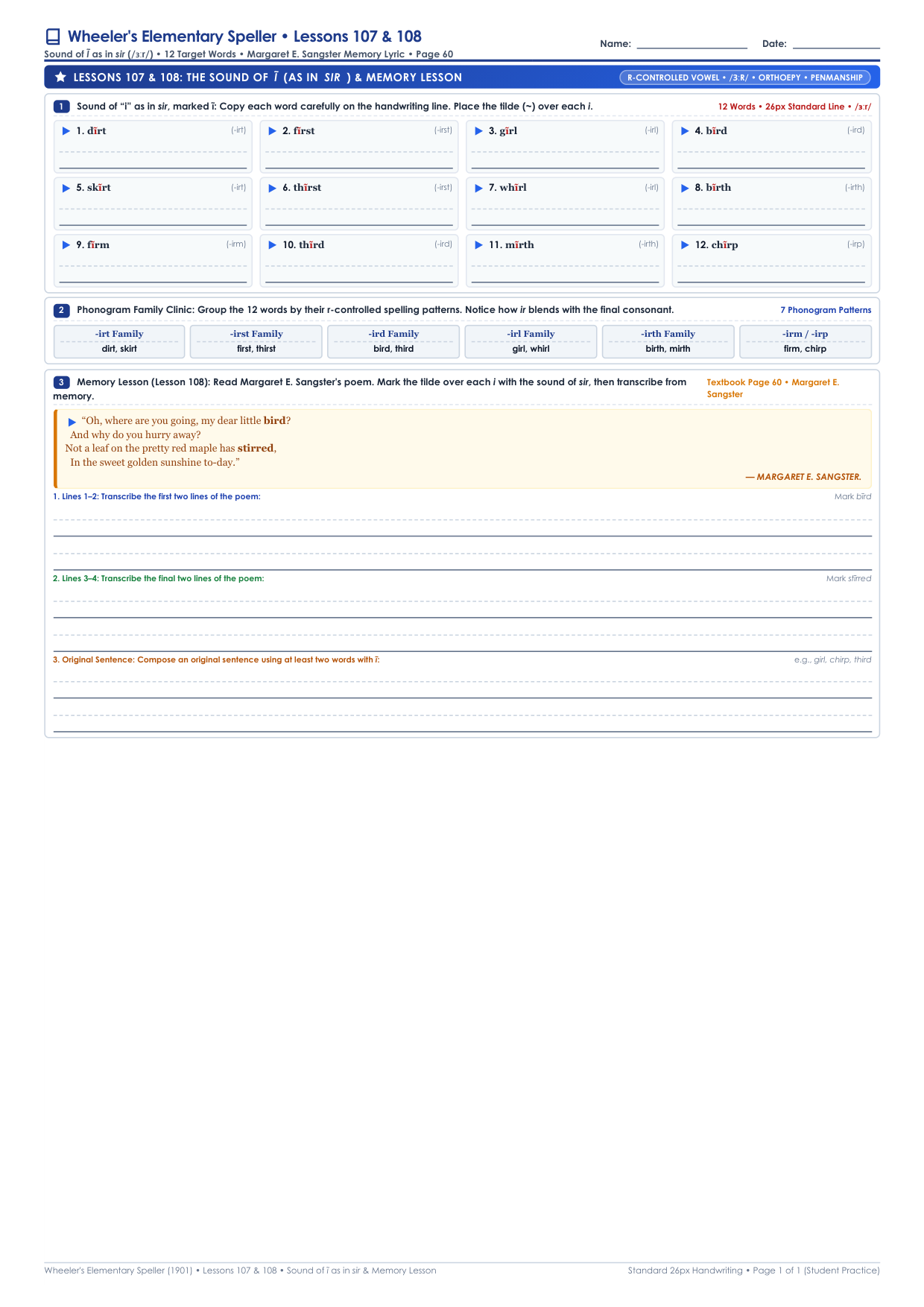
Lesson 107: The Sound of Ĩ (As in Sir)
Mastery of 12 r-controlled target words (dirt, skirt, firm, first, thirst, third, girl, whirl, mirth, bird, birth, chirp) across 7 phonogram families with diacritic tilde marking (ĩ) and 26px handwriting lines.
Open Student HTML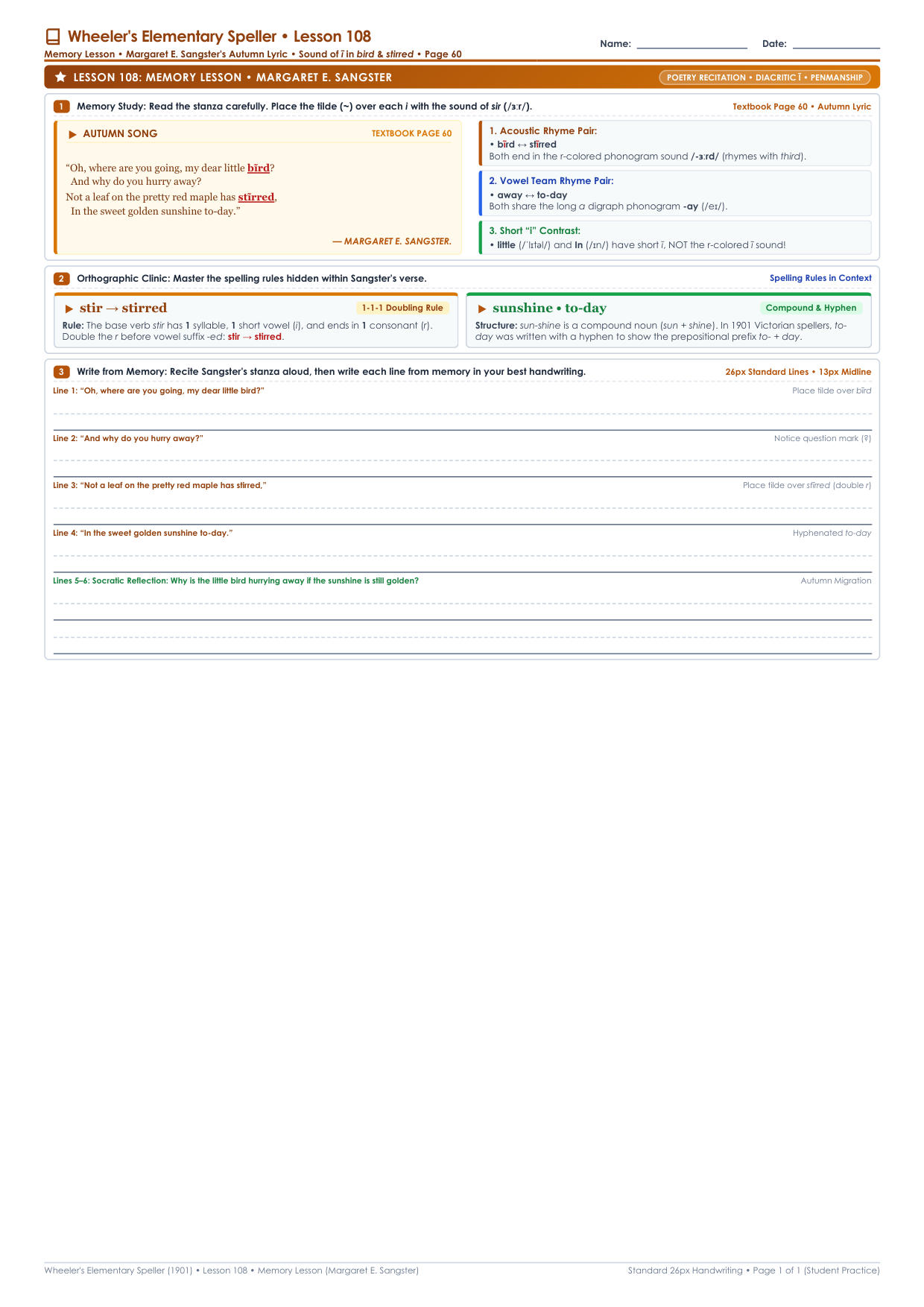
Lesson 108: Memory Lesson (Margaret E. Sangster)
Recitation and verbatim memory penmanship of Margaret E. Sangster's autumn lyric, diacritic tilde marking in bird and stirred, and 1-1-1 consonant doubling rule with 6 handwriting lines.
Open Student HTML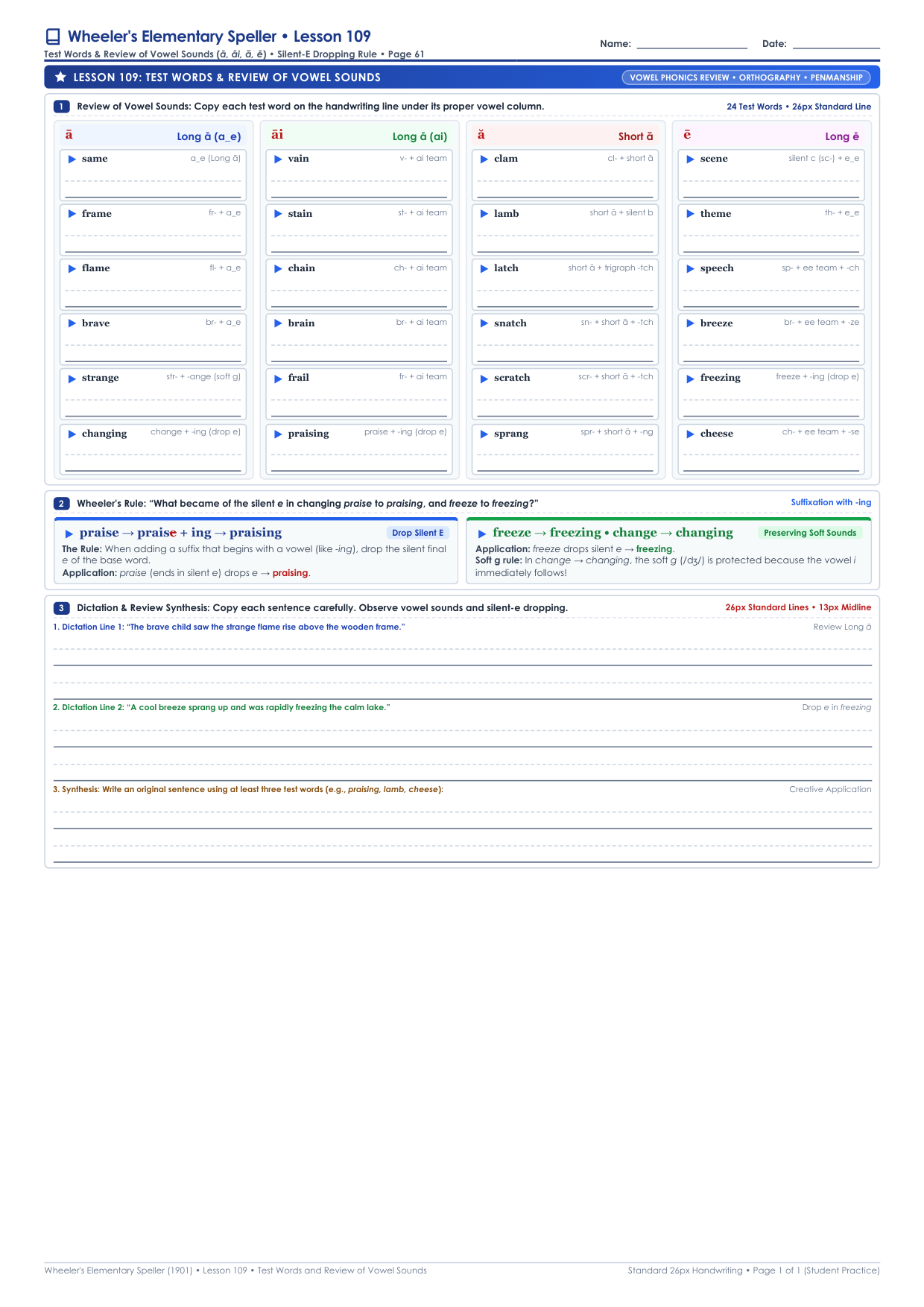
Lesson 109: Test Words & Review of Vowel Sounds
Orthographic review of 24 test words across four vowel categories (ā, āi, ă, ē) and mastery of the universal silent-e dropping rule before vowel suffix -ing with 26px handwriting lines.
Open Student HTML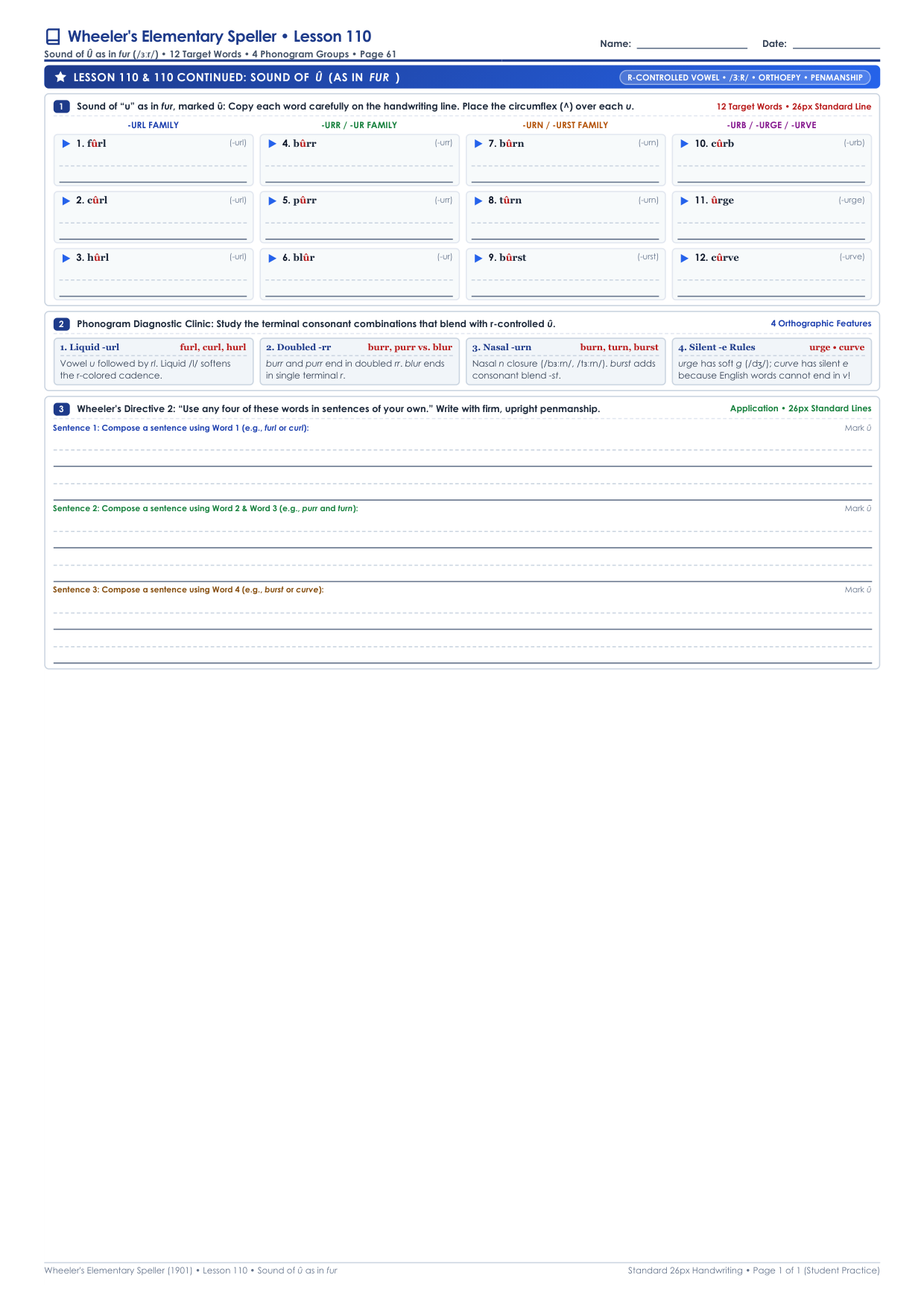
Lesson 110 & 110 Continued: Sound of û as in fur
Phonetic study of r-controlled û (/Ȝːr/) across 12 target words, phonogram clinic (-url, -urr, -urn, -urst, -urb, -urge, -urve), and sentence synthesis on 26px handwriting lines.
Open Student HTML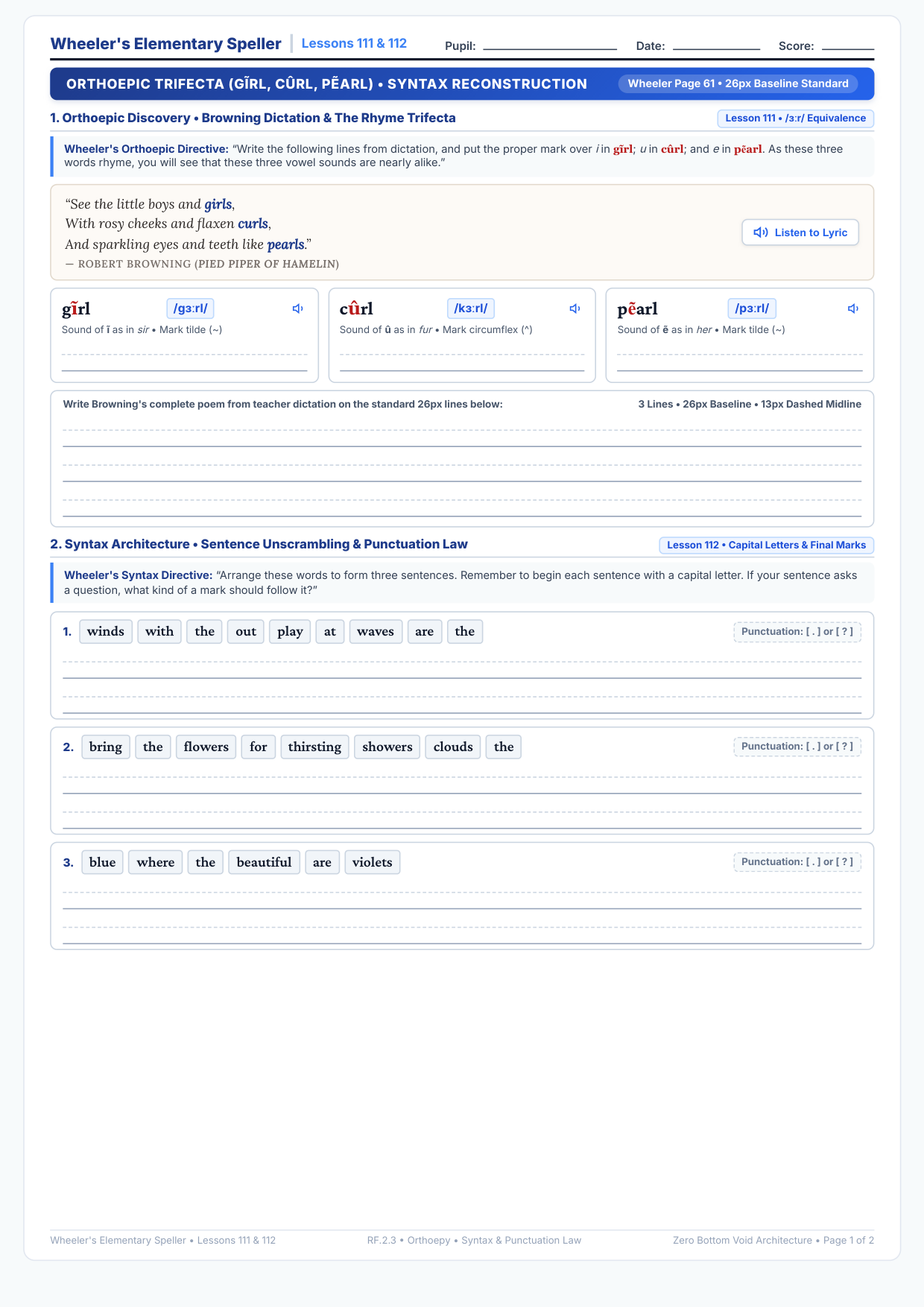
Lesson 111: Robert Browning Lyric & The /ɜːr/ Trifecta
Robert Browning classic lyric from Pied Piper, dictation copywork, orthoepic equivalence of gĩrl, cûrl, and pẽarl (/ɜːr/), and descriptive imagery study.
Open Student HTML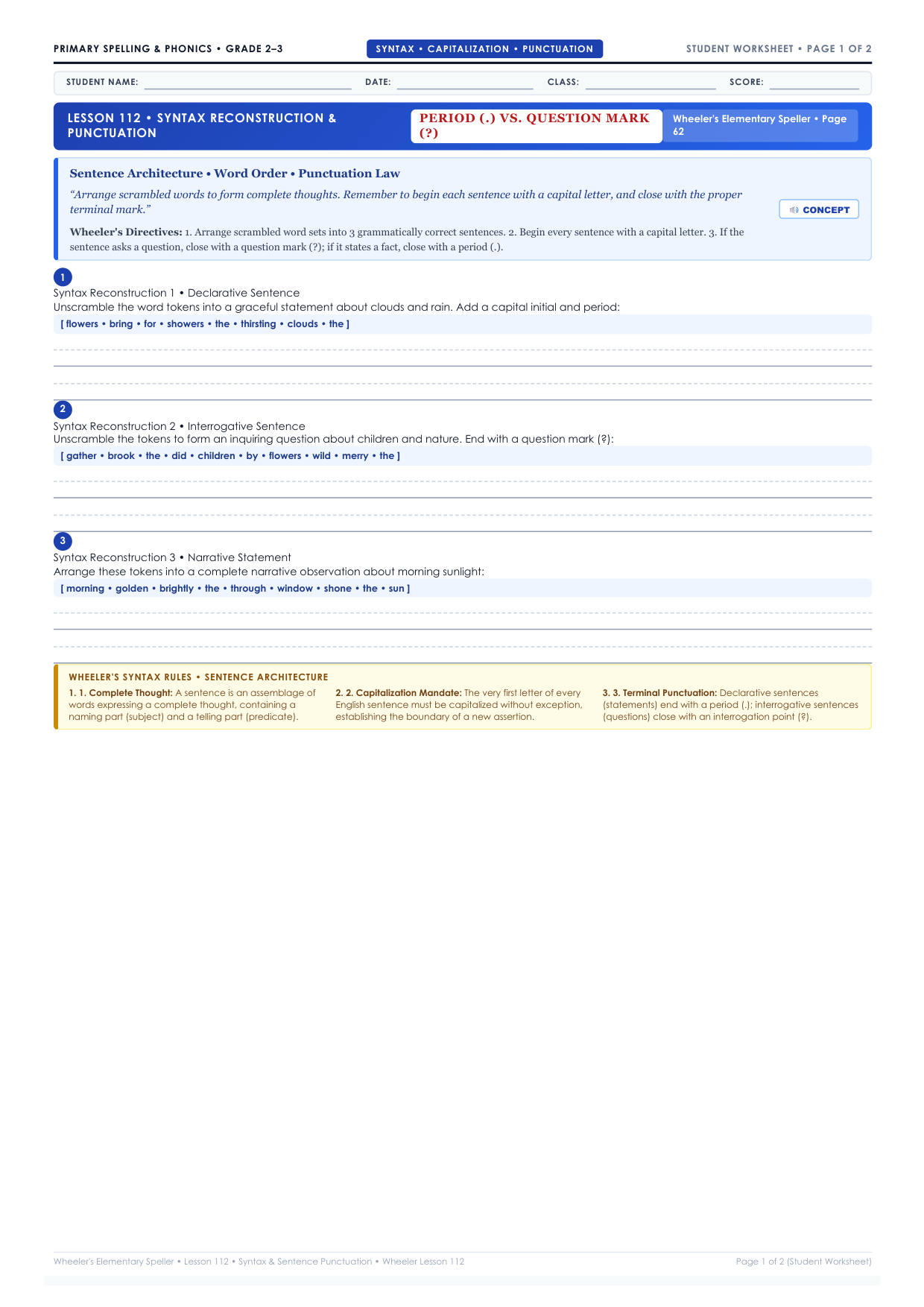
Lesson 112: Syntax Reconstruction & Punctuation
Scrambled sentence architecture, capital letters, distinguishing declarative statements (period .) from interrogative questions (question mark ?).
Open Student HTML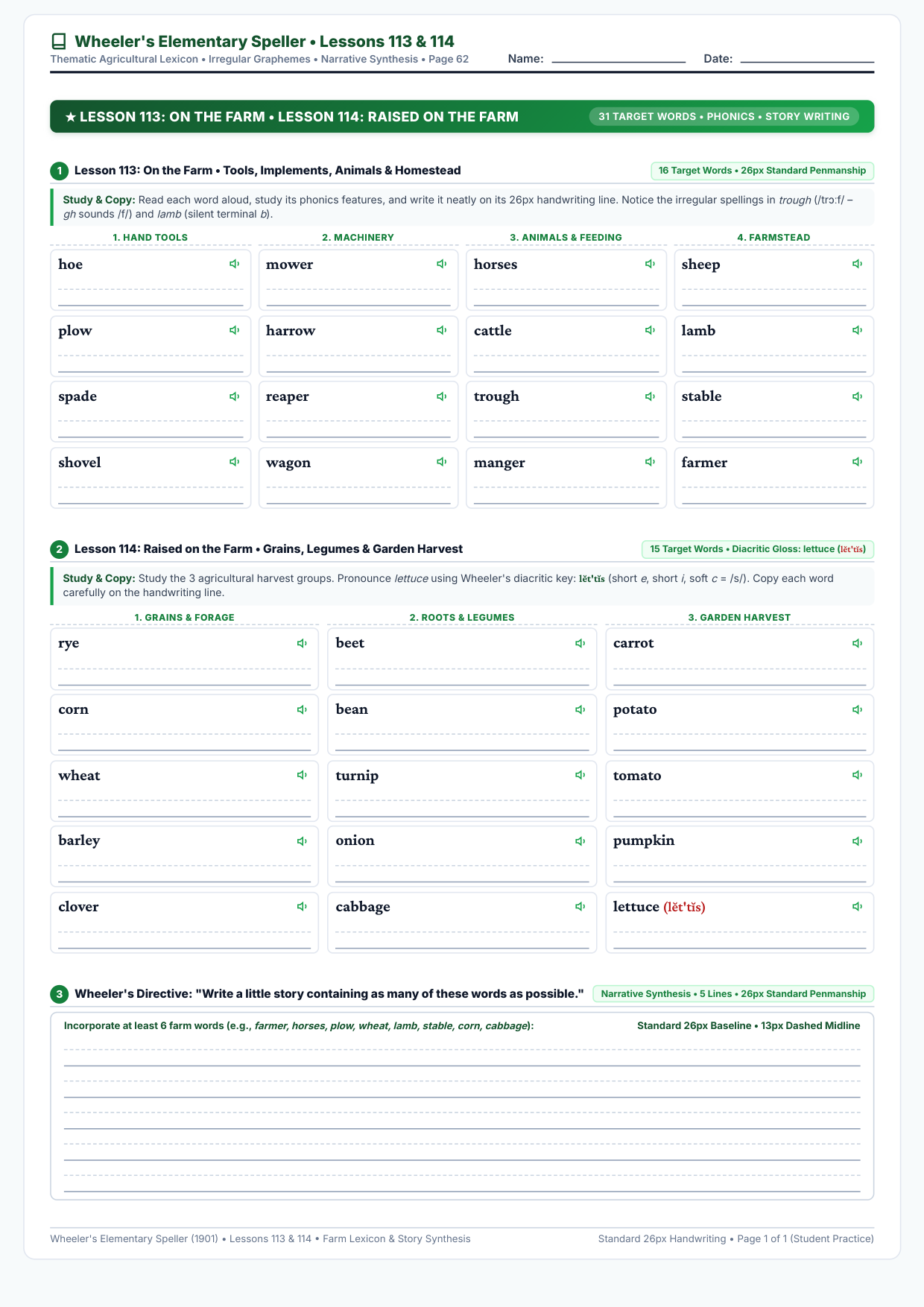
Lesson 113: On the Farm & Agricultural Equipment
16 homestead terms (farmer, stable, horses, cattle, sheep, lamb, wagon, plow, spade, shovel, trough), silent b in lamb, and gh = /f/ in trough.
Open Student HTML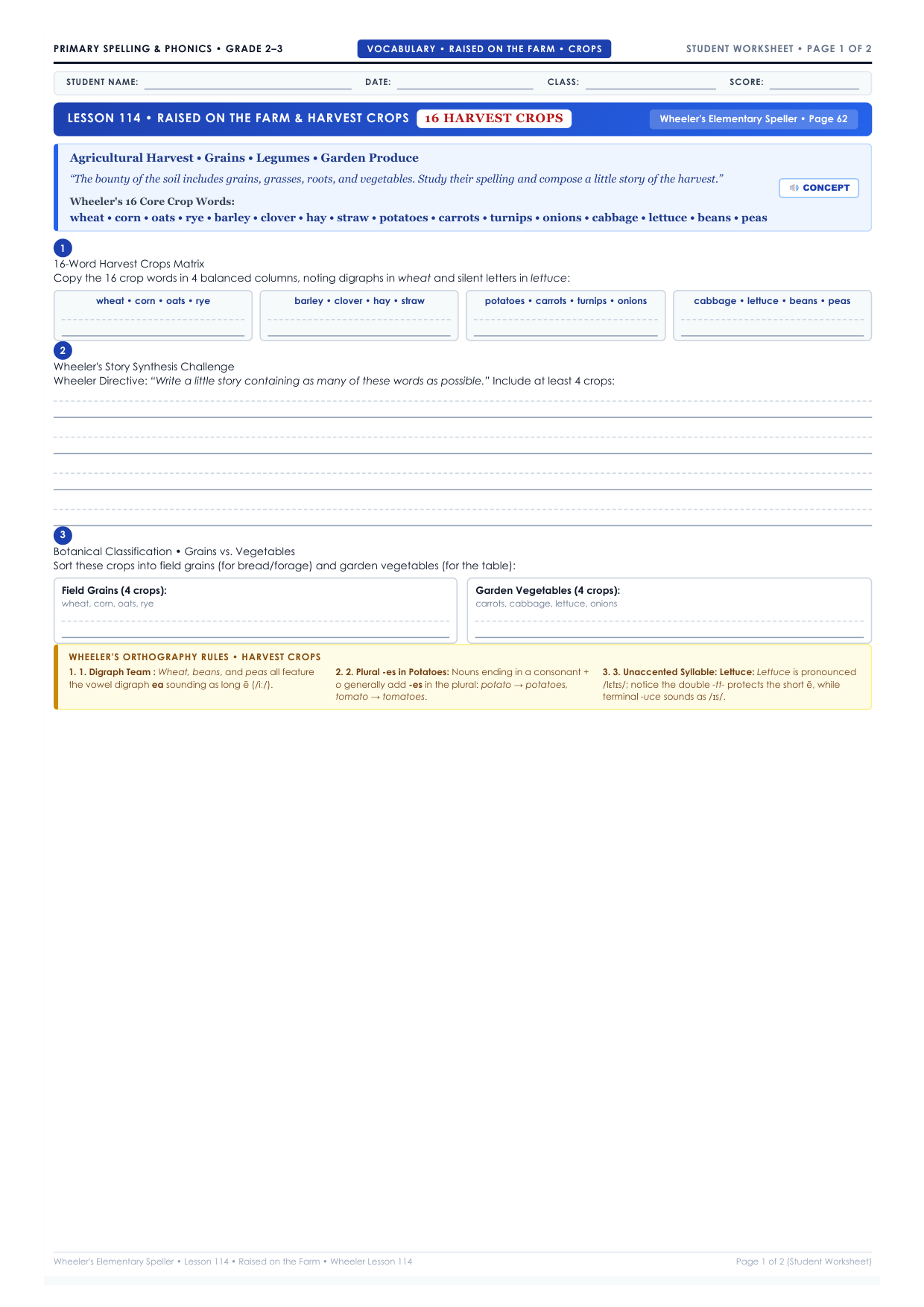
Lesson 114: Raised on the Farm & Harvest Crops
16 harvest crops (wheat, corn, oats, rye, barley, clover, potatoes, carrots, cabbage, lettuce), Wheeler's creative story synthesis, and field grain sorting.
Open Student HTML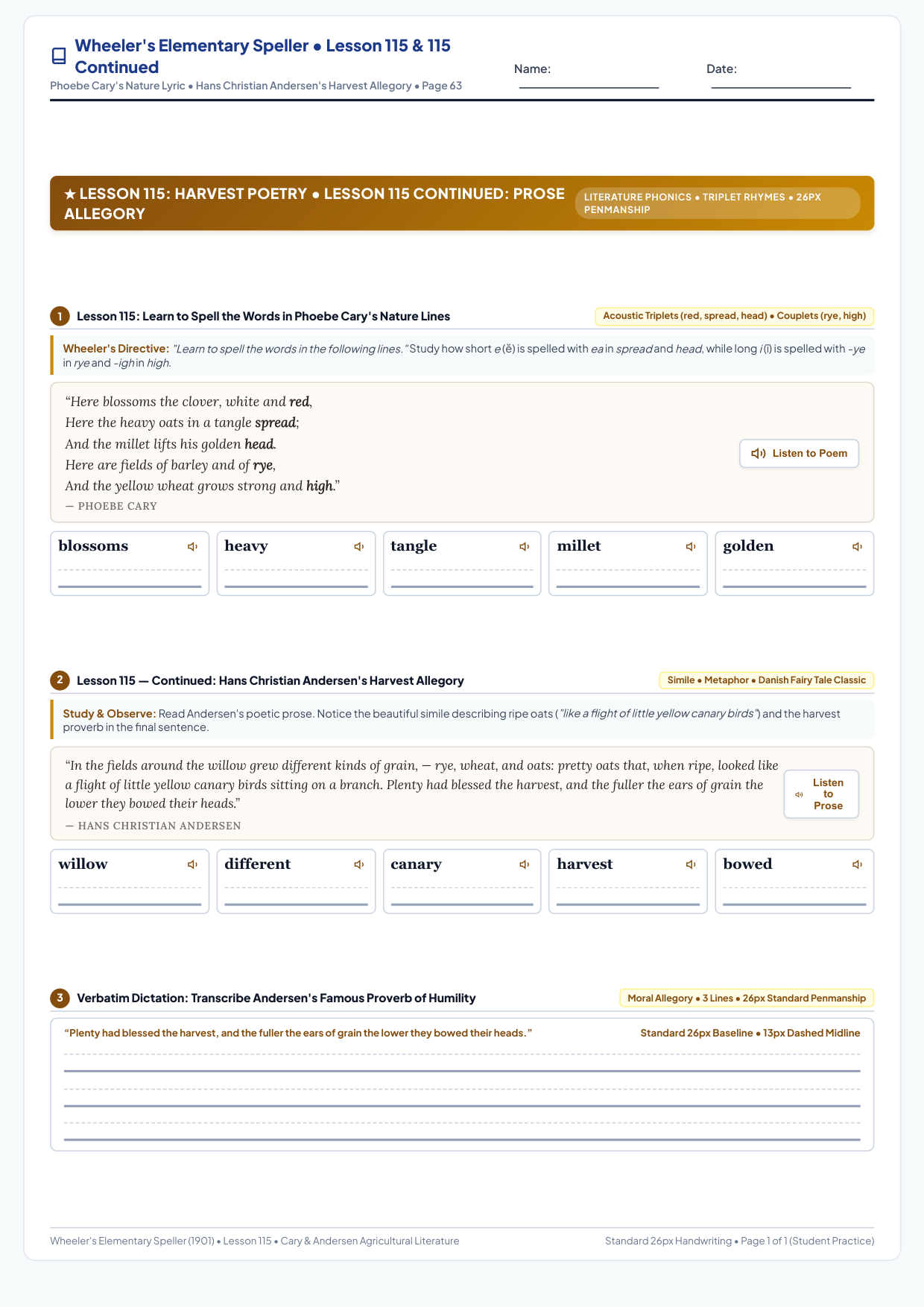
Lesson 115: Agricultural Poetry & Harvest Allegory
Literary phonics study of Phoebe Cary's nature lyric (acoustic triplet rhymes red, spread, head; couplets rye, high) and Hans Christian Andersen's harvest humility allegory with verbatim dictation on 26px handwriting lines.
Open Student HTML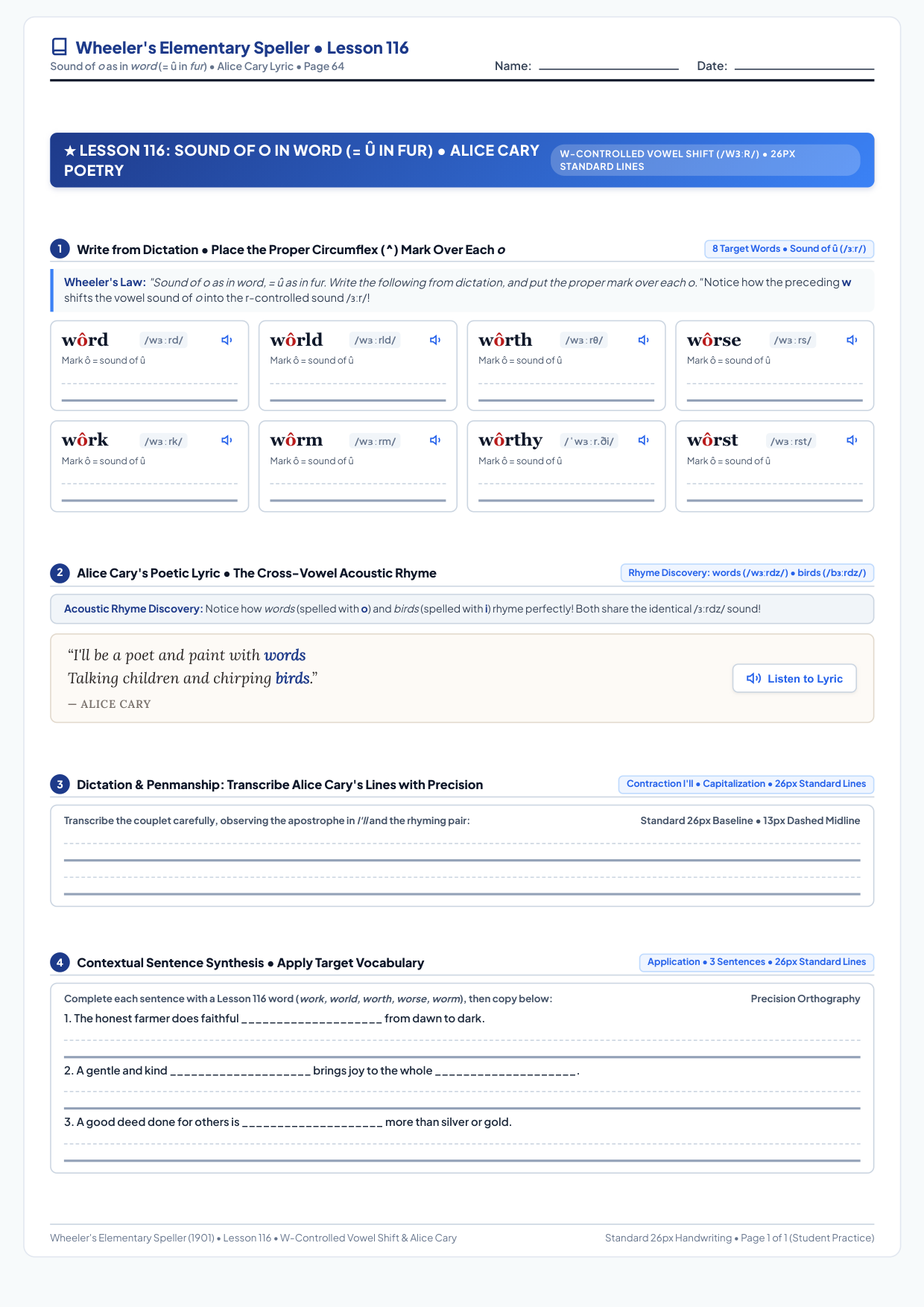
Lesson 116: Sound of O in Word (= Û in Fur) • Alice Cary Lyric
Wheeler's orthoepic study of the /w/-controlled vowel shift (/wɜːr/) across 8 target words (word, world, worth, worse, work, worm, worthy, worst), cross-vowel rhyme discovery with Alice Cary's lyric (words / birds), and contextual sentence synthesis on standard 26px handwriting lines.
Open Student HTML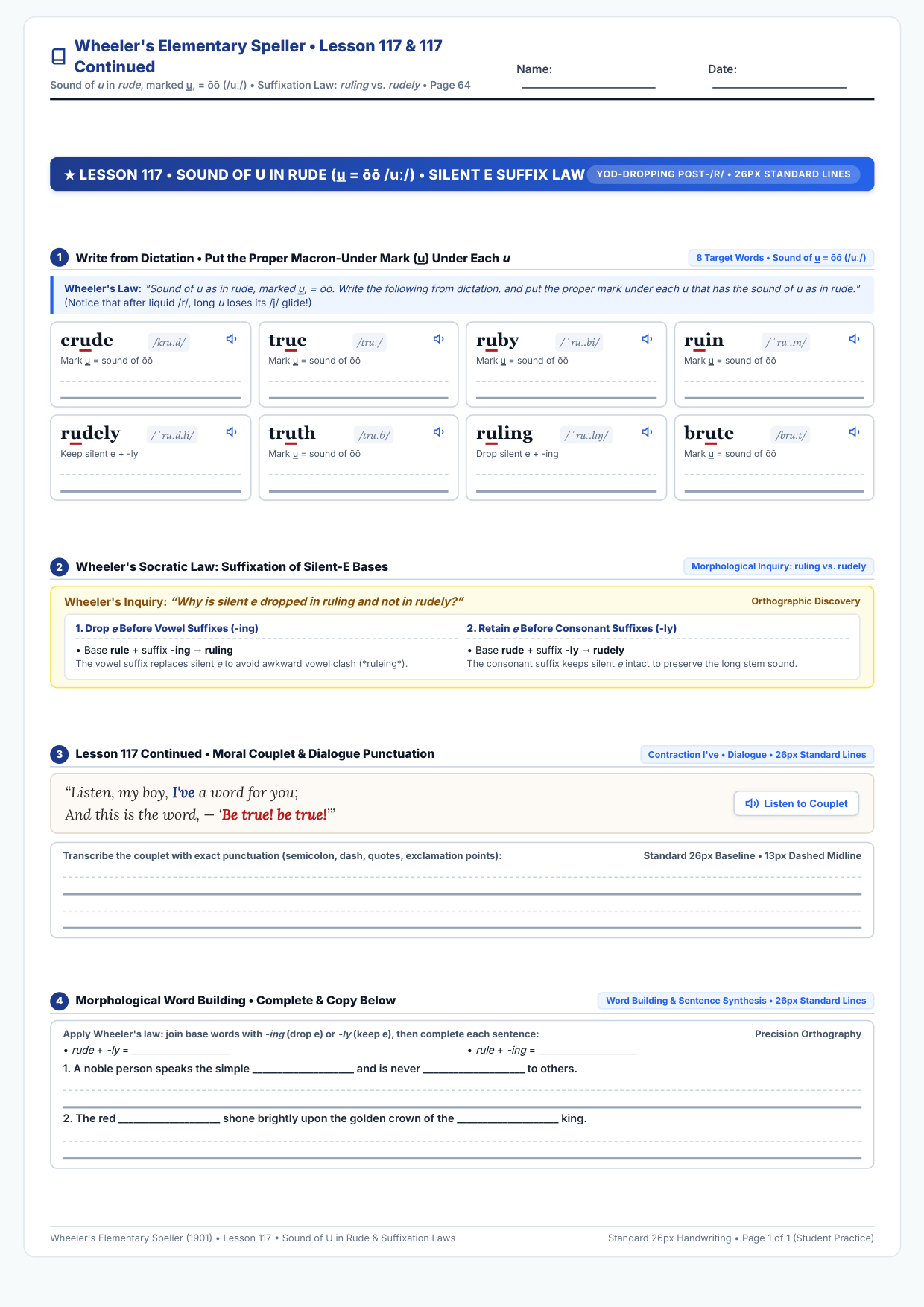
Lesson 117: Sound of U in Rude & Suffixation Law
Orthoepic study of liquid-conditioned yod-dropping post-/r/ across 8 target words (crude, true, ruby, ruin, rudely, truth, ruling, brute), Wheeler's Socratic silent-e suffix law (ruling vs. rudely), and transcription of the moral couplet on standard 26px handwriting lines.
Open Student HTML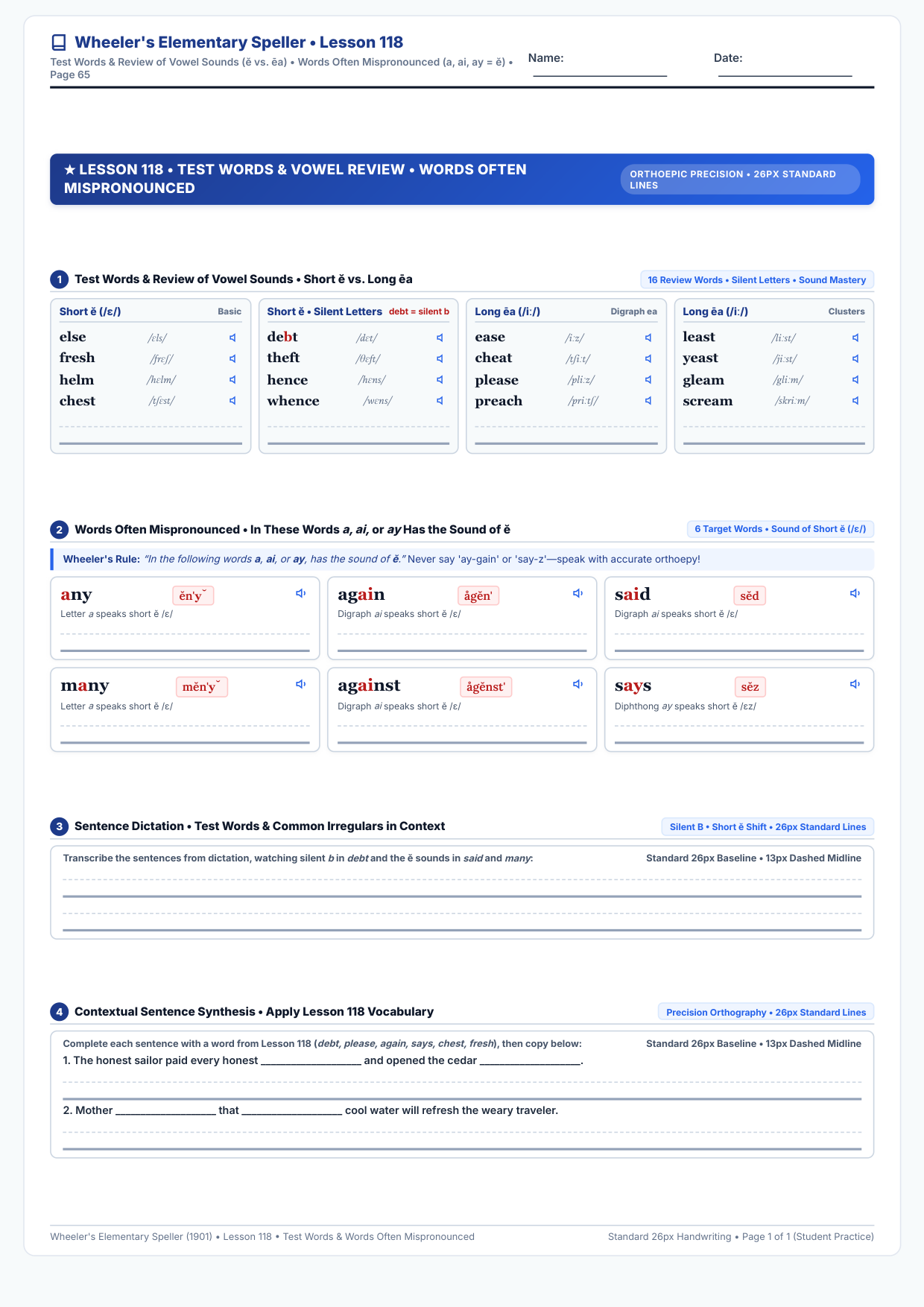
Lesson 118: Test Words • Words Often Mispronounced
Orthoepic mastery across 22 words: short ĕ vs. long ēa review, silent-b etymology in debt, and Wheeler's clinic on irregular short-ĕ shifts in any, many, said, says, again, against, with dictation on standard 26px handwriting lines.
Open Student HTML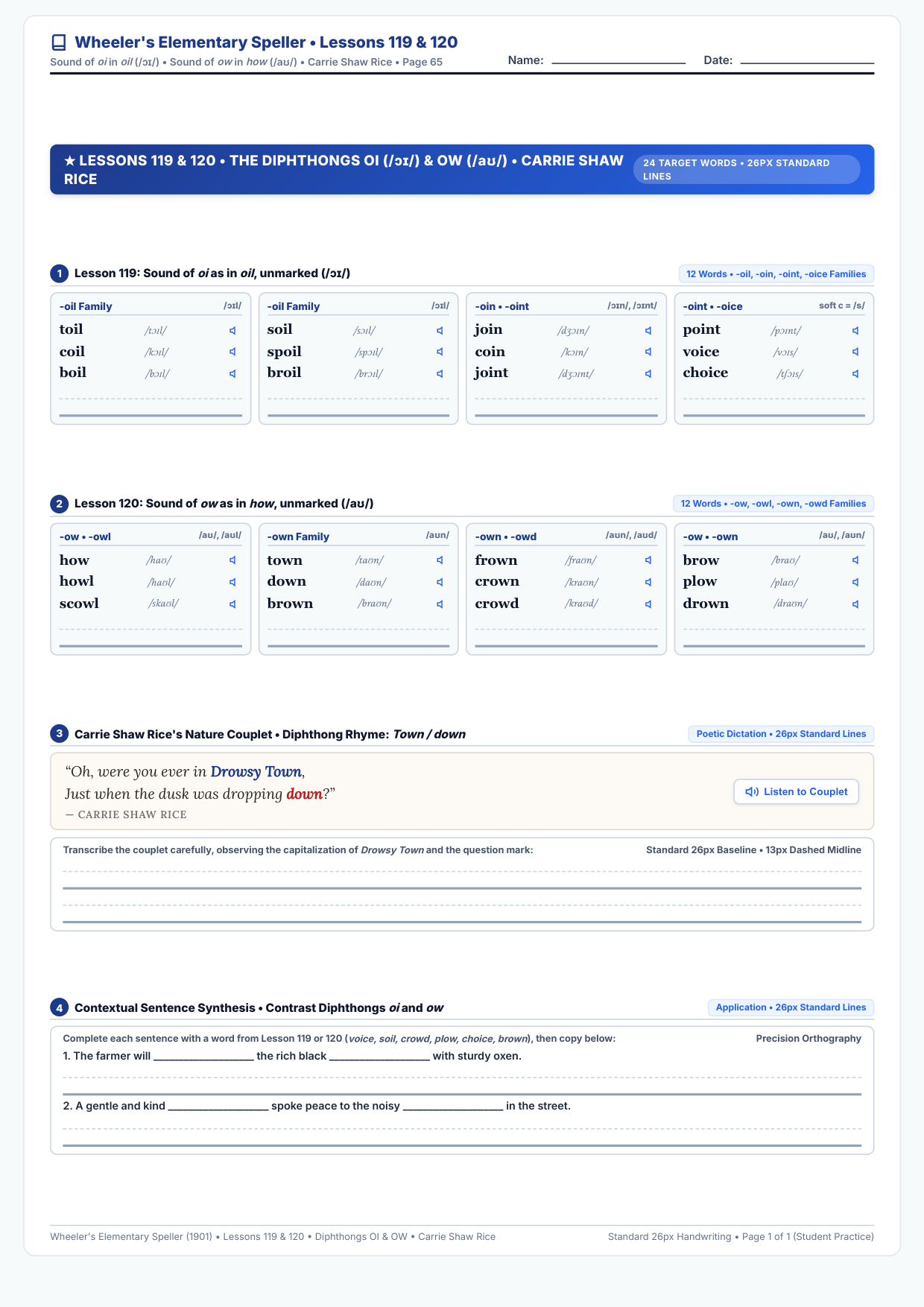
Lesson 119: Sound of OI as in Oil (/ɔɪ/)
12 core words with diphthong oi (toil, soil, join, point, coil, spoil, coin, voice, boil, broil, joint, choice), rime families, and soft c in voice.
Open Student HTML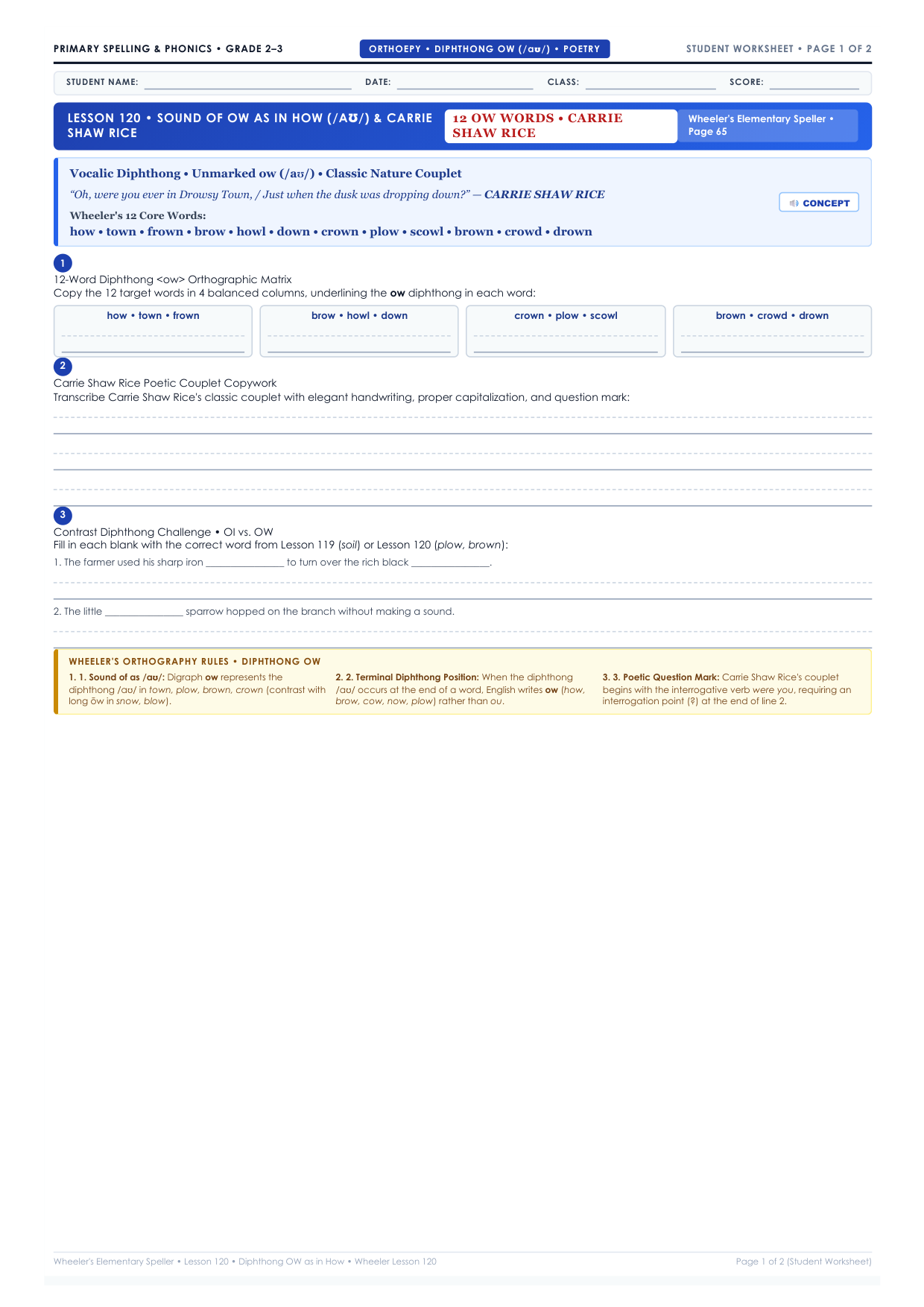
Lesson 120: Sound of OW as in How (/aʊ/) & Carrie Shaw Rice
12 diphthong ow words (how, town, frown, brow, howl, down, crown, plow, scowl, brown), Carrie Shaw Rice classic nature poetry copywork, and diphthong contrasts.
Open Student HTML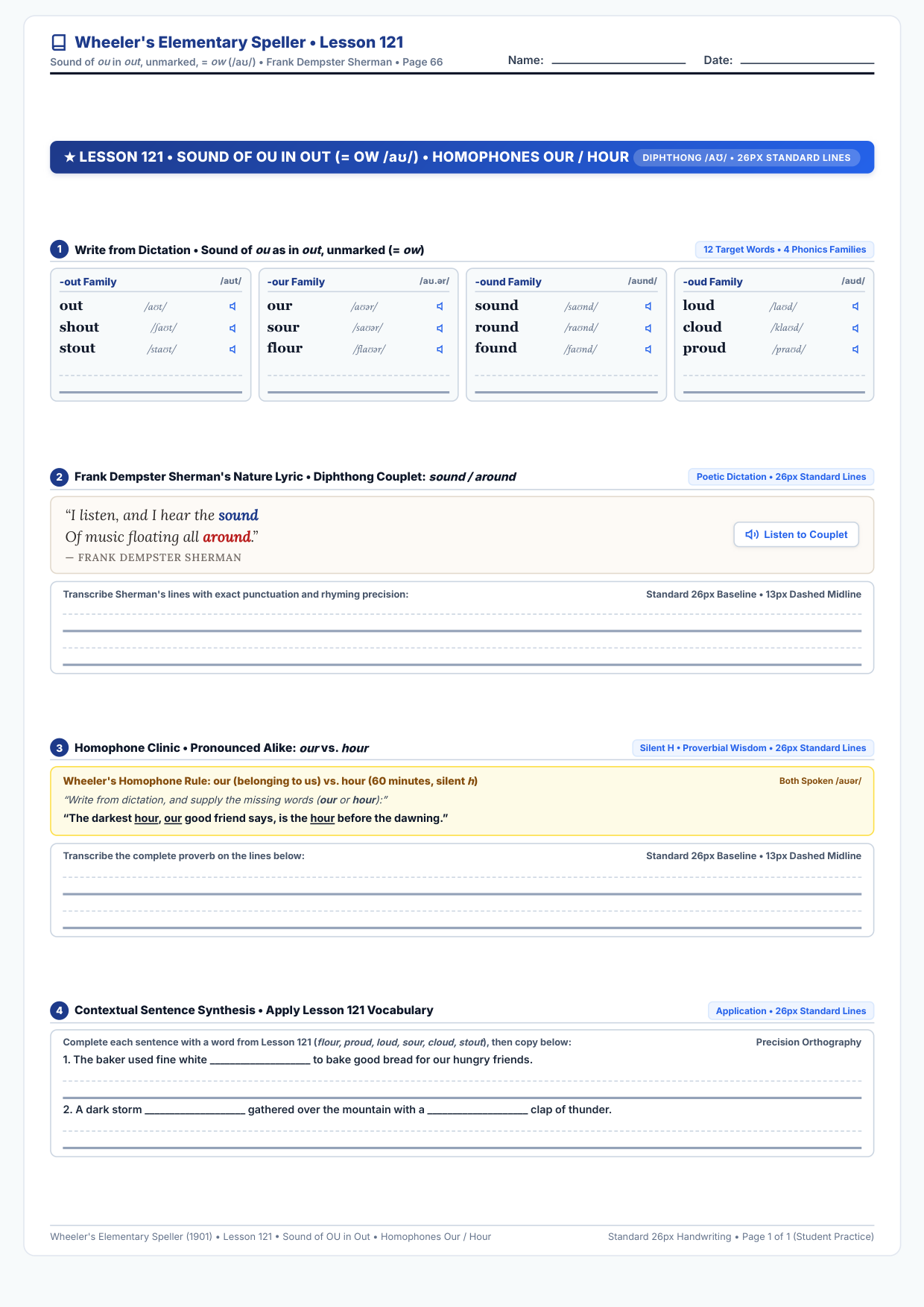
Lesson 121: Sound of OU in Out • Homophones Our / Hour
Phonetic study of internal diphthong ou (/aʊ/) across 12 words (out, shout, stout, our, sour, flour, sound, round, found, loud, cloud, proud), Frank Dempster Sherman lyric transcription, and our / hour homophone discrimination on standard 26px handwriting lines.
Open Student HTML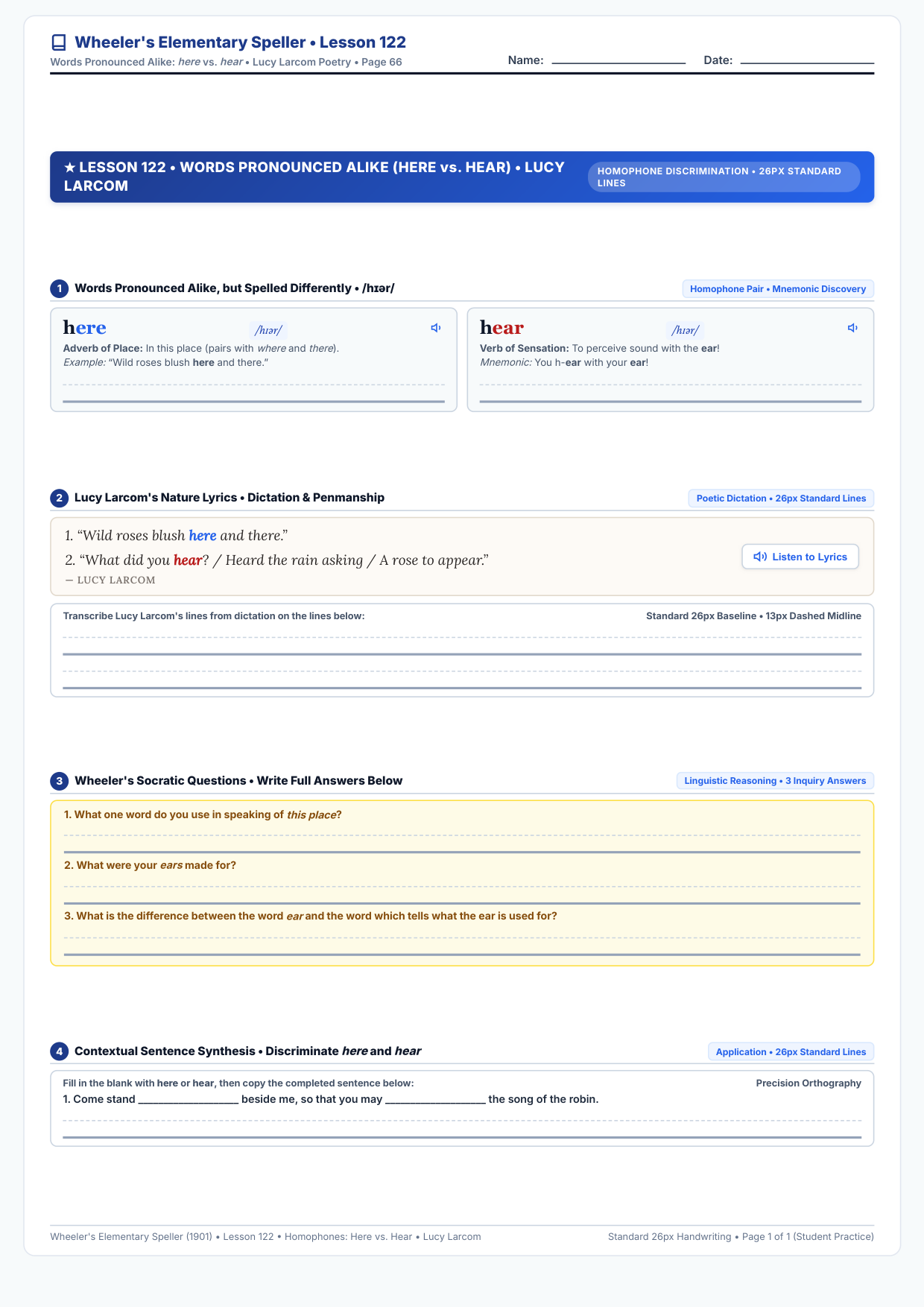
Lesson 122: Homophones: Here vs. Hear • Lucy Larcom
Orthoepic discrimination between homophones here (/hɪər/, place) and hear (/hɪər/, auditory organ), transcription of Lucy Larcom's nature lyrics, and Wheeler's Socratic questions on standard 26px handwriting lines.
Open Student HTML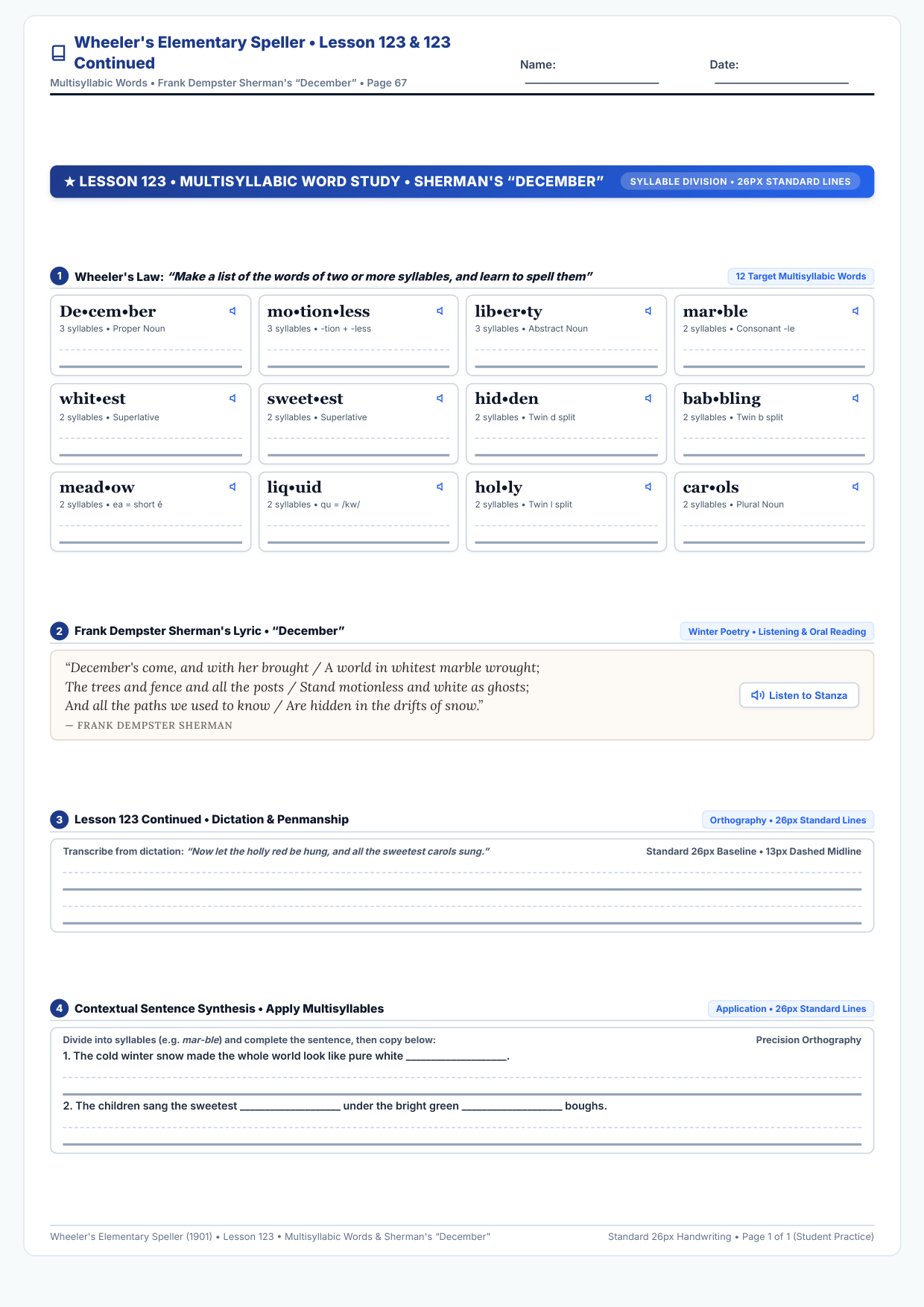
Lesson 123: Multisyllabic Study • "December"
Syllabication rules for 2- and 3-syllable vocabulary (De•cem•ber, mo•tion•less, lib•er•ty, mar•ble), twin consonant splitting, and poetic dictation from Frank Dempster Sherman's "December".
Open Student HTML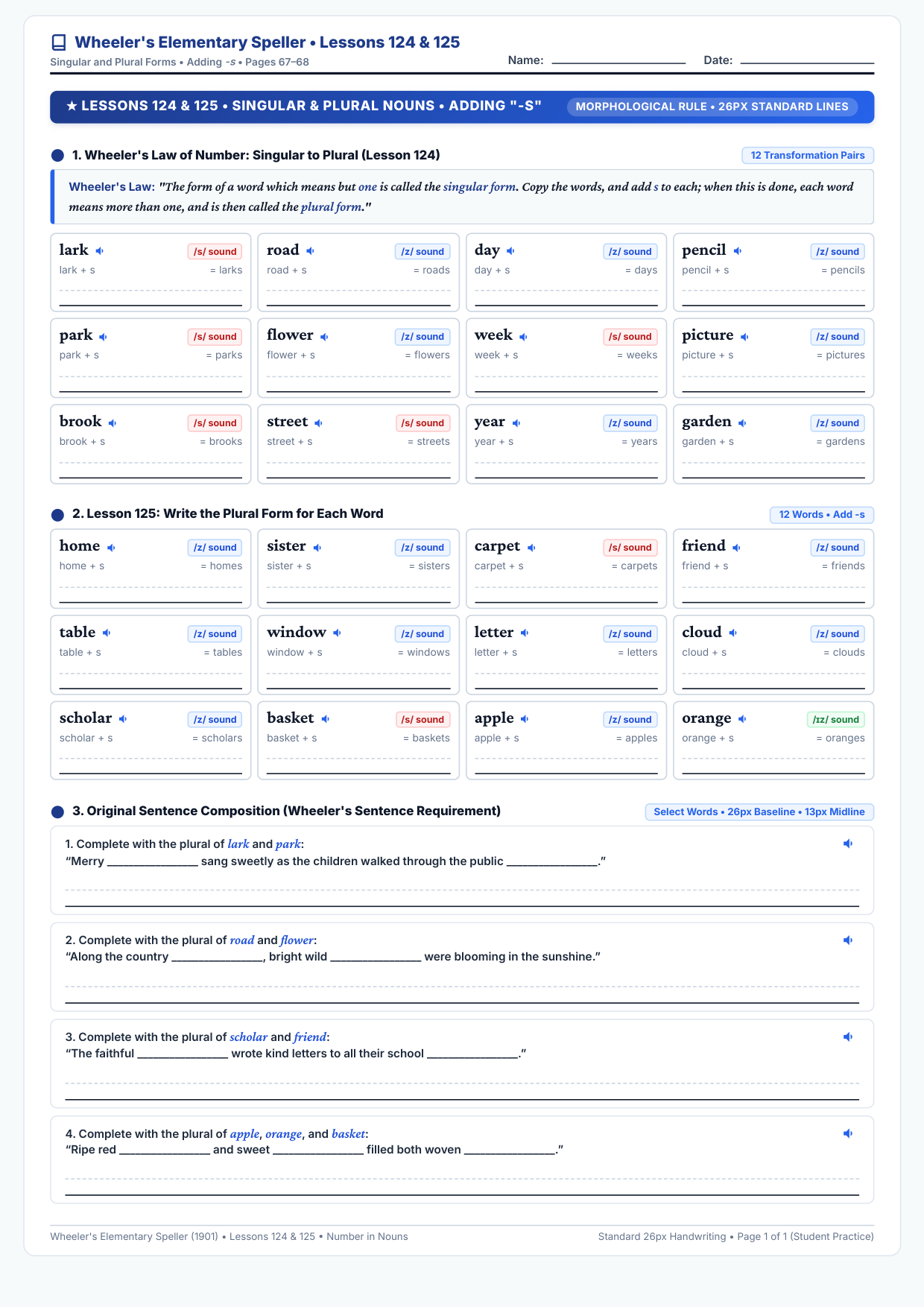
Lesson 124: Singular and Plural Nouns: Adding -S
12 noun pairs (lark/larks, road/roads, flower/flowers, street/streets), Wheeler's law of grammatical number, and allomorph audition (/s/ vs. /z/).
Open Student HTML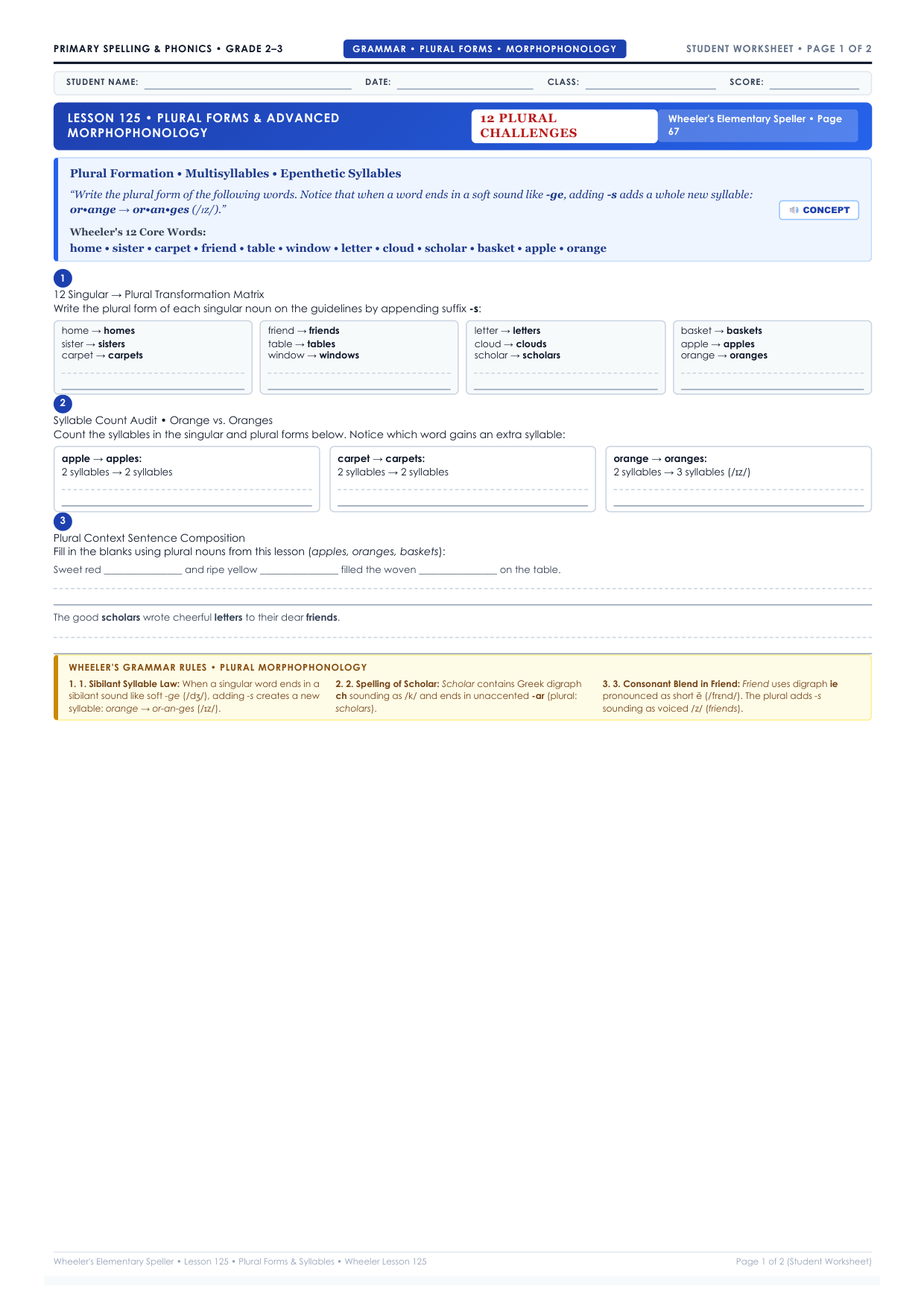
Lesson 125: Plural Forms & Advanced Morphophonology
12 multisyllabic noun transformations (homes, sisters, carpets, friends, tables, windows, scholars, baskets, apples, oranges), and the epenthetic extra syllable /ɪz/.
Open Student HTML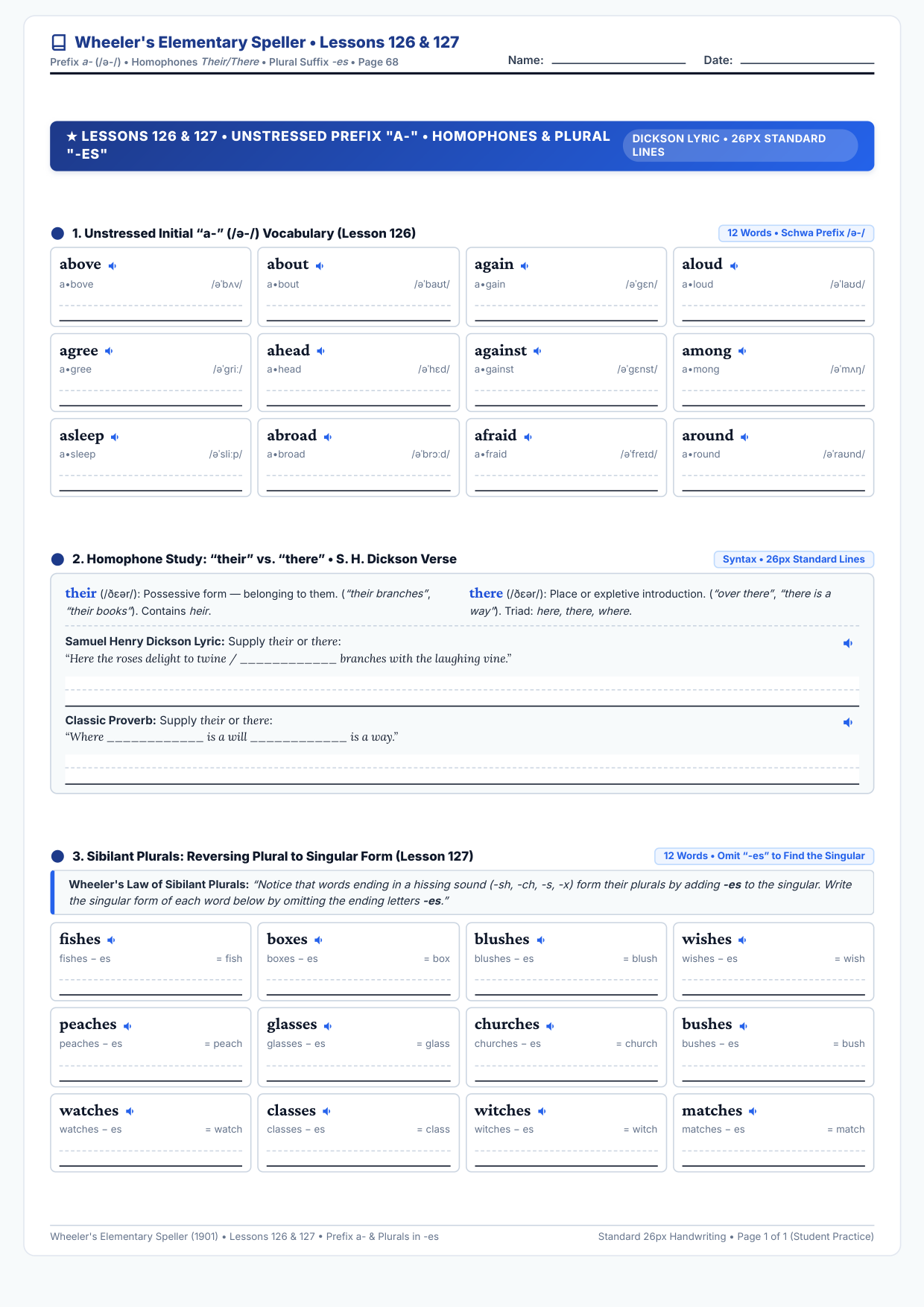
Lesson 126: Unstressed Prefix A- & Homophones Their / There
12 words with unaccented Anglo-Saxon prefix a- (above, about, again, aloud, agree, ahead, asleep, abroad, around), and homophone discrimination (their / there).
Open Student HTML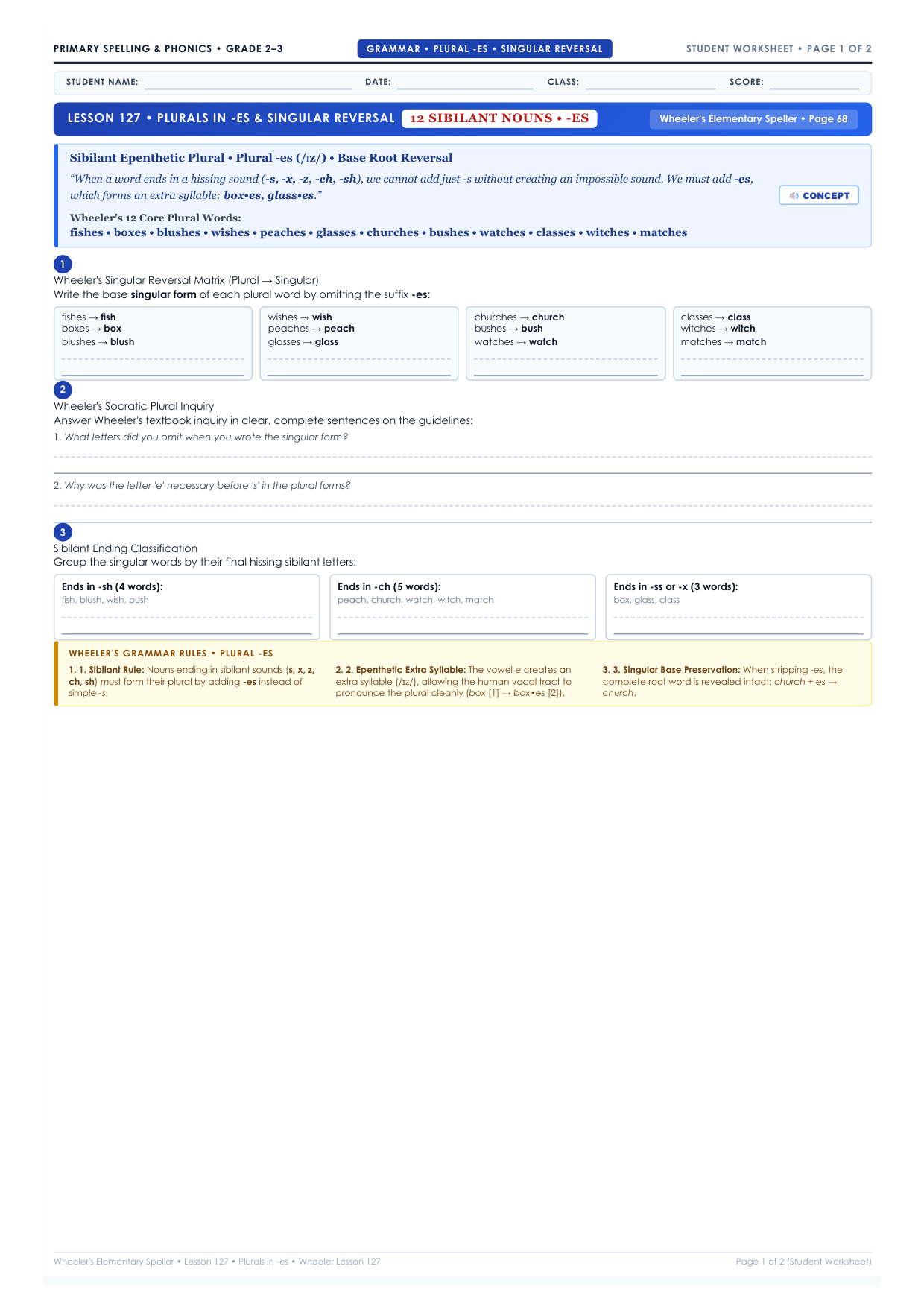
Lesson 127: Plurals in -ES & Singular Reversal
12 sibilant plural nouns (fishes, boxes, blushes, wishes, peaches, glasses, churches, bushes, watches, classes), Wheeler's singular reversal, and sibilant ending rules.
Open Student HTML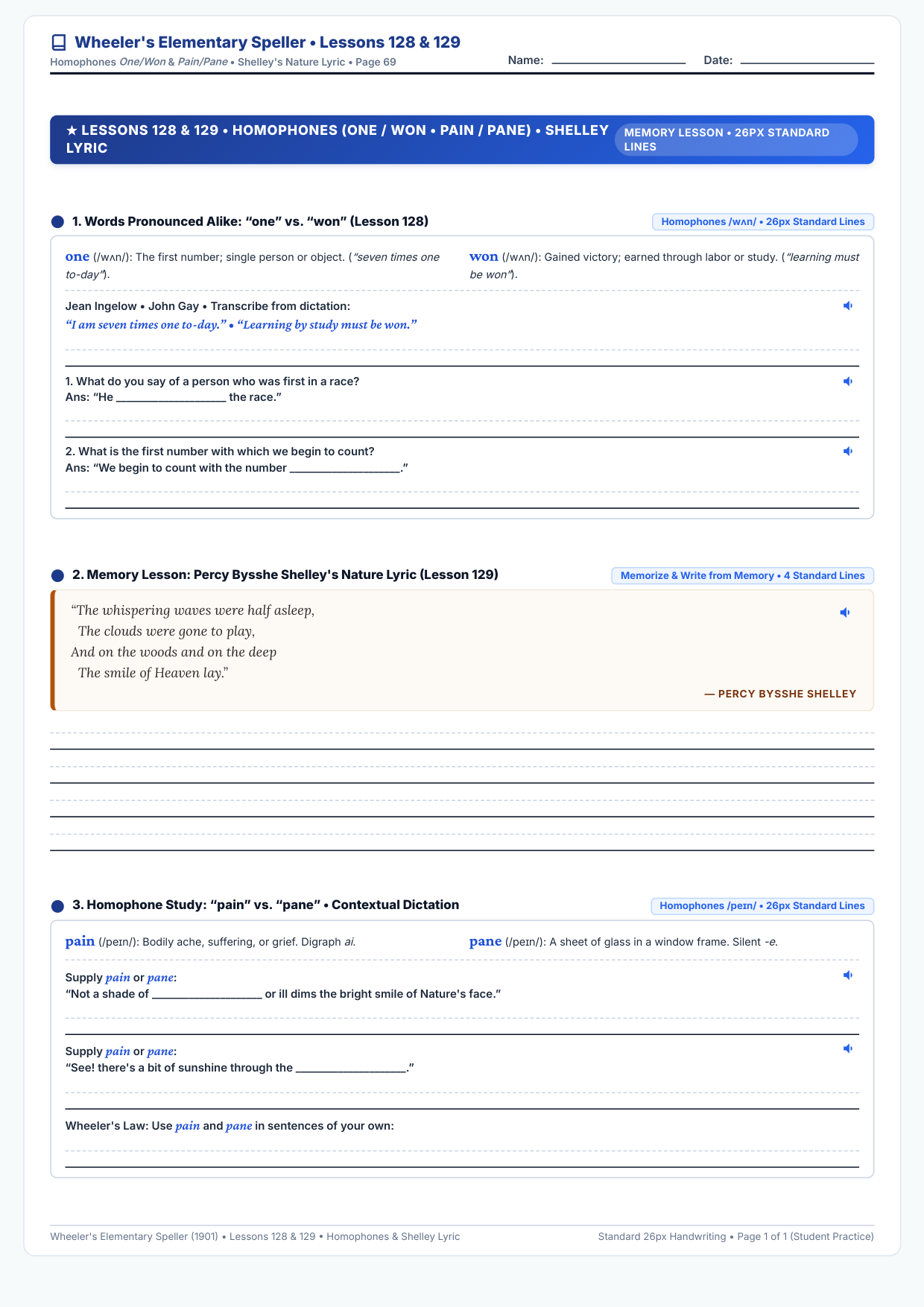
Lesson 128: Words Pronounced Alike: one vs. won
Orthographic contrast of /wʌn/, unique initial labial glide in one (Old English ān), strong verb mutation in won, and cloze mastery.
Open Student HTML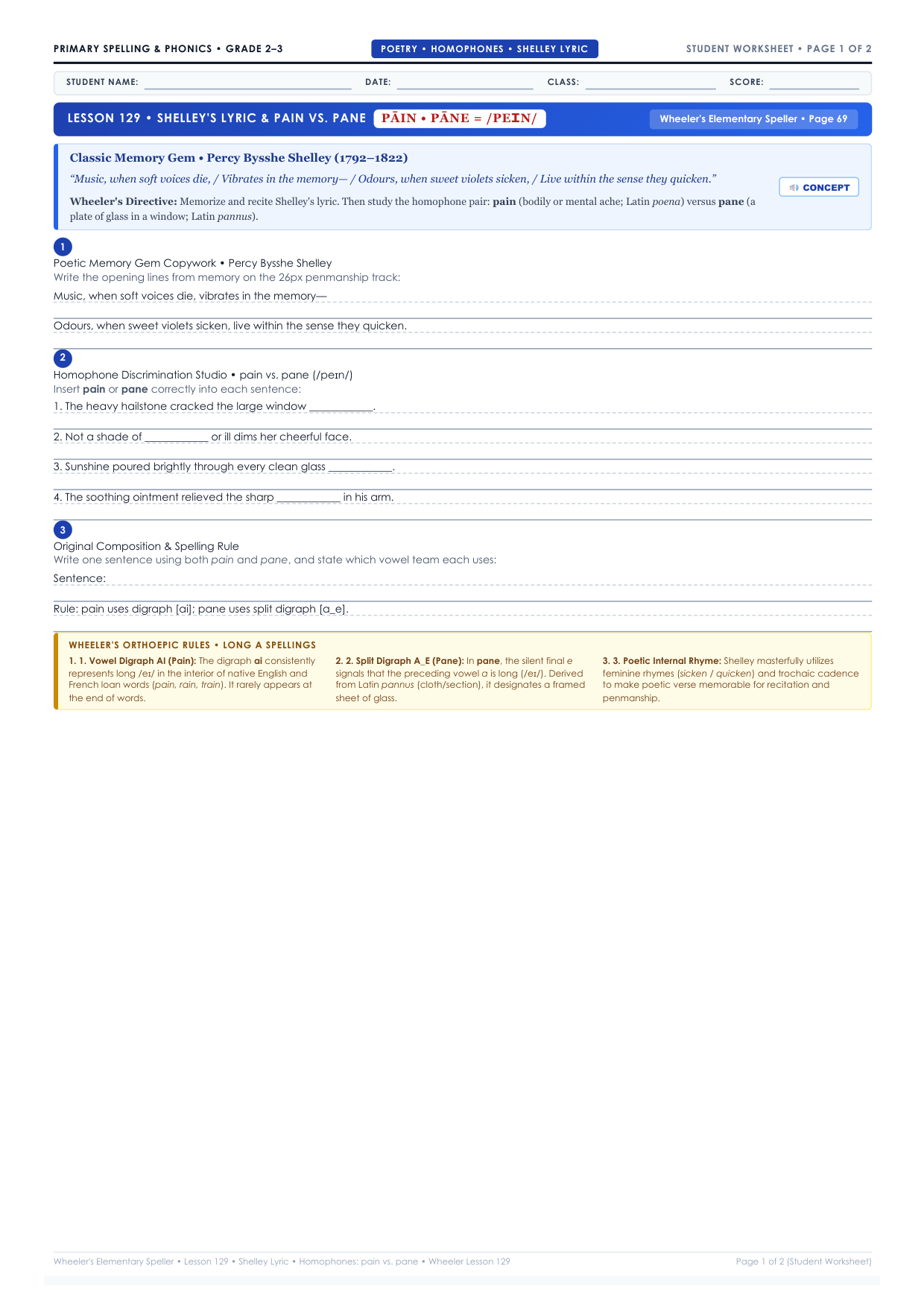
Lesson 129: Shelley's Lyric & pain vs. pane
Percy Bysshe Shelley classic memory lyric, recitation copywork, and homophone discrimination between pain (digraph ai) and pane (split digraph a_e).
Open Student HTML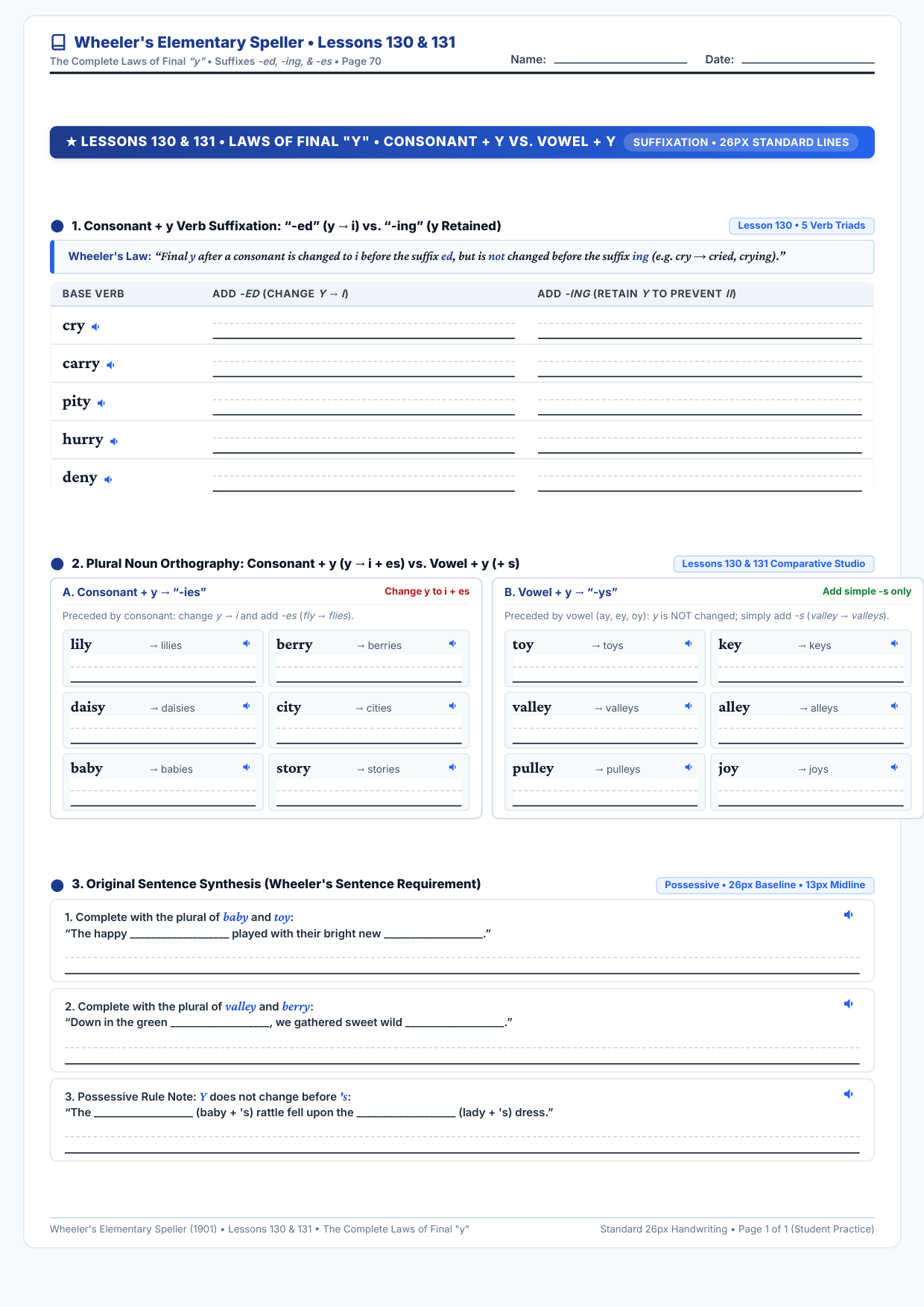
Lesson 130: The Laws of Final Y (Consonant + Y)
Cardinal orthographic rule: changing y to i before suffixes (-ed, -es), the -ing exception protecting against double ii, and plural nouns in -ies.
Open Student HTML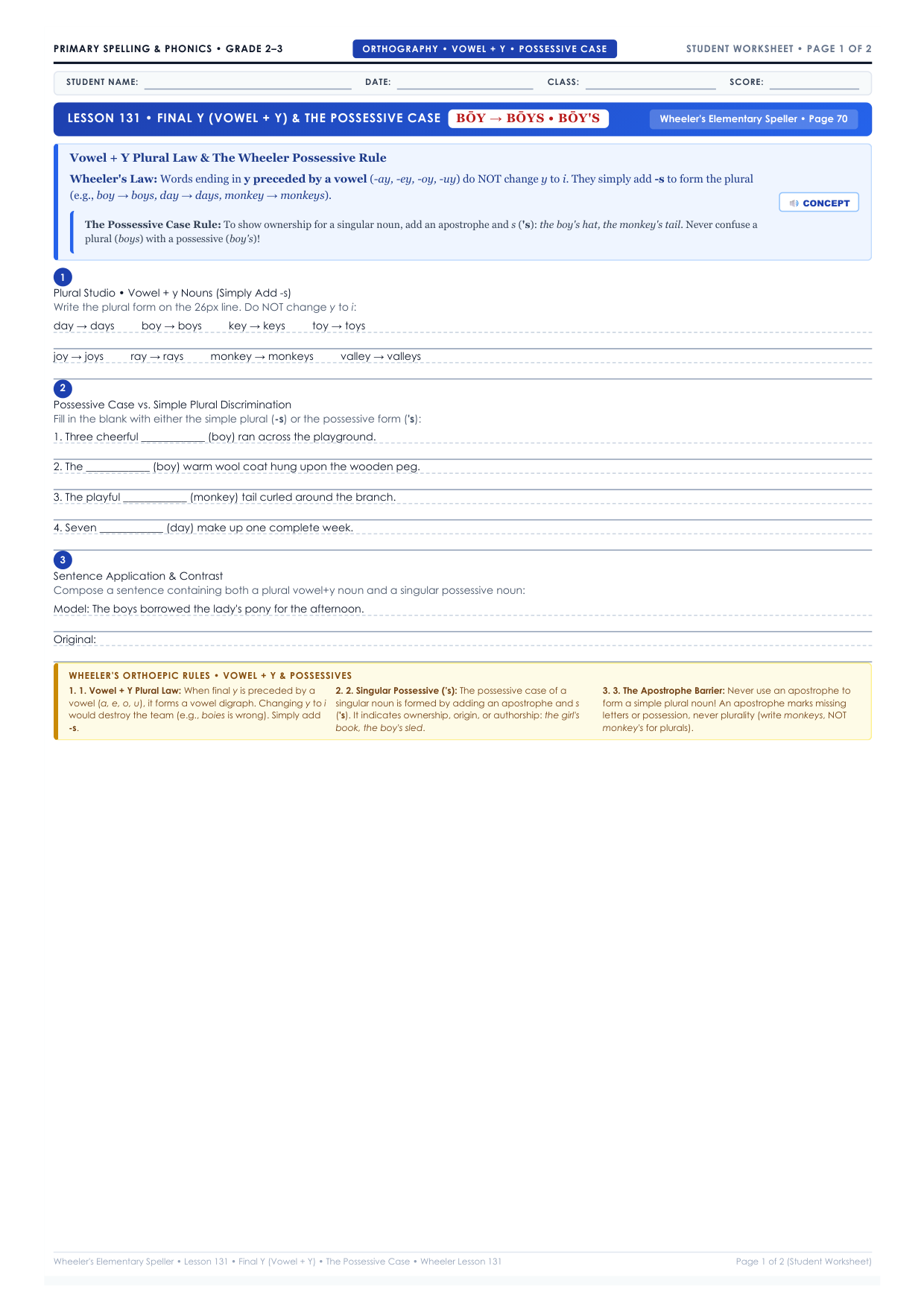
Lesson 131: Final Y (Vowel + Y) & The Possessive Case
Vowel digraph stability: simply adding -s to form plurals (boys, days, monkeys), and Wheeler's possessive rule adding 's to singular nouns.
Open Student HTML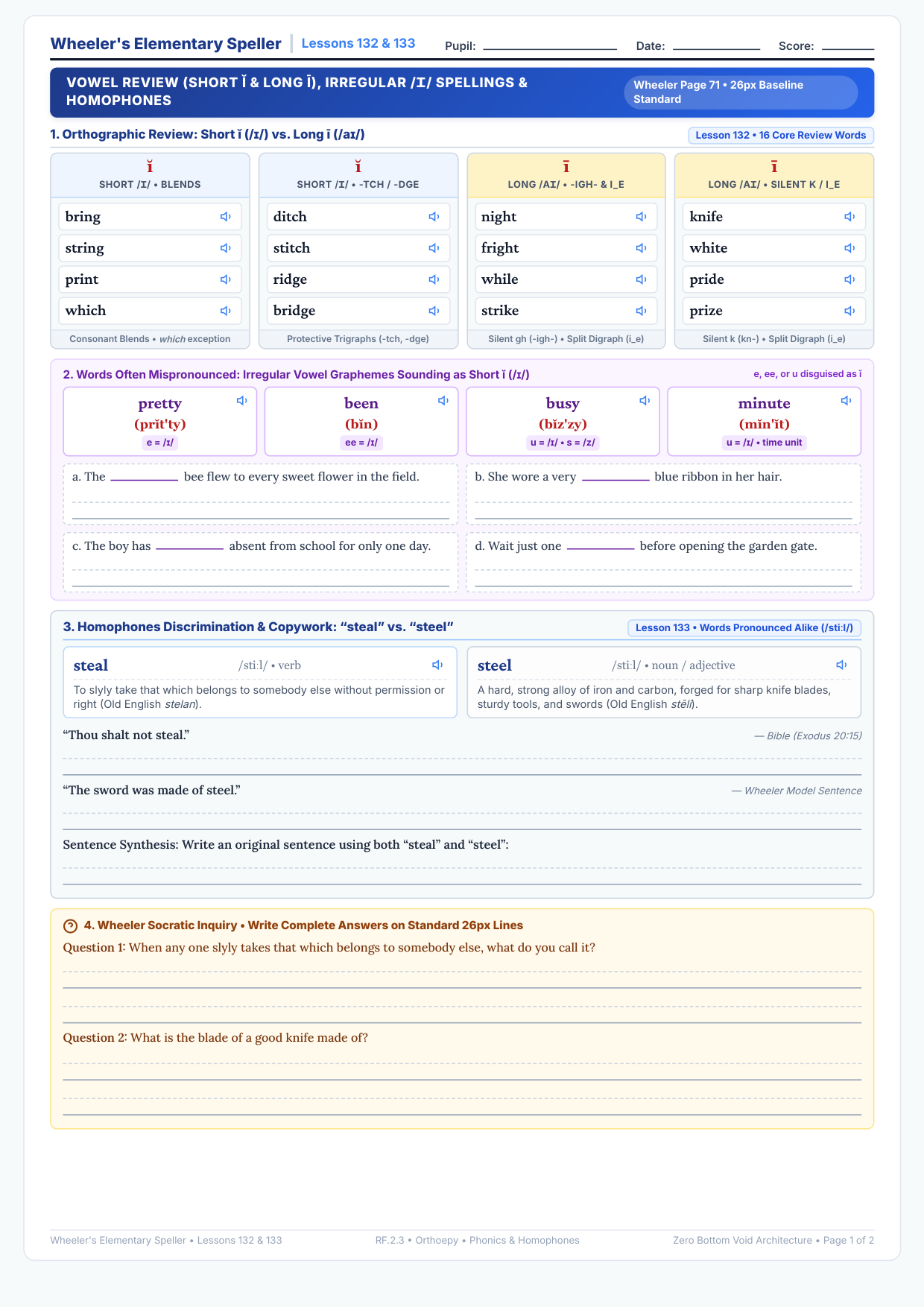
Lesson 132: Review of Vowel Sounds & Irregular /ɪ/
16 core test words (ā, ē, ī, ō), and orthoepic clinic on words often mispronounced where vowels represent short /ɪ/ (pretty, been, busy, business).
Open Student HTML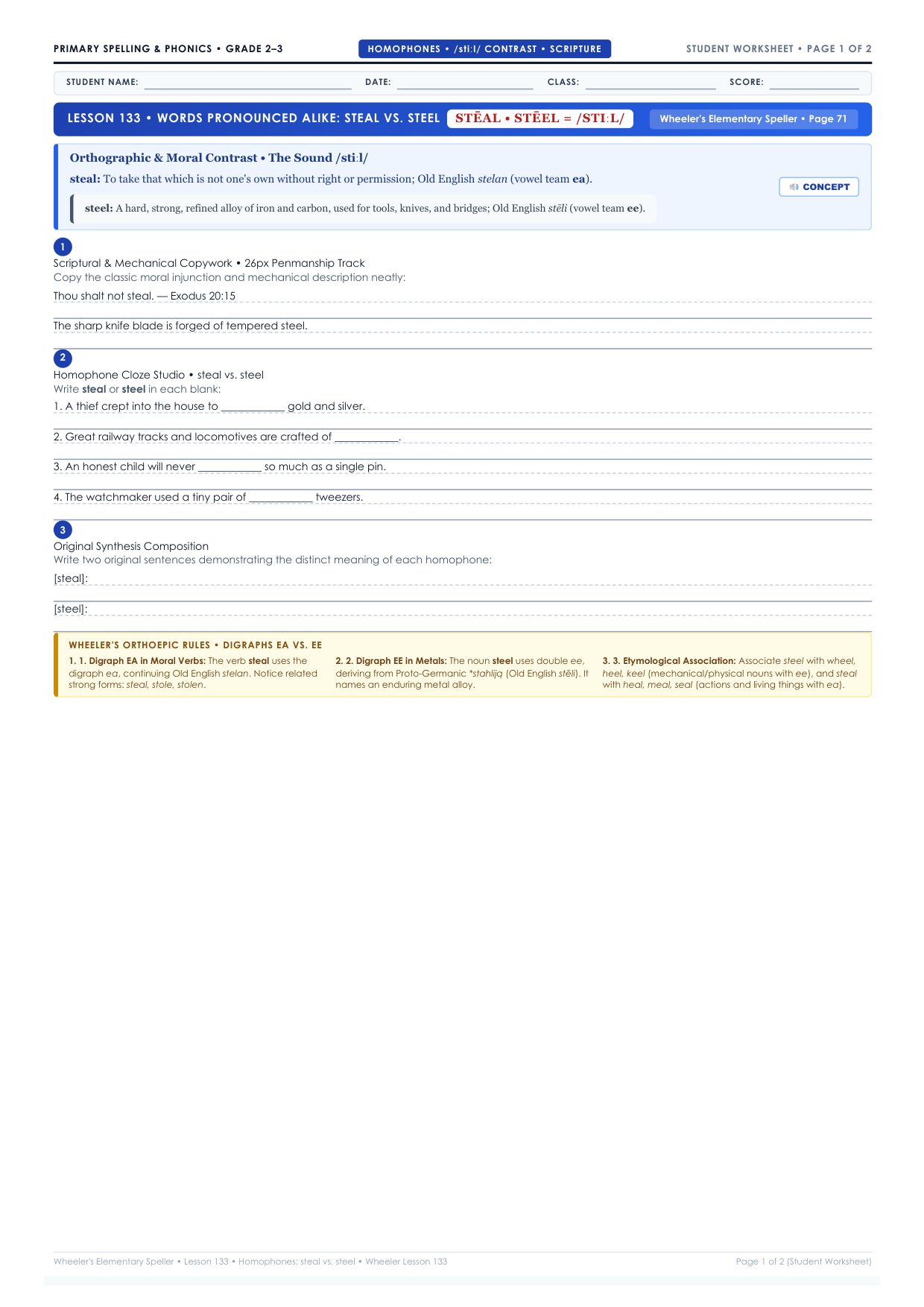
Lesson 133: Words Pronounced Alike: steal vs. steel
Moral scriptural injunction (Thou shalt not steal, digraph ea), hardened metal alloy steel (digraph ee), and semantic cloze application.
Open Student HTML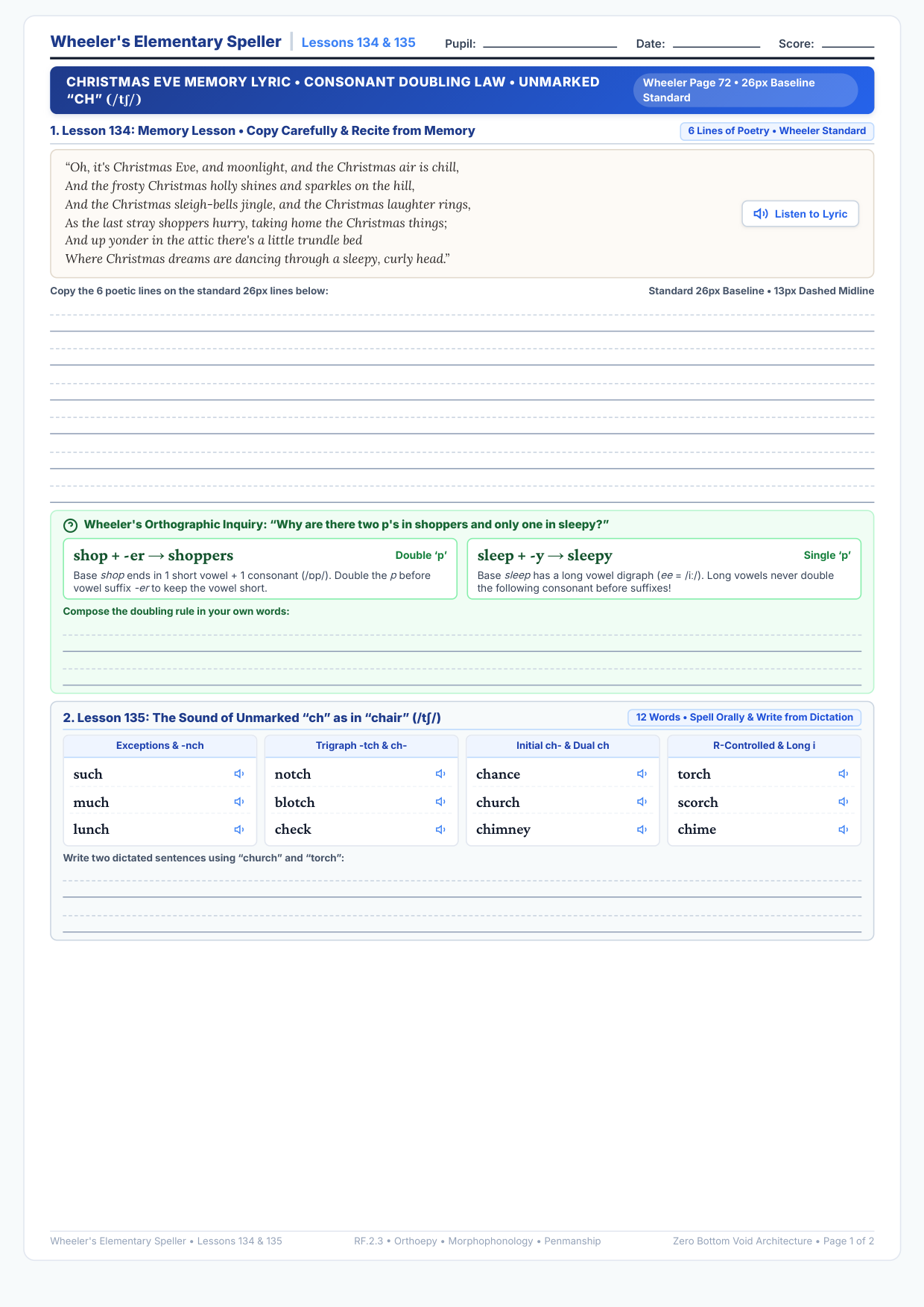
Lesson 134: Christmas Eve Lyric & Doubling Law
Christmas Eve lyric recitation copywork, Wheeler's orthographic doubling inquiry (shoppers with double p vs. sleepy with single p), and proper holiday capitalization.
Open Student HTML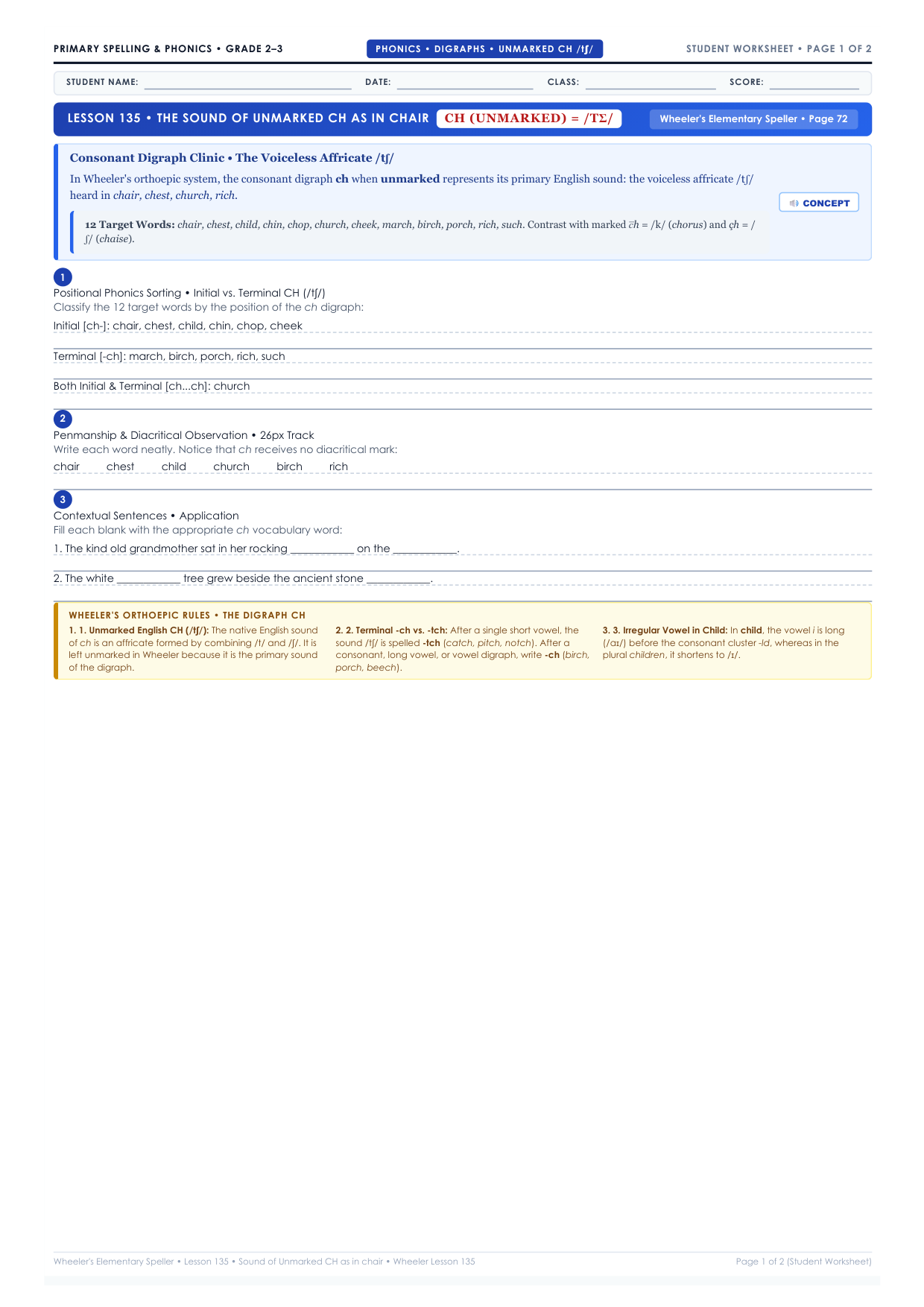
Lesson 135: The Sound of Unmarked CH as in chair
12 target words with voiceless affricate /tʃ/ (chair, chest, child, church, birch, rich), positional classification (initial vs. terminal), and the -ch vs. -tch rule.
Open Student HTML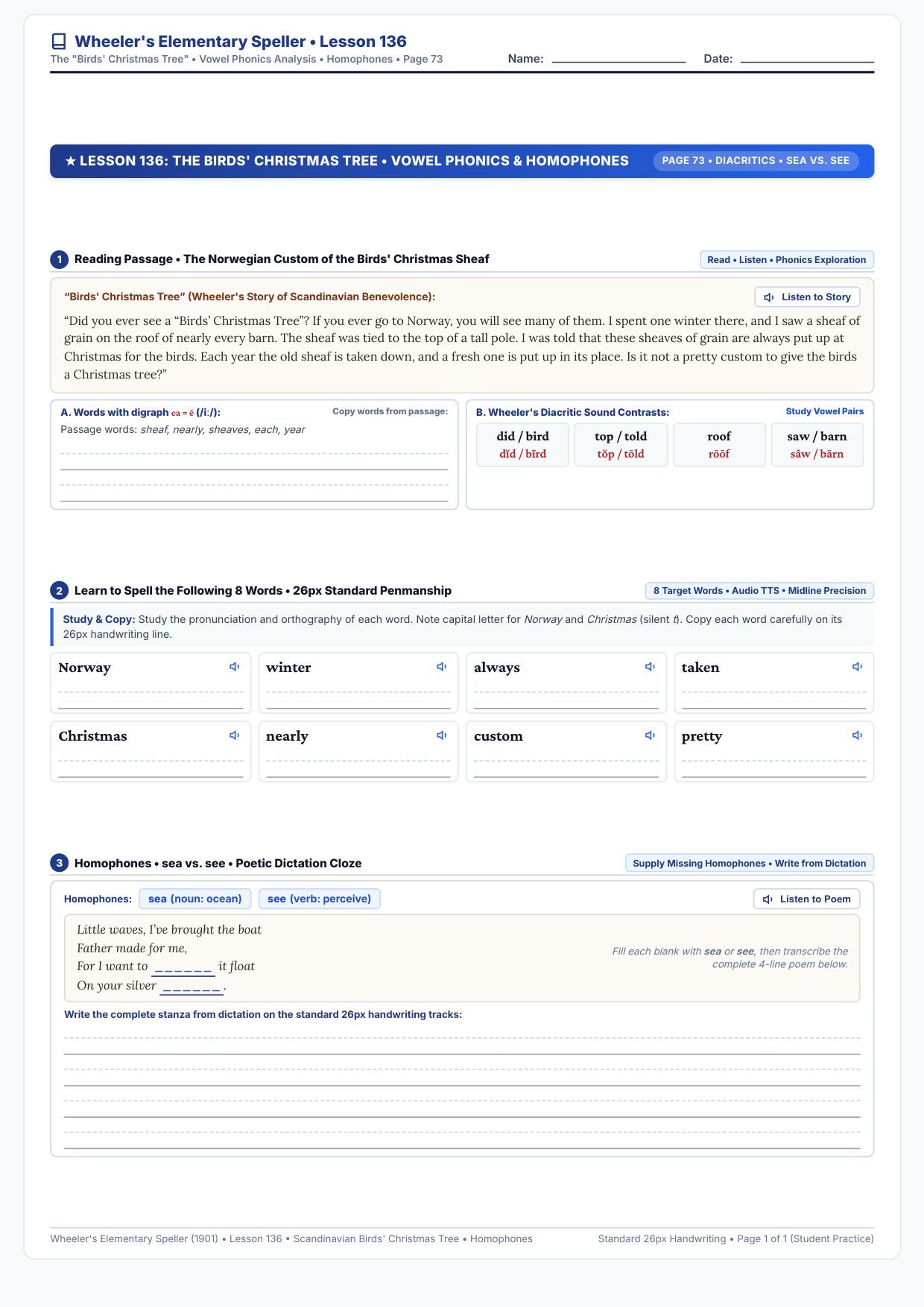
Lesson 136: The Birds' Christmas Tree • Vowel Phonics • Homophones
Scandinavian cultural narrative of the Christmas sheaf (julenek), comprehensive vowel diacritic analysis (ea = ē, ĭ vs. ĩ, ŏ vs. ō, ōō, â vs. ä), 8 target words, and homophone discrimination (sea vs. see) with poetic dictation cloze.
Open Student HTML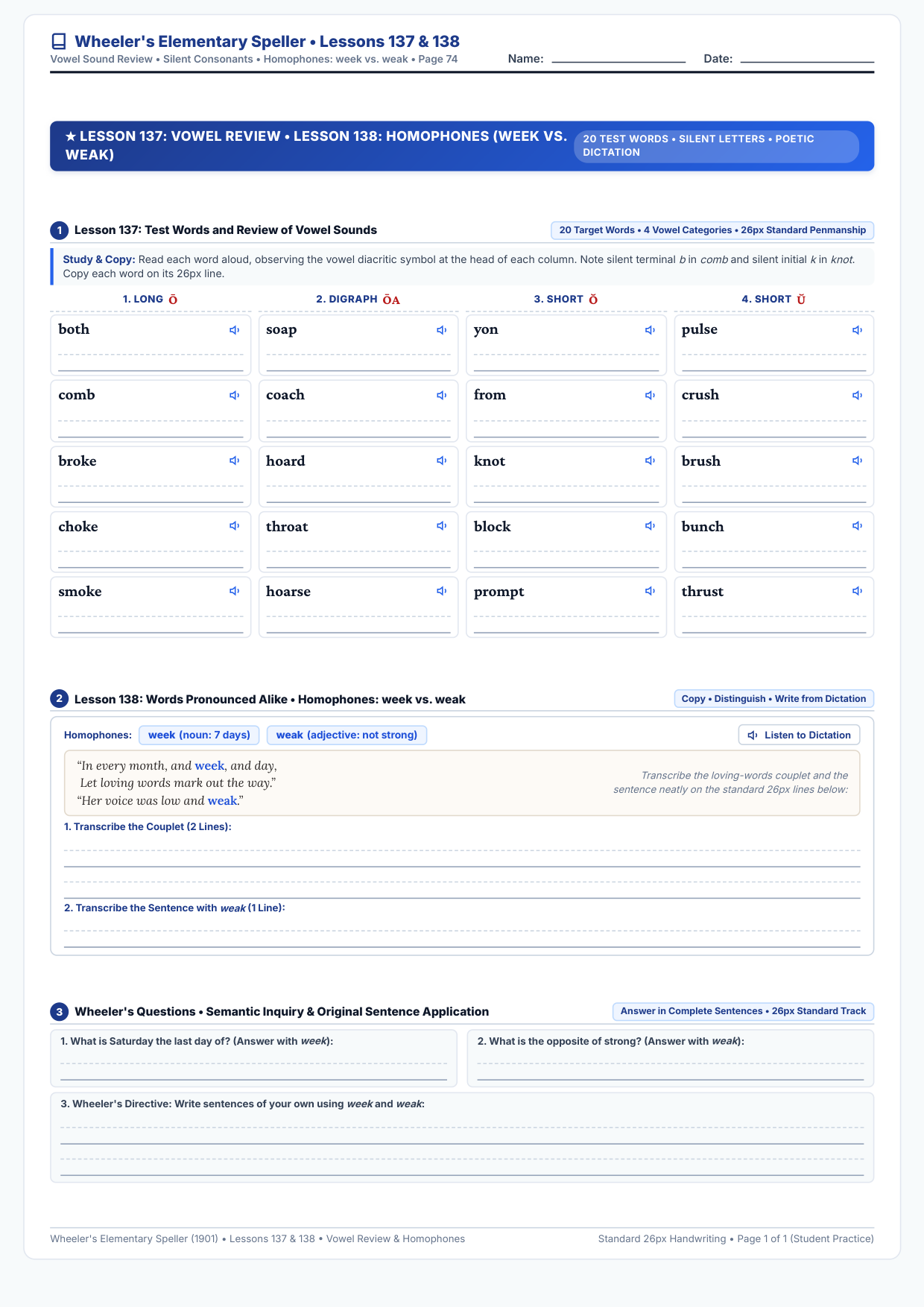
Lesson 137: Review of Vowel Sounds & Diphthongs
16 review words sorting into diphthong families (oi, ow, ou) and consonant blends (qu, wh, ph), including voice, crown, ground, quench, wheat.
Open Student HTML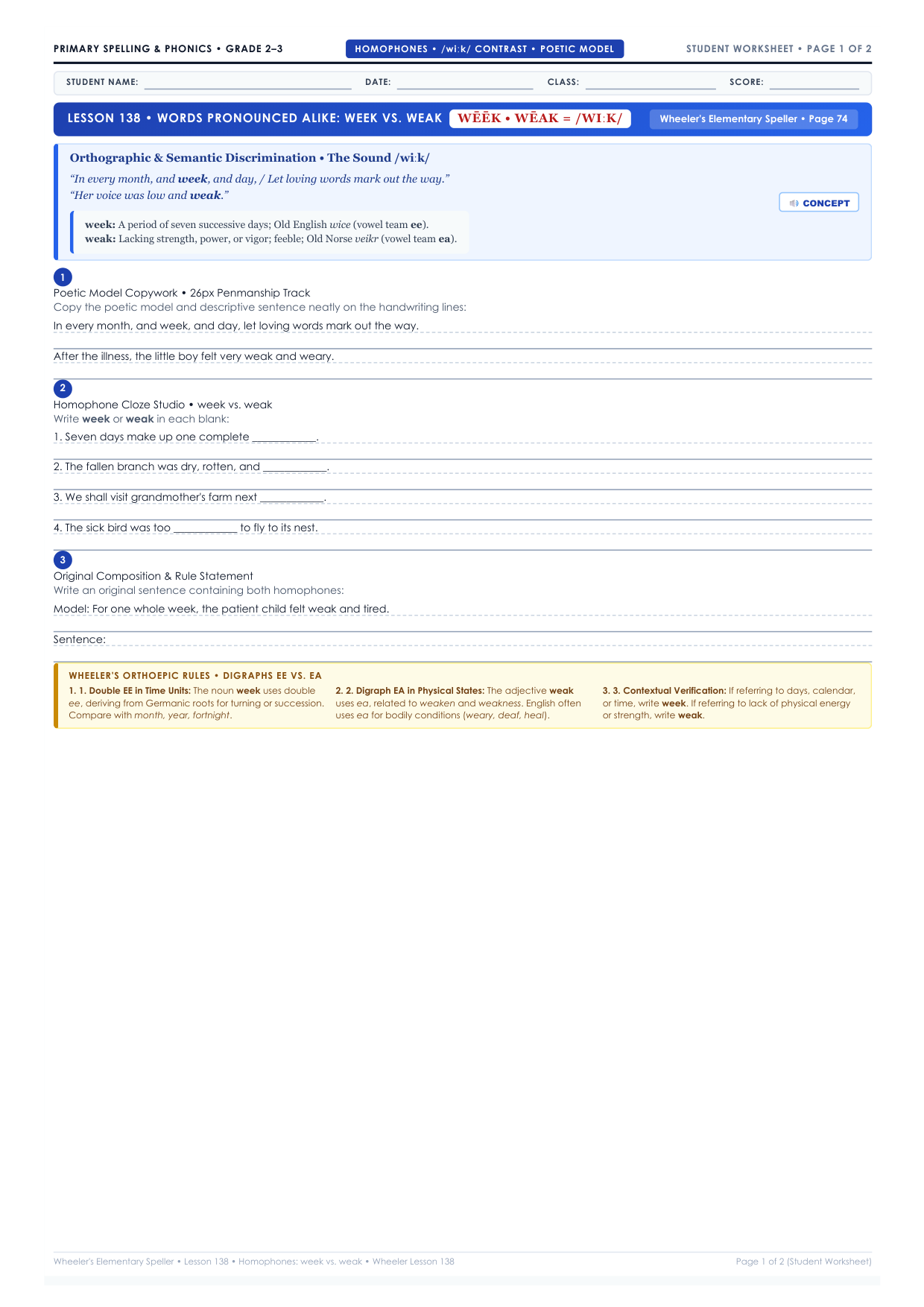
Lesson 138: Words Pronounced Alike: week vs. weak
Poetic model copywork, temporal unit week (seven days, double ee), physical fragility weak (digraph ea), and sentence discrimination.
Open Student HTML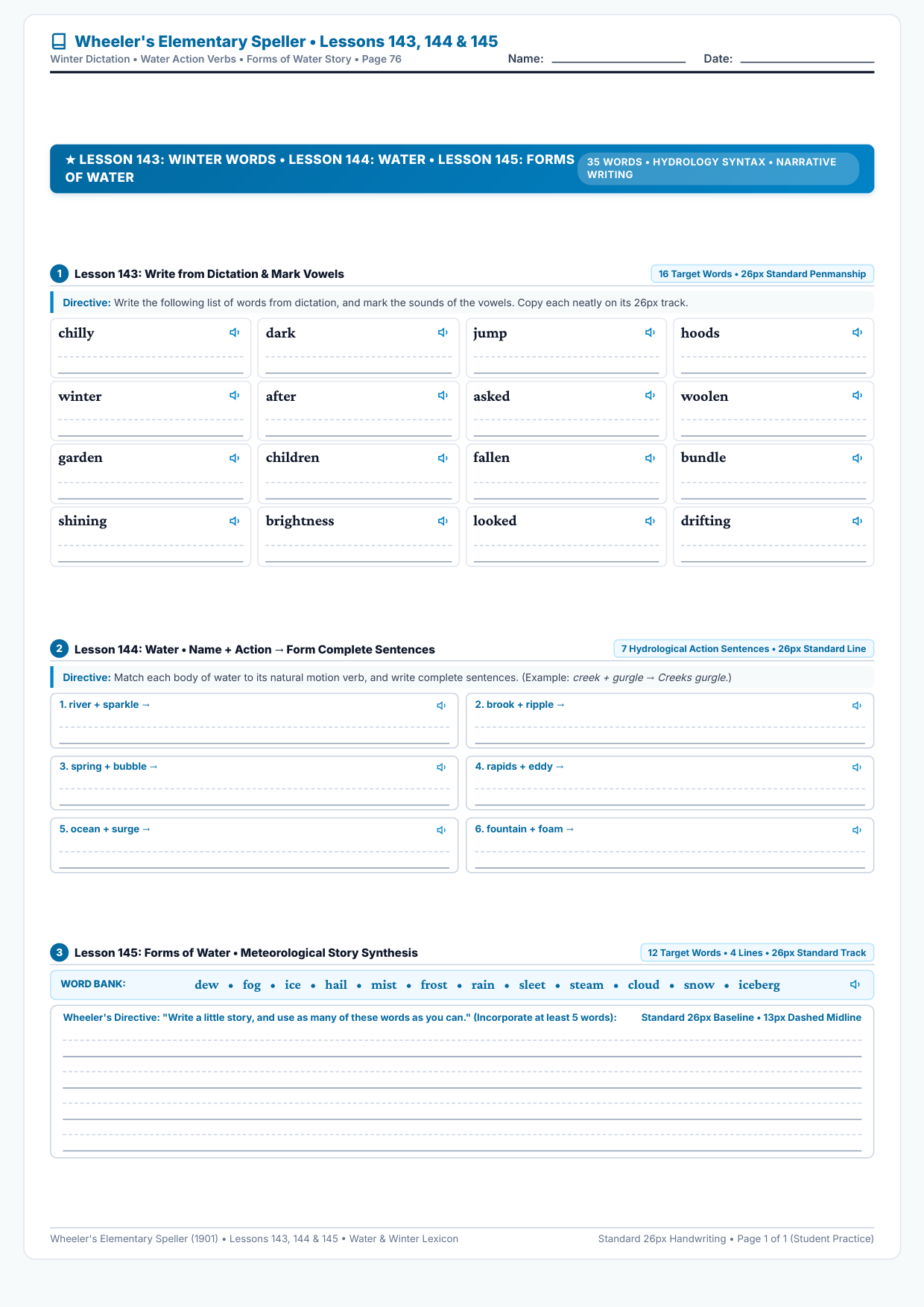
Lesson 143: Winter Dictation & Vowel Markings
16 seasonal test words written from oral dictation (winter, frost, freeze, skate, sled, snow, blizzard), marking macrons (long) and breves (short).
Open Student HTML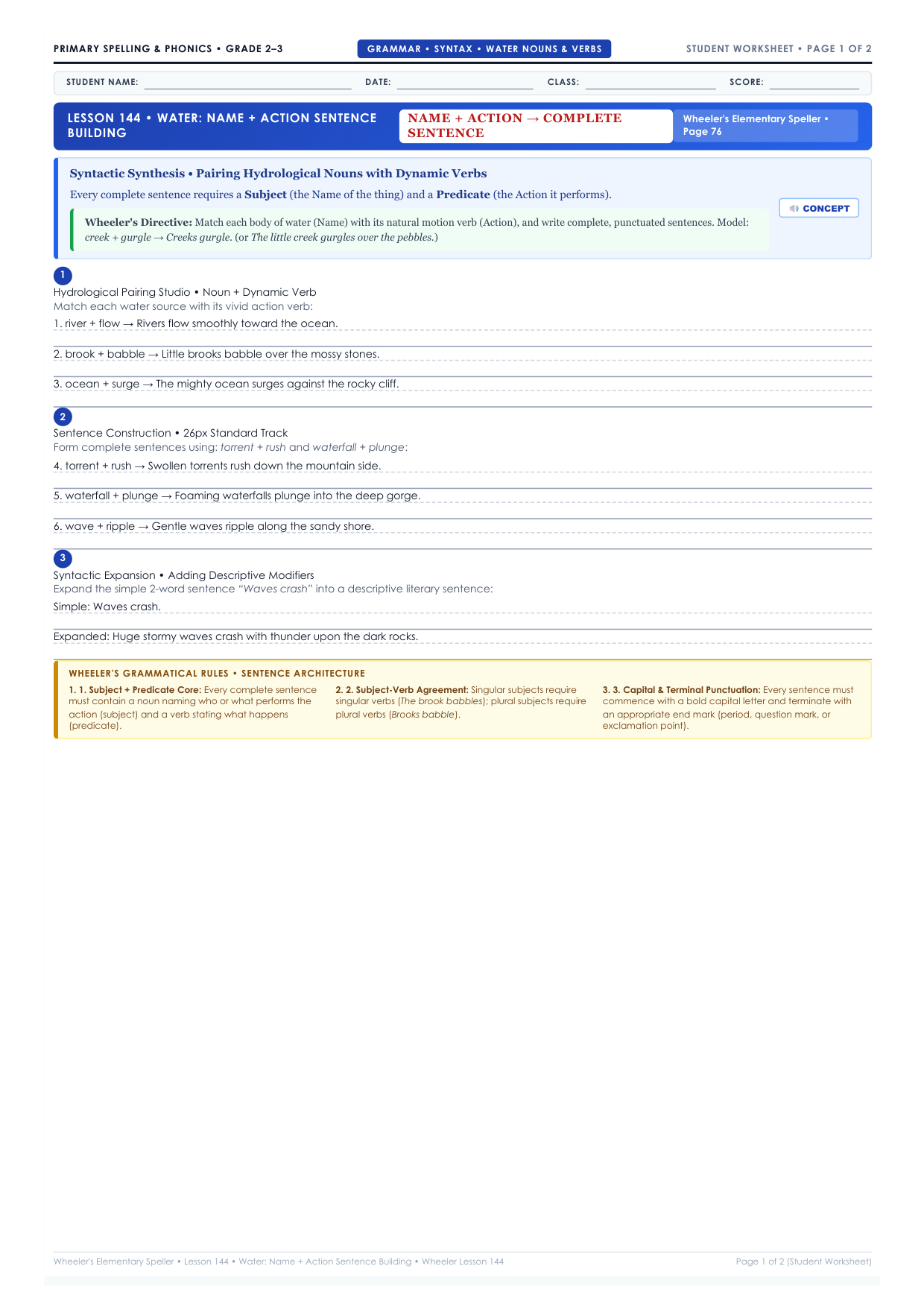
Lesson 144: Water: Name + Action Sentence Building
Pairing hydrological nouns (river, brook, ocean, torrent, waterfall) with dynamic motion verbs (flow, babble, surge, rush, plunge) to construct complete sentences.
Open Student HTML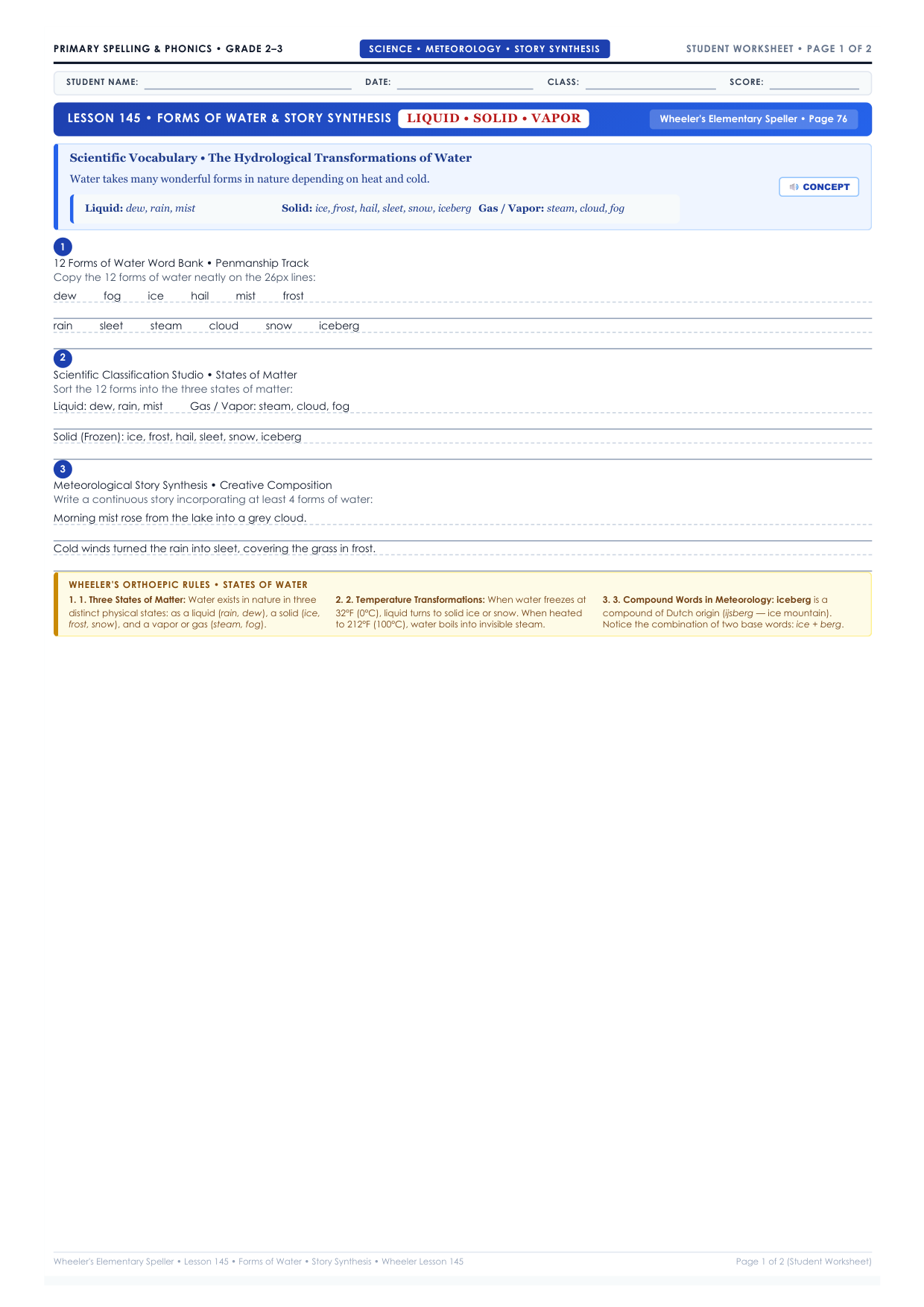
Lesson 145: Forms of Water & Story Synthesis
12 forms of water classified into liquid, solid, and vapor states (dew, fog, ice, hail, mist, frost, rain, sleet, steam, cloud, snow, iceberg), and creative meteorological narrative.
Open Student HTML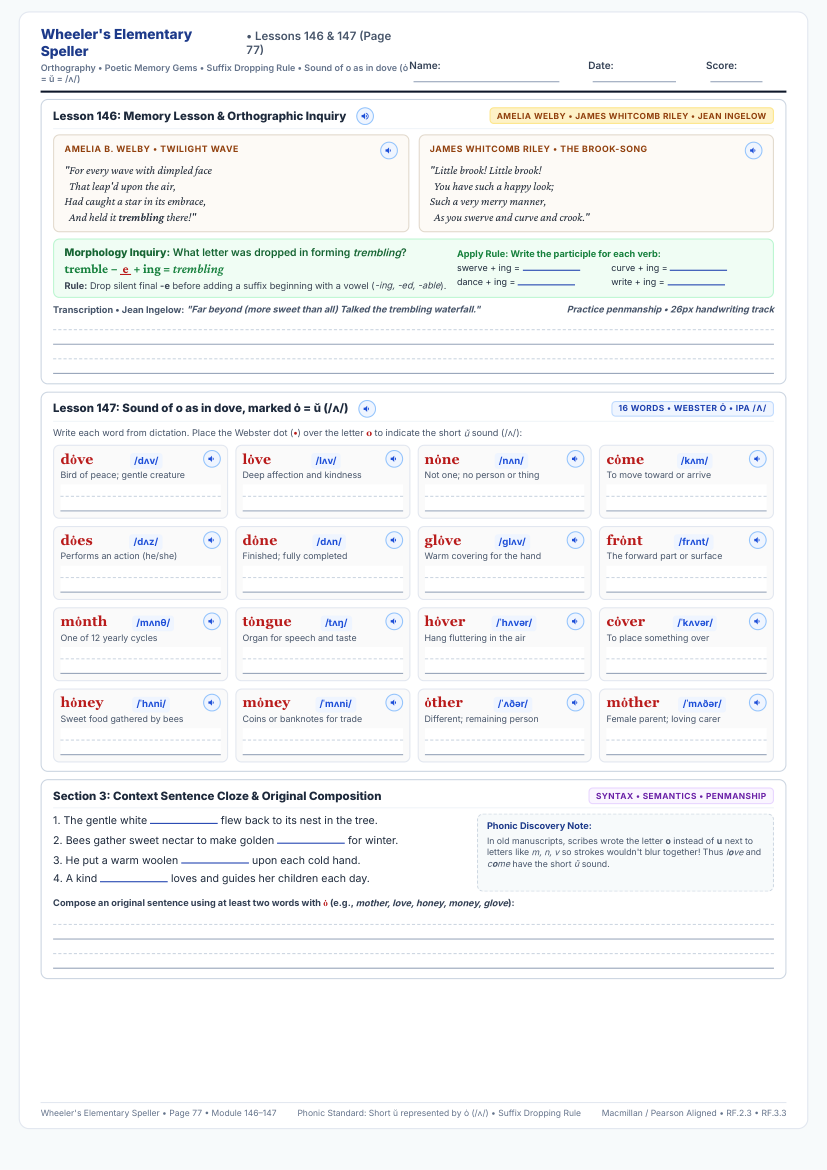
Lesson 146: Memory Gems & The Silent E Dropping Rule
Poetic memory gems by Amelia B. Welby and James Whitcomb Riley, personification, and the silent e dropping rule before vowel suffixes (tremble → trembling, swerve → swerving).
Open Student HTML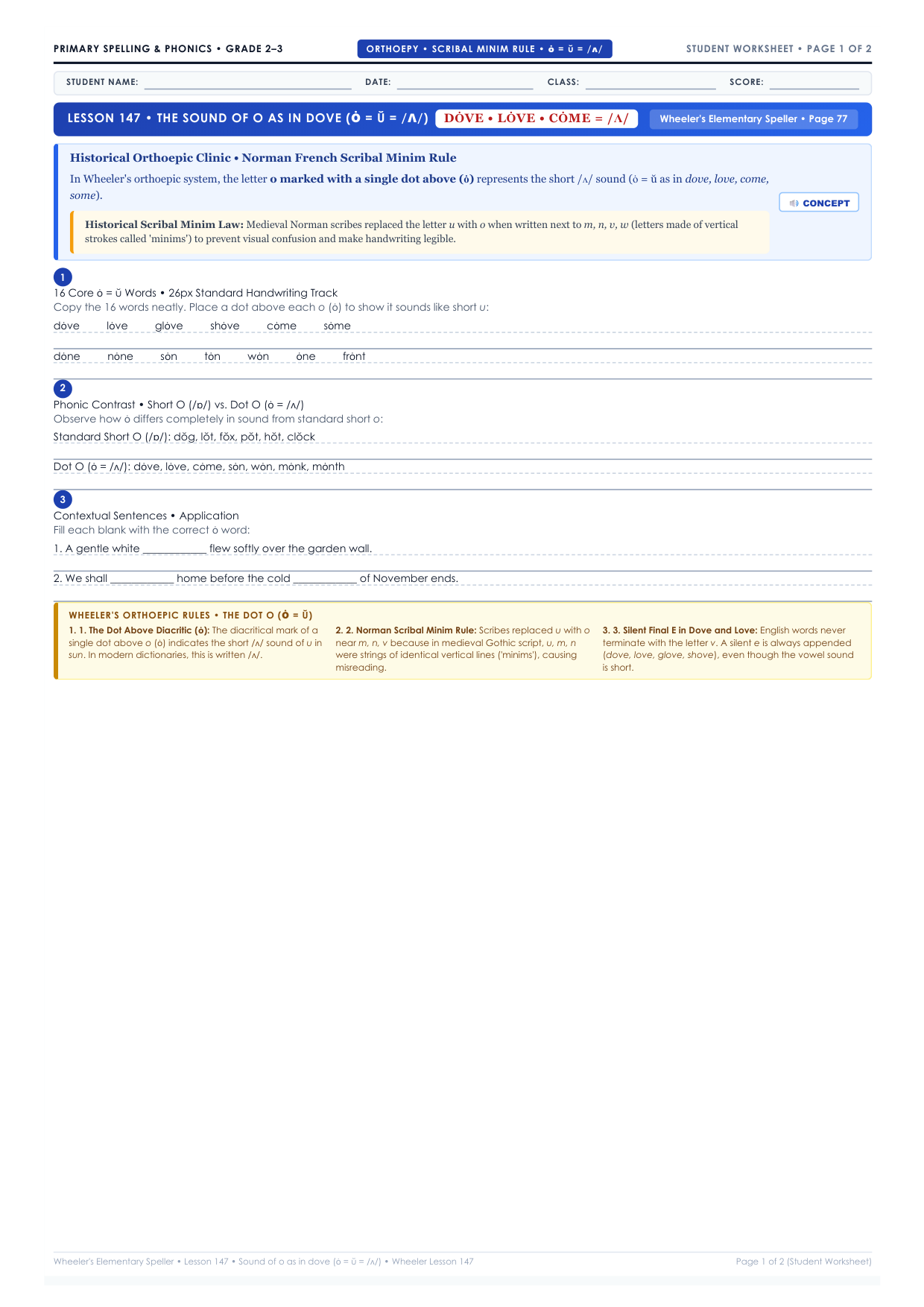
Lesson 147: The Sound of O as in Dove (ȯ = ŭ = /ʌ/)
The dot above diacritic (ȯ), medieval Norman French scribal minim rule replacing u with o near m, n, v (dove, love, come, some, done, son, monk), and terminal ve.
Open Student HTML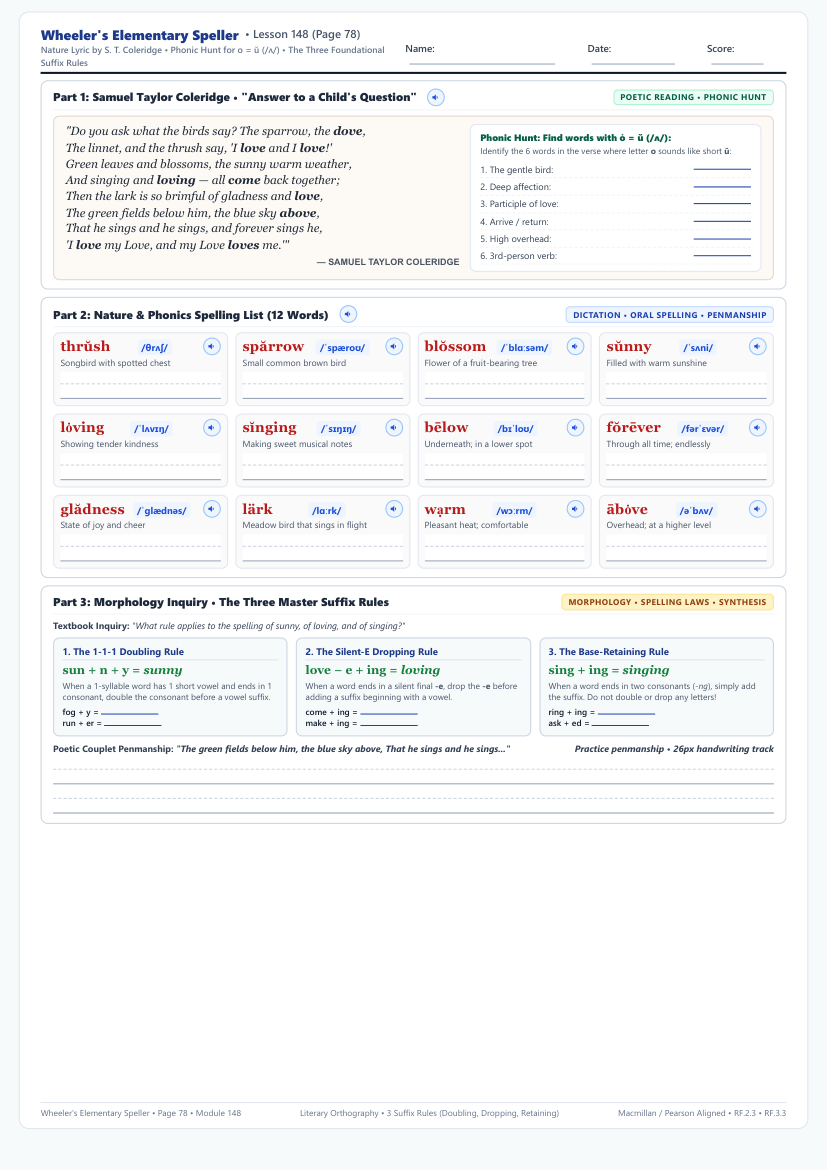
Lesson 148: Coleridge's Bird Lyric • The Three Master Suffix Rules
Samuel Taylor Coleridge's "Answer to a Child's Question", phonic treasure hunt for short ŭ (o = /ʌ/), 12 avian nature words, and inquiry into the 3 foundational English suffix laws (Doubling in sunny, Dropping in loving, and Retaining in singing).
Open Student HTML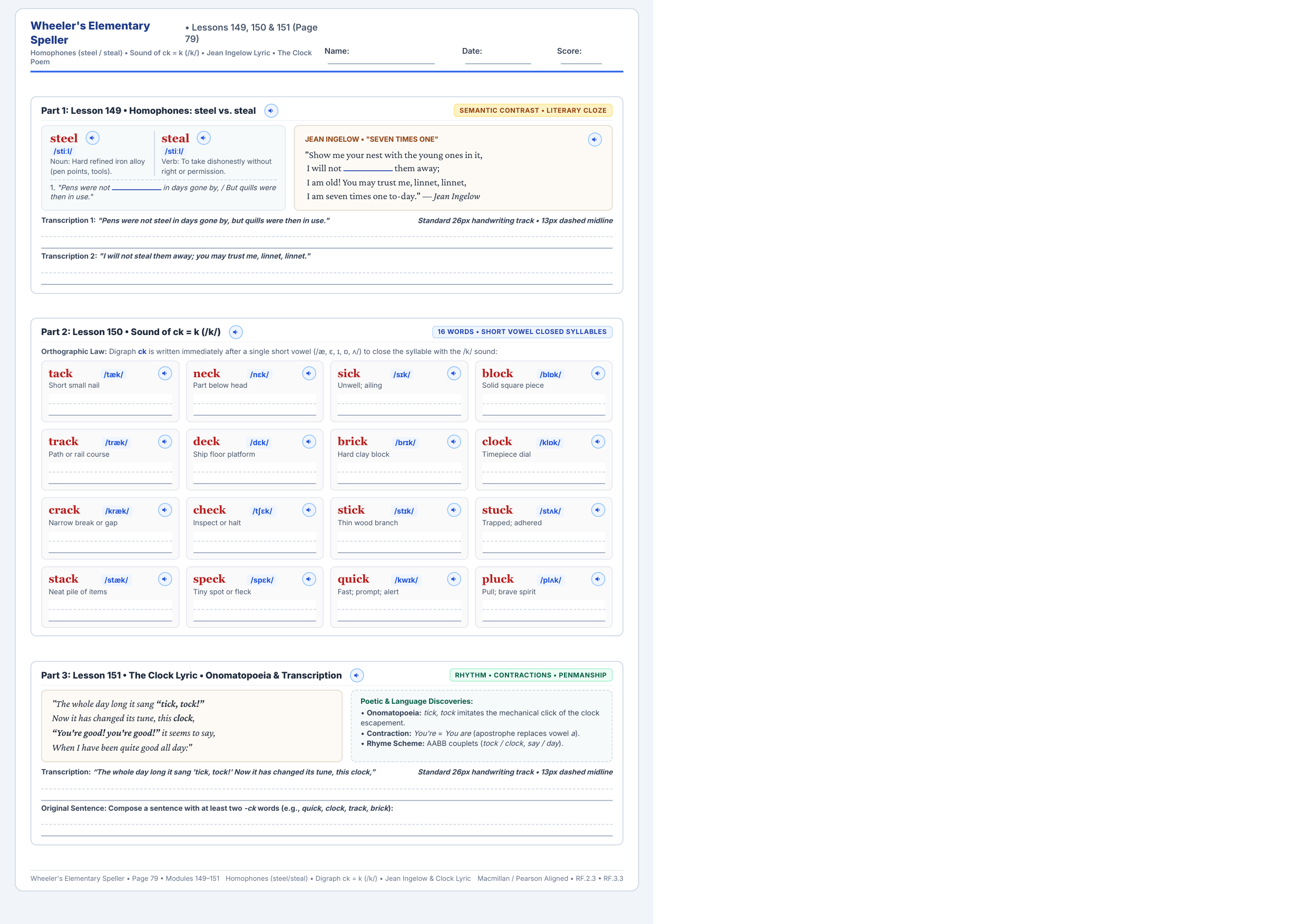
Lesson 149: Words Pronounced Alike: steel vs. steal
Historical context of quill vs. flexible steel writing pens, moral prohibition against theft (digraph ea), and cloze mastery.
Open Student HTML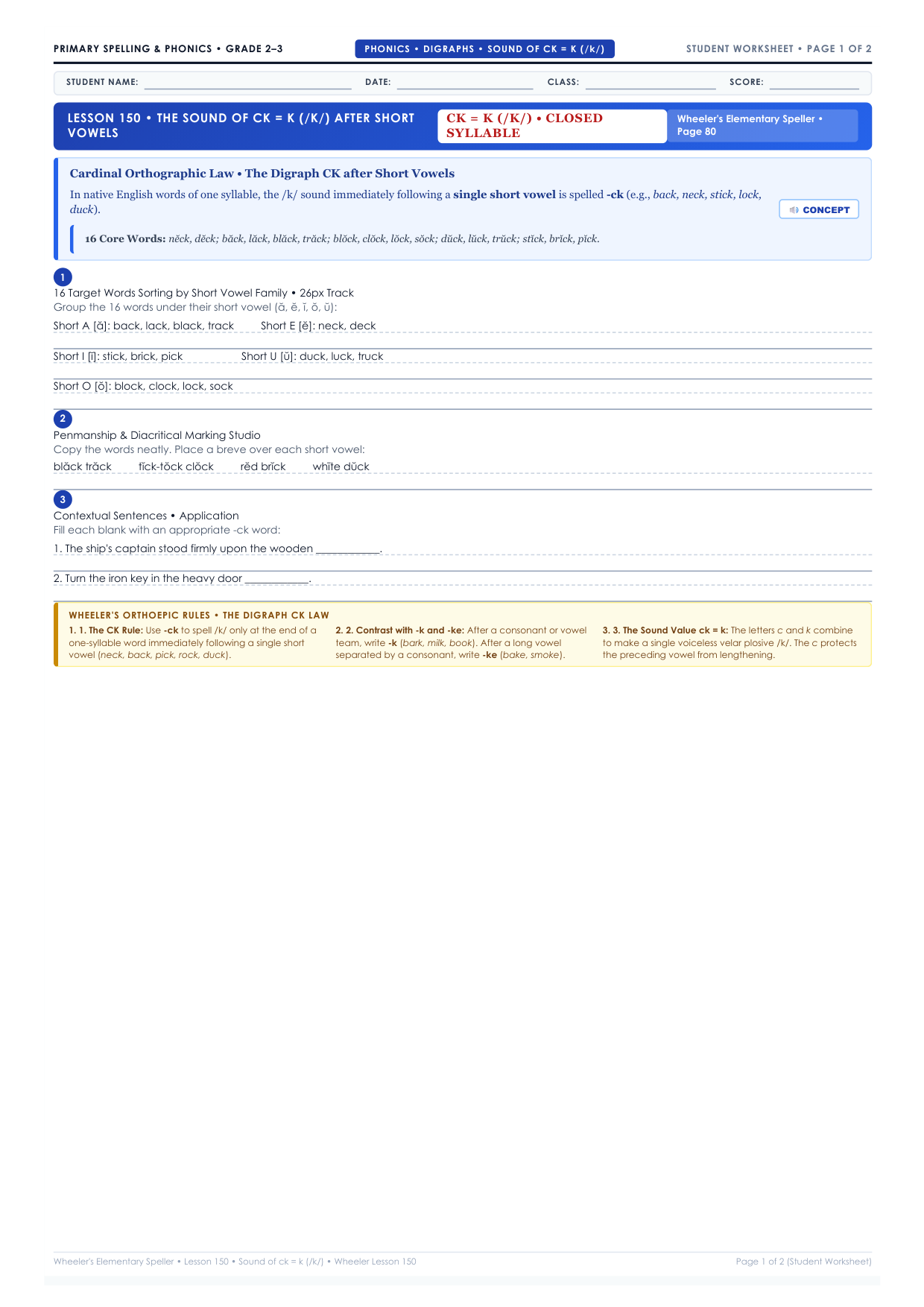
Lesson 150: Sound of ck = k (/k/) After Short Vowels
16 core monosyllables ending in -ck (neck, back, stick, block, duck), short vowel closed syllables, and terminal spelling rules.
Open Student HTML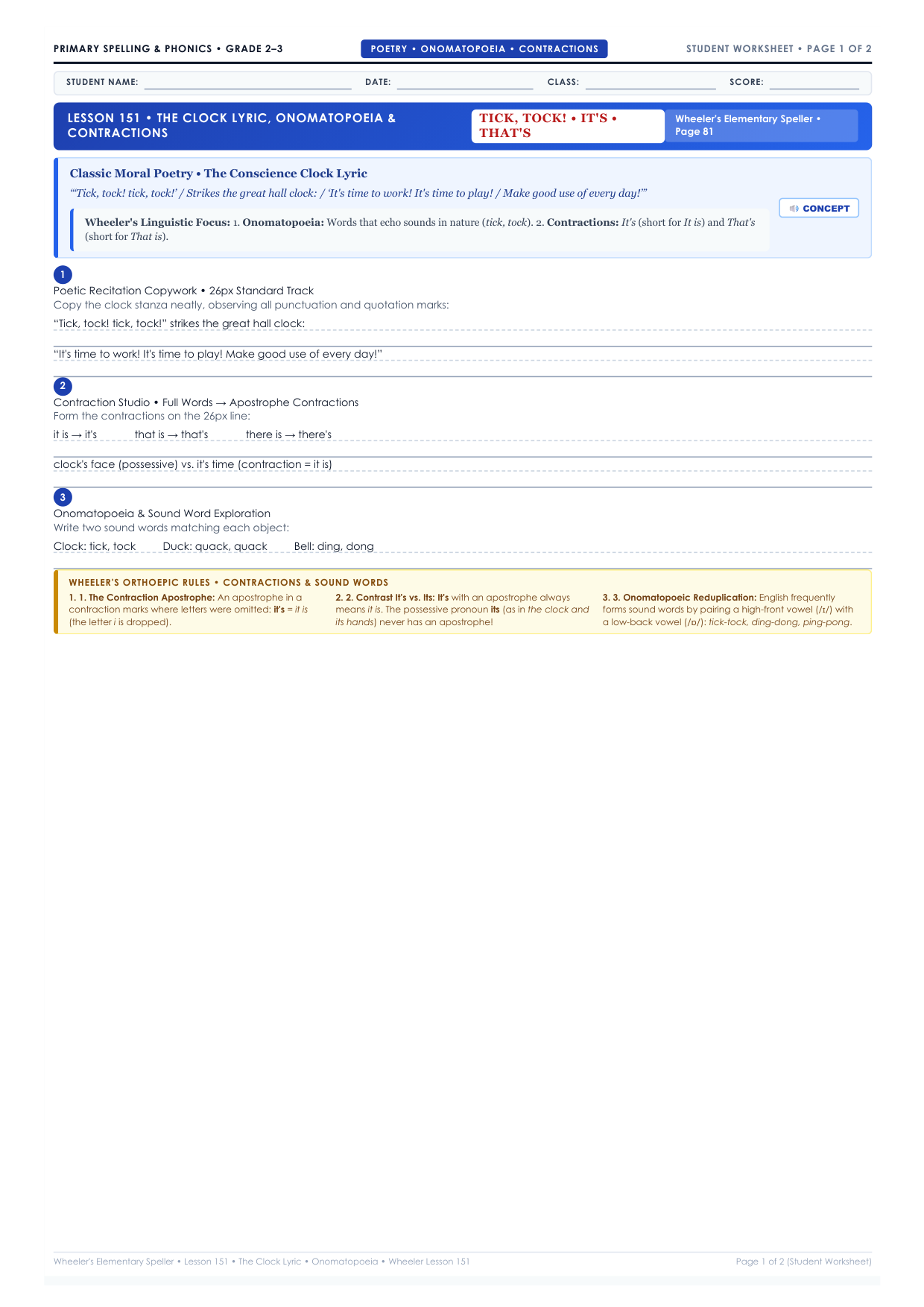
Lesson 151: The Clock Lyric, Onomatopoeia & Contractions
The Conscience Clock lyric copywork, natural sound words (tick, tock), and contraction apostrophe rules (it's, that's, there's).
Open Student HTML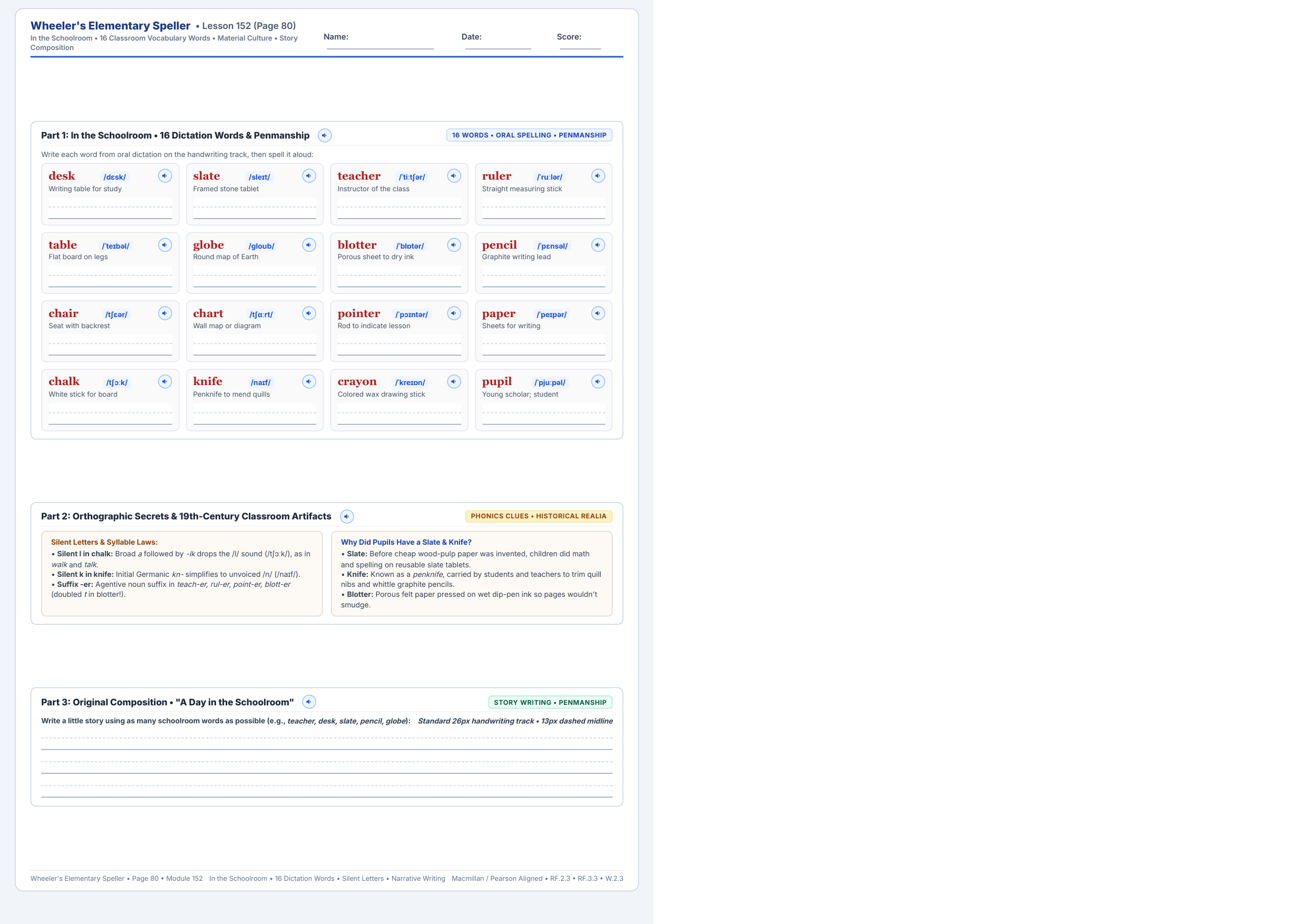
Lesson 152: In the Schoolroom • Classroom Realia & Story Writing
Explore 16 essential schoolroom vocabulary words (desk, slate, teacher, ruler, table, globe, blotter, pencil, chair, chart, pointer, paper, chalk, knife, crayon, pupil), silent letters (chalk, knife), agent suffixes (-er), historical schoolhouse realia, and creative narrative story composition on standard 26px handwriting tracks.
Open Student HTML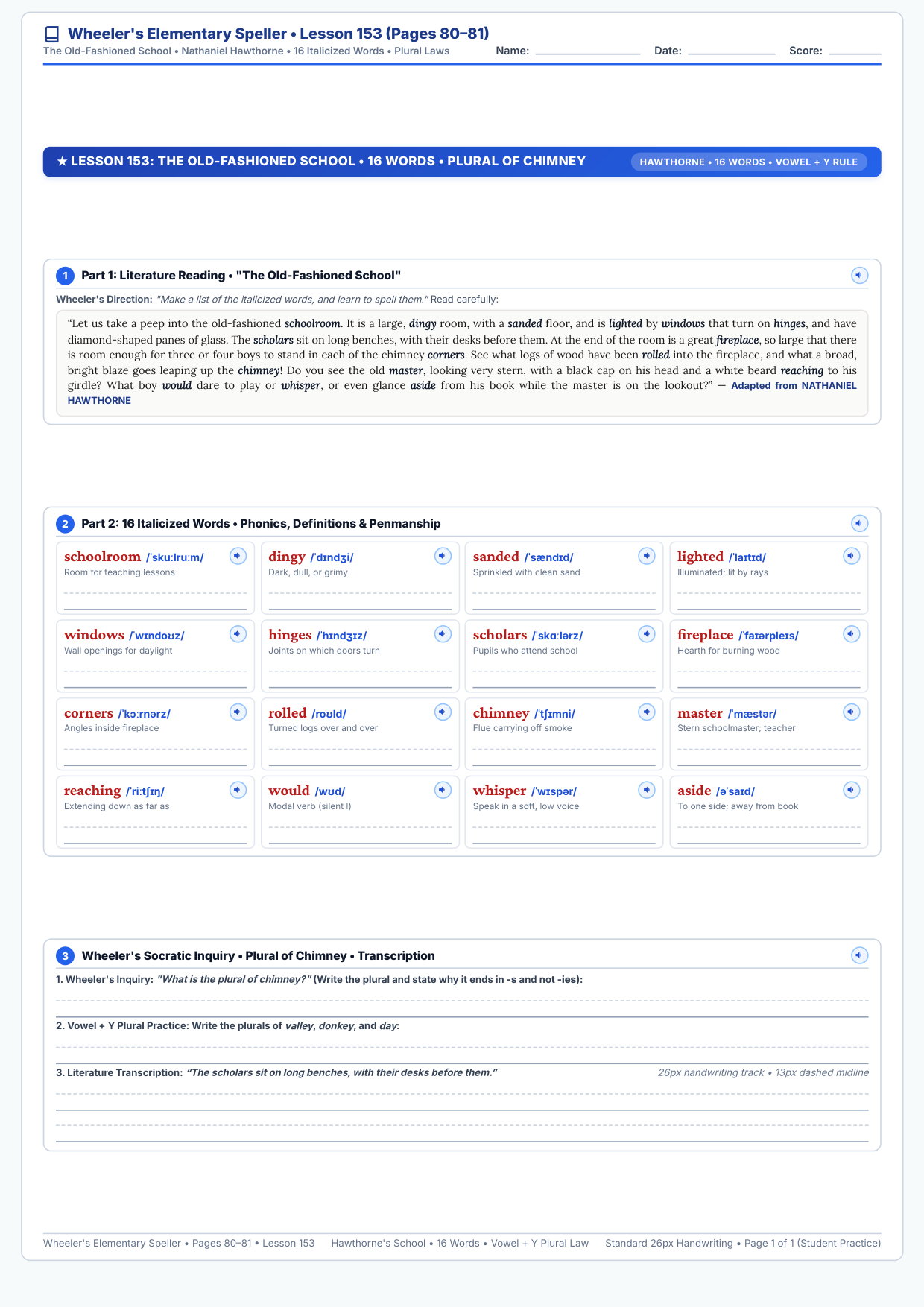
Lesson 153: The Old-Fashioned School • Hawthorne's Classic
Explore Nathaniel Hawthorne's vivid description of a colonial schoolhouse (schoolroom, dingy, sanded, lighted, windows, hinges, scholars, fireplace, corners, rolled, chimney, master, reaching, would, whisper, aside), discover the orthographic law of vowel + y plurals (chimneys), examine silent letters (would, lighted) and Greek sch- (/sk/), and practice penmanship on standard 26px handwriting tracks.
Open Student HTML
Lesson 154: Review of 20 Test Words: ōō, ow, ẽ/ĩ, and û
20 test words categorized into long ōō (/uː/), diphthong ow (/aʊ/), and the /ɜːr/ triad (ẽ, ĩ, û in fern, bird, burn).
Open Student HTML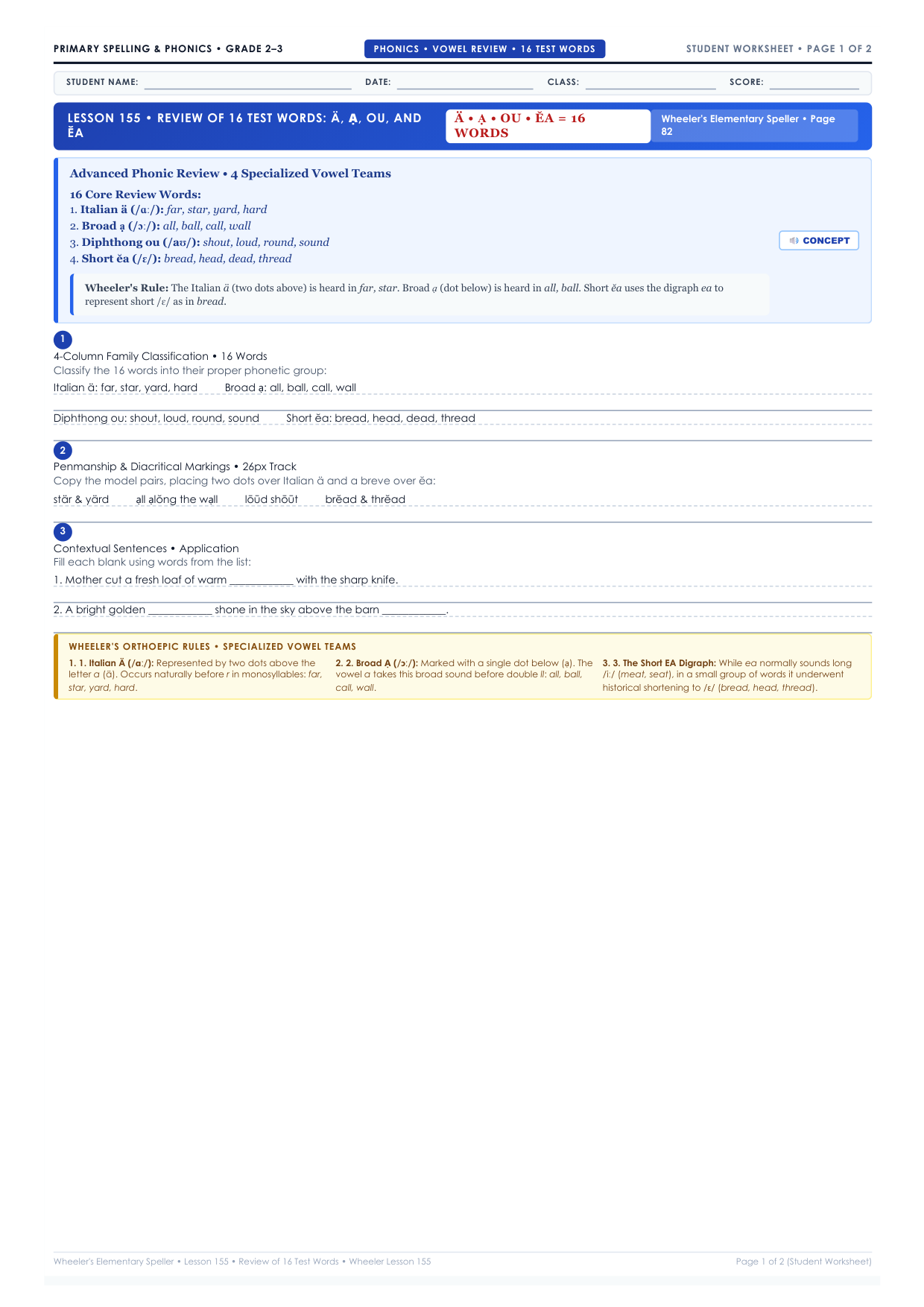
Lesson 155: Review of 16 Test Words: ä, ạ, ou, and ĕa
16 test words sorting into Italian ä (star), broad ạ (wall), diphthong ou (shout), and short ĕa (bread).
Open Student HTML
Lesson 156: Memory Lesson: “Clouds” (Brainard & Scott)
John G. C. Brainard's sublime Niagara Falls cataract poem, recitation copywork, elevated descriptive vocabulary, and iambic meter.
Open Student HTML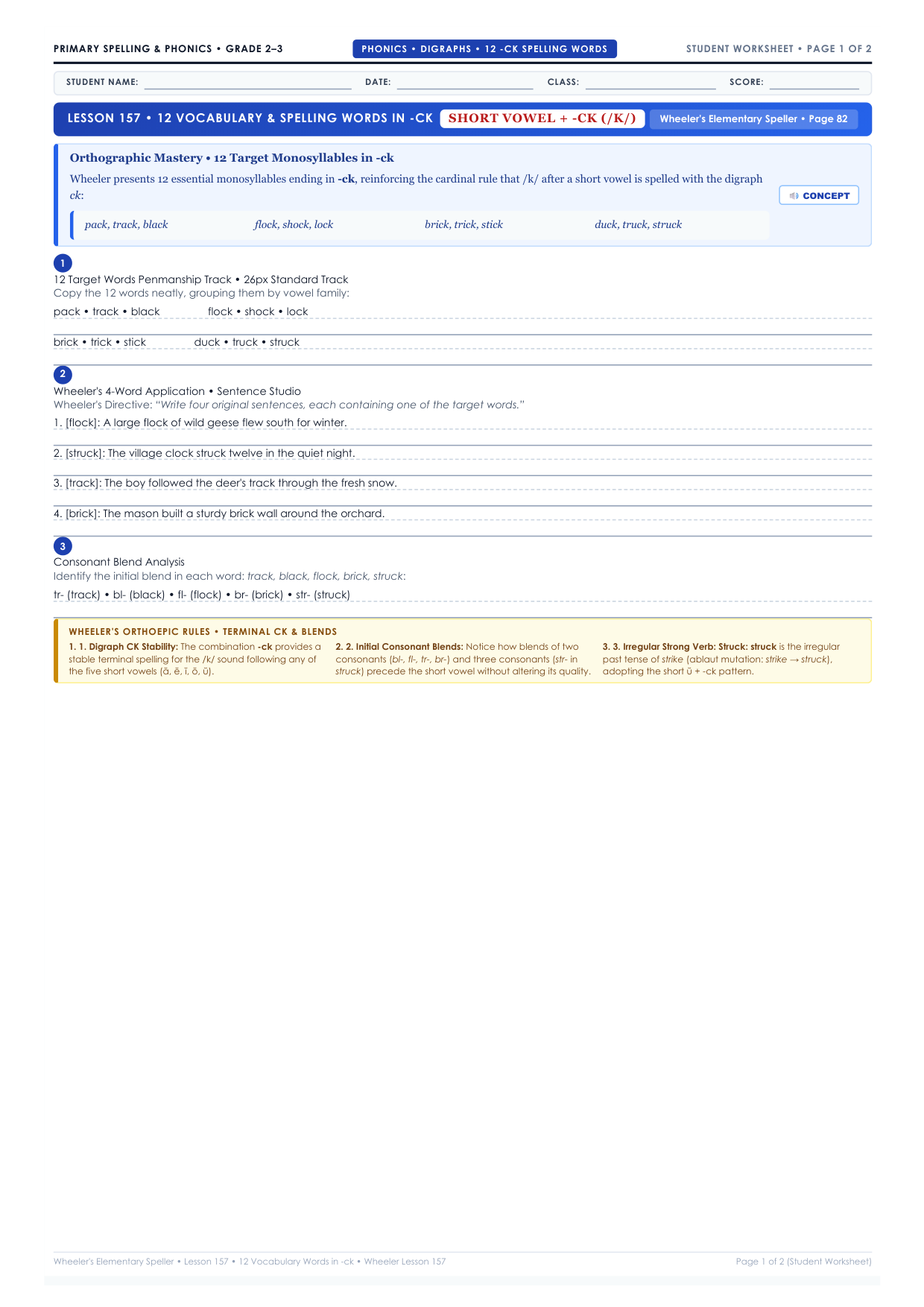
Lesson 157: 12 Vocabulary & Spelling Words in -ck
12 target monosyllables (pack, track, black, flock, shock, lock, brick, trick, stick, duck, truck, struck), and Wheeler's sentence studio.
Open Student HTML
Lesson 158: Short a in Dissyllables (ă as in hat)
12 two-syllable words with accented short ă (handle, candle, cattle, battle, rabbit, habit, pantry, travel, narrow), and geminate consonants.
Open Student HTML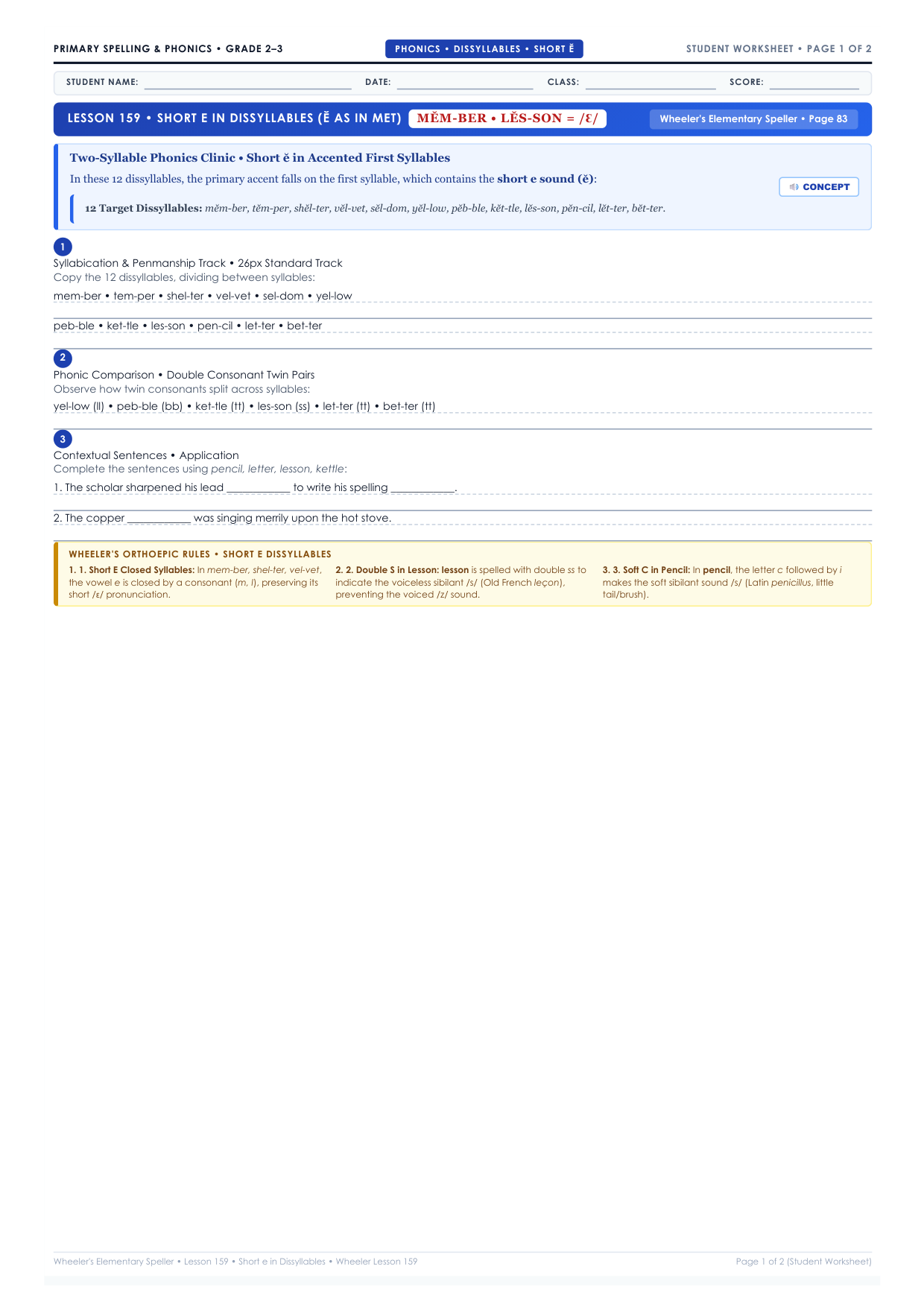
Lesson 159: Short e in Dissyllables (ĕ as in met)
12 two-syllable words with accented short ĕ (member, shelter, velvet, yellow, kettle, lesson, pencil, letter, better), and soft c in pencil.
Open Student HTML
Lesson 160: The “One L Only” Rule • Homophones weak / week
Master the single l orthographic rule for compound and derived words (also, almost, always, welcome, until, already). Explore homophone discrimination between adjective weak and calendar noun week (/wiːk/) through Wheeler's historical dictation sentences and full 6-word sentence composition tracks.
Open Student HTML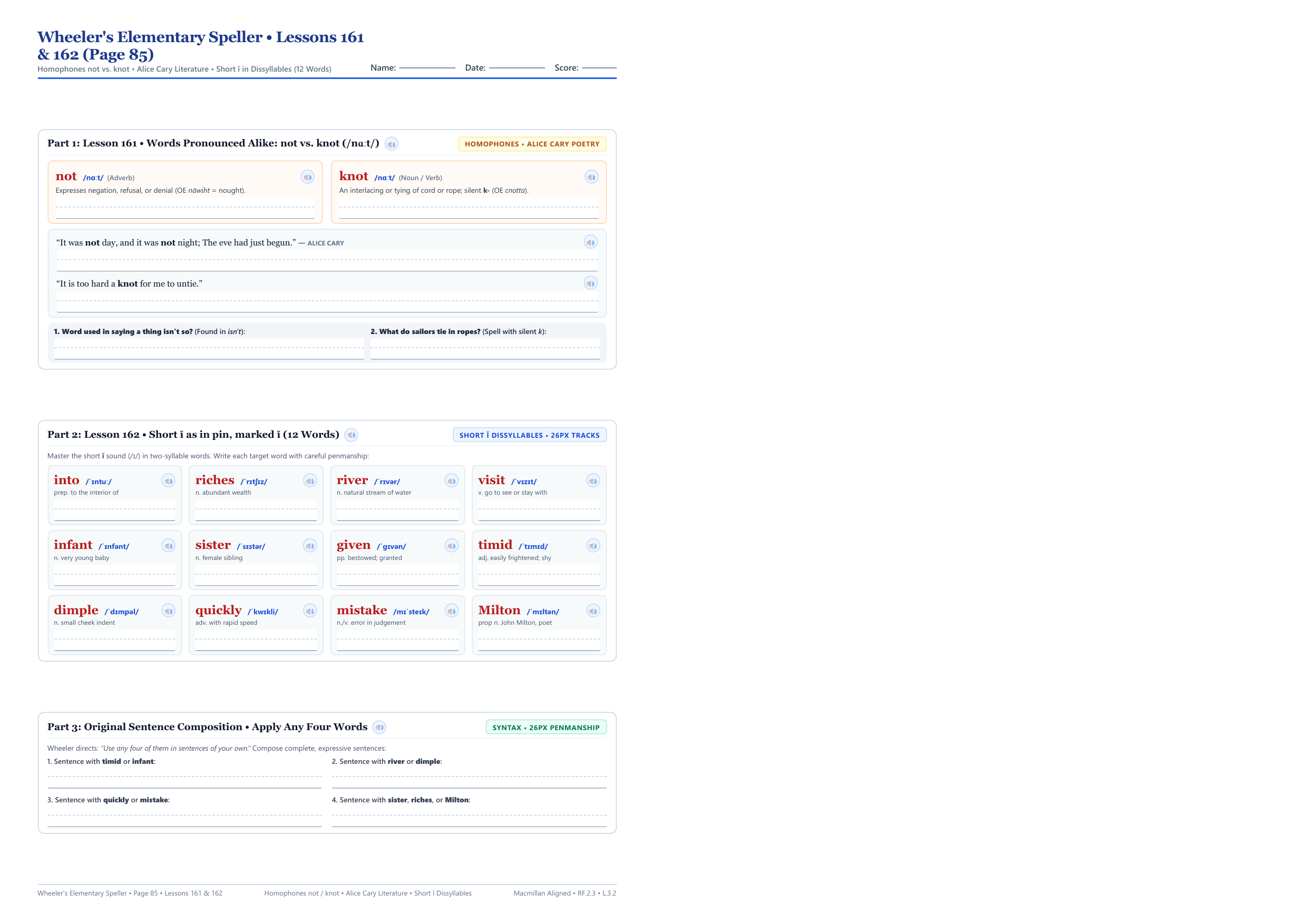
Lesson 161: Words Pronounced Alike: not vs. knot
Silent initial k in knot (rope fastening), particle of negation not, and Alice Cary classic moral poetry copywork.
Open Student HTML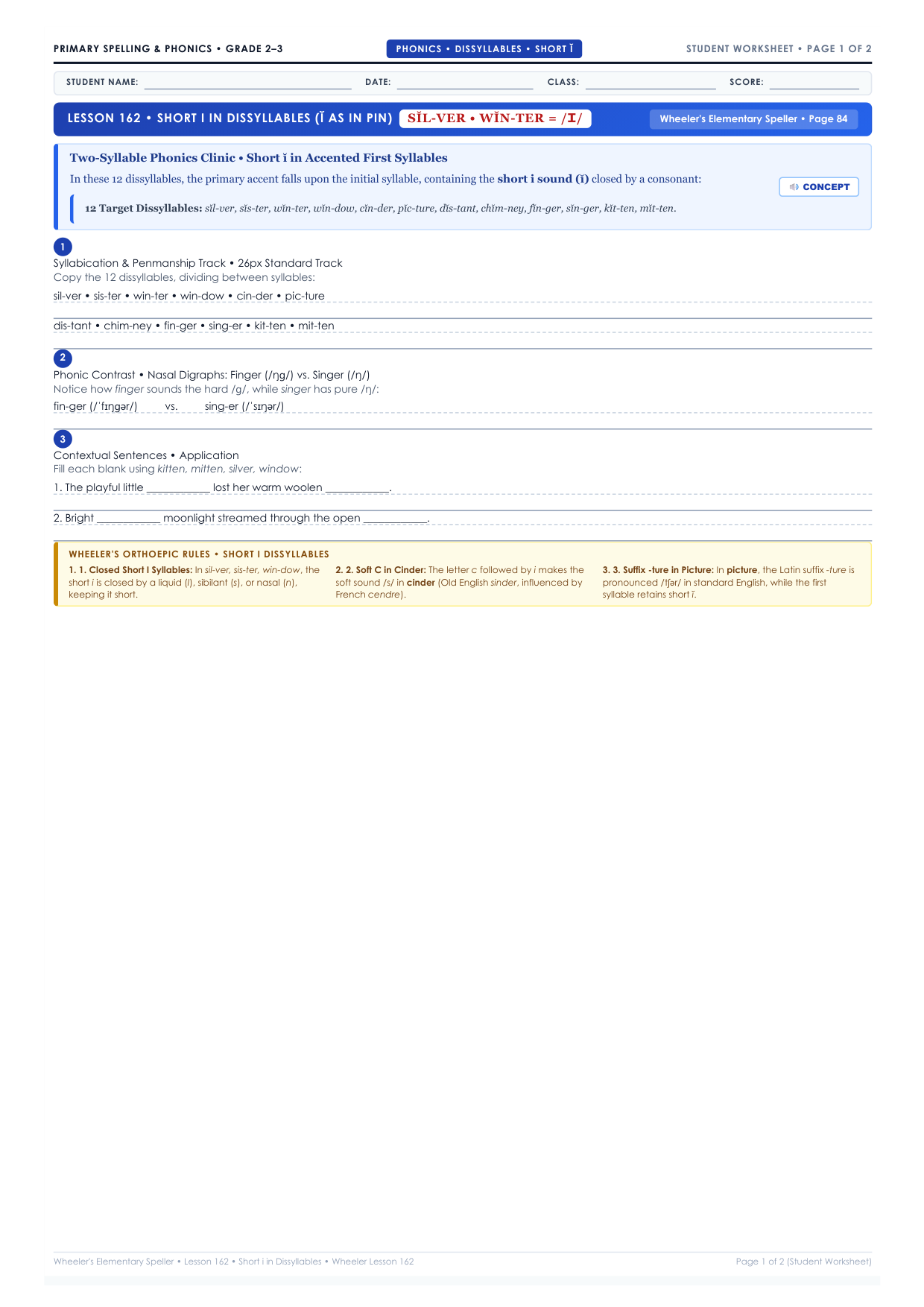
Lesson 162: Short i in Dissyllables (ĭ as in pin)
12 two-syllable words with accented short ĭ (silver, sister, winter, window, cinder, picture, distant, chimney, finger, kitten).
Open Student HTML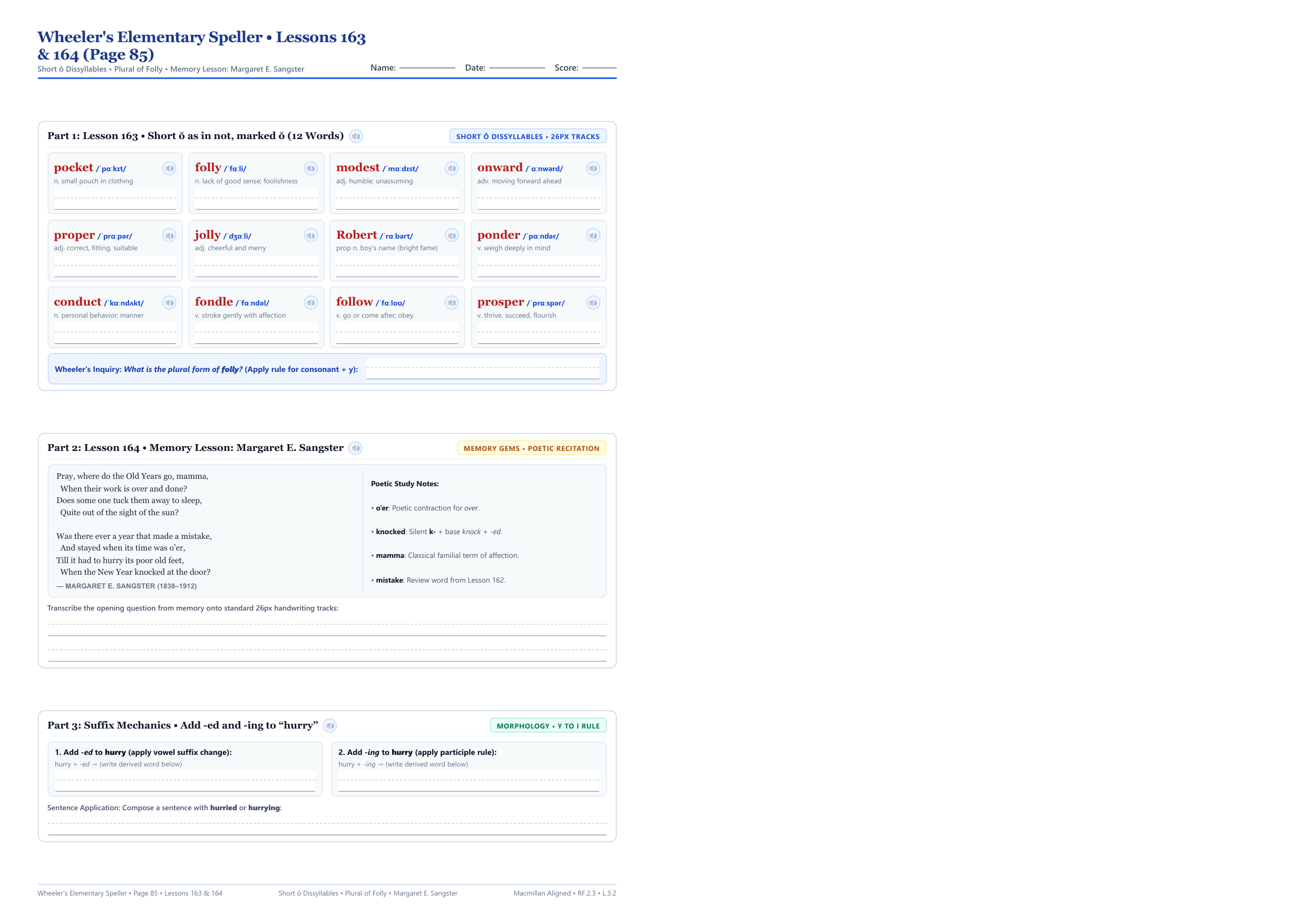
Lesson 163: Short o in Dissyllables (ŏ as in not)
12 two-syllable words with accented short ŏ (bonnet, pocket, bottle, copper, dollar, cotton, collar, follow, hollow, blossom, robin).
Open Student HTML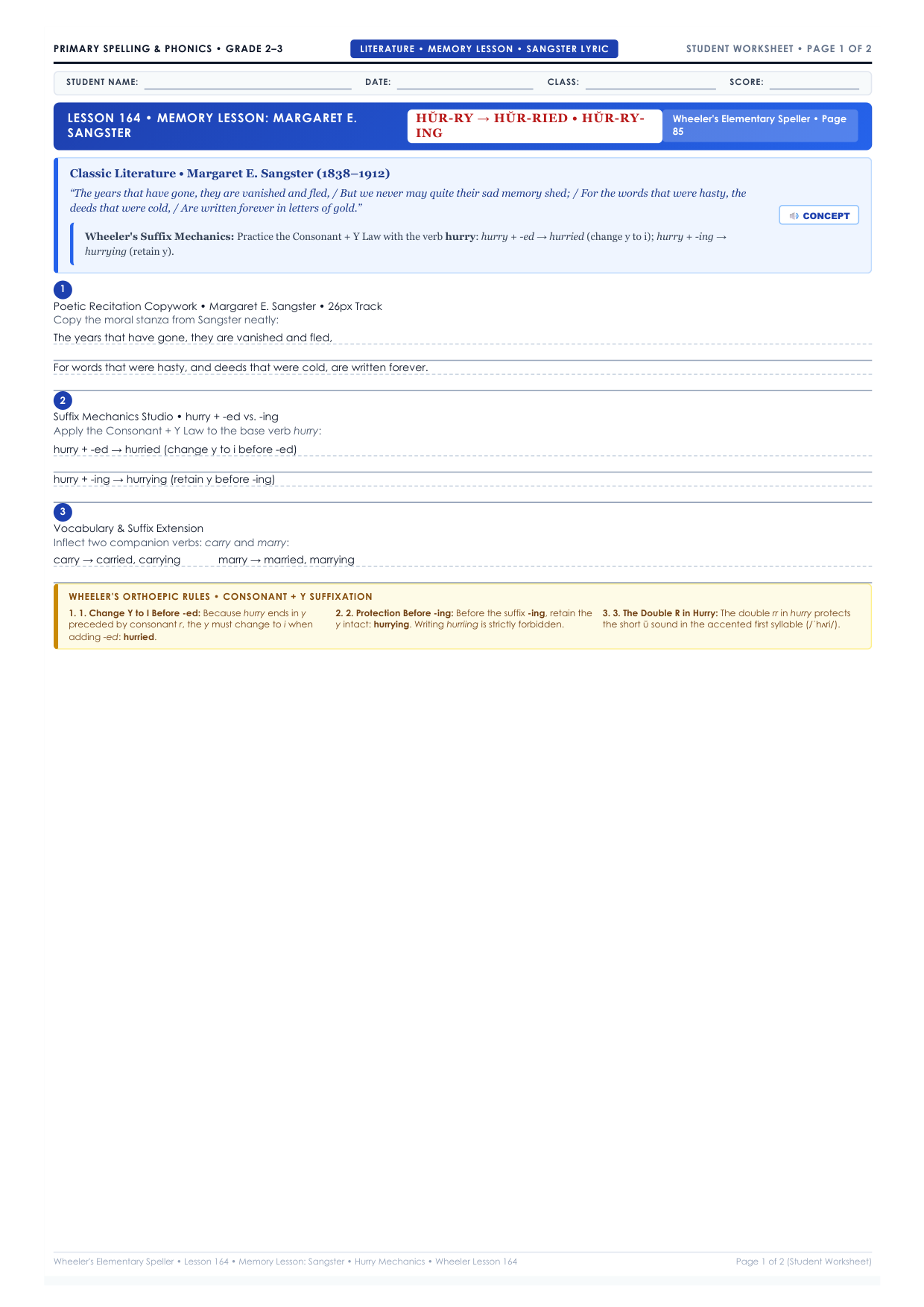
Lesson 164: Memory Lesson: Margaret E. Sangster
Margaret E. Sangster classic lyric (The years that have gone), and suffix mechanics with hurry (hurried, hurrying).
Open Student HTML
Lesson 165: Short u in Dissyllables (ŭ as in tub)
12 two-syllable words with accented short ŭ (butter, supper, summer, number, slumber, thunder, mutton, button, rudder, ladder).
Open Student HTML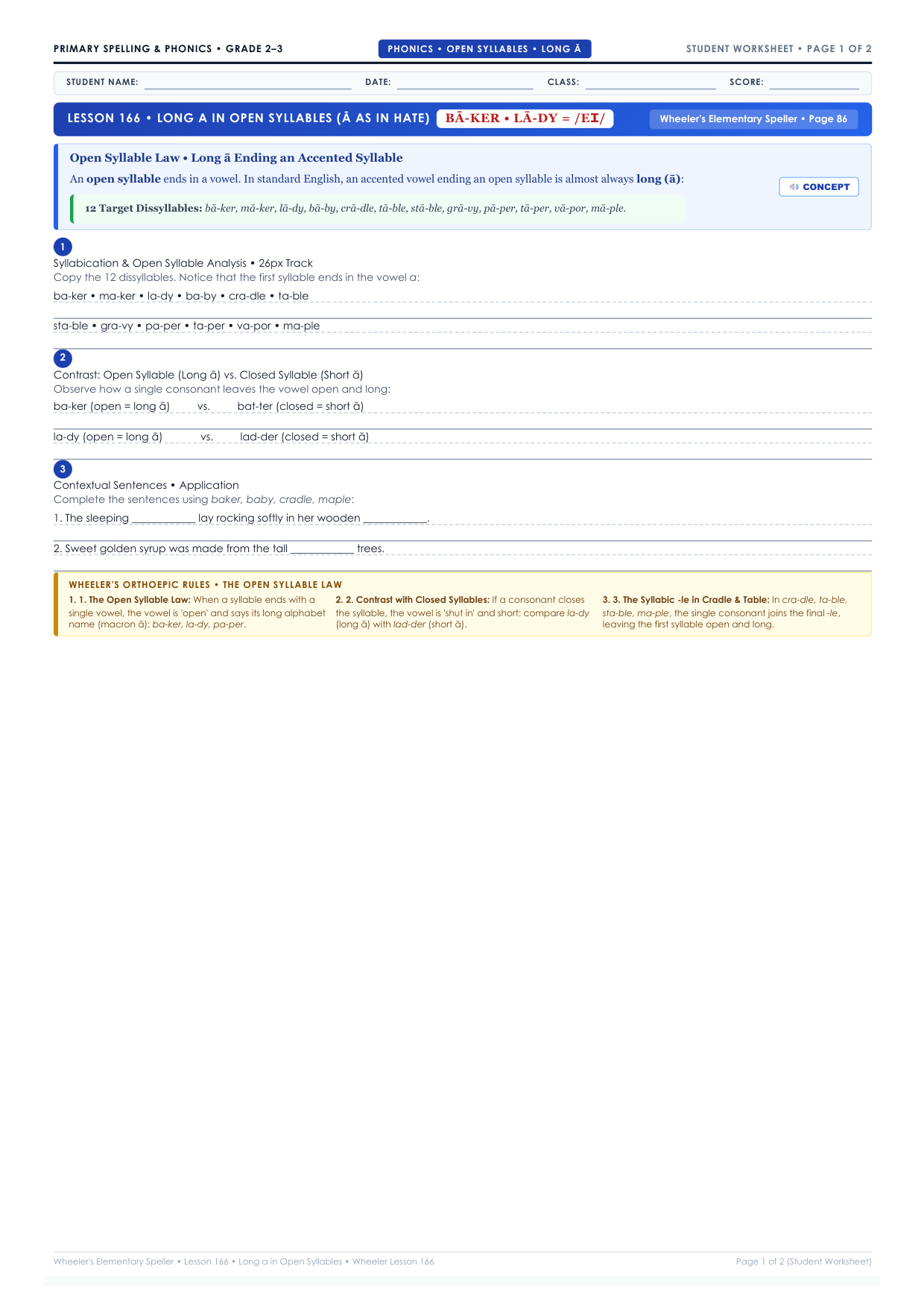
Lesson 166: Long a in Open Syllables (ā as in hate)
Open syllable law: accented vowels ending a syllable are long (ba-ker, ma-ker, la-dy, ba-by, cra-dle, ta-ble, pa-per, ma-ple).
Open Student HTML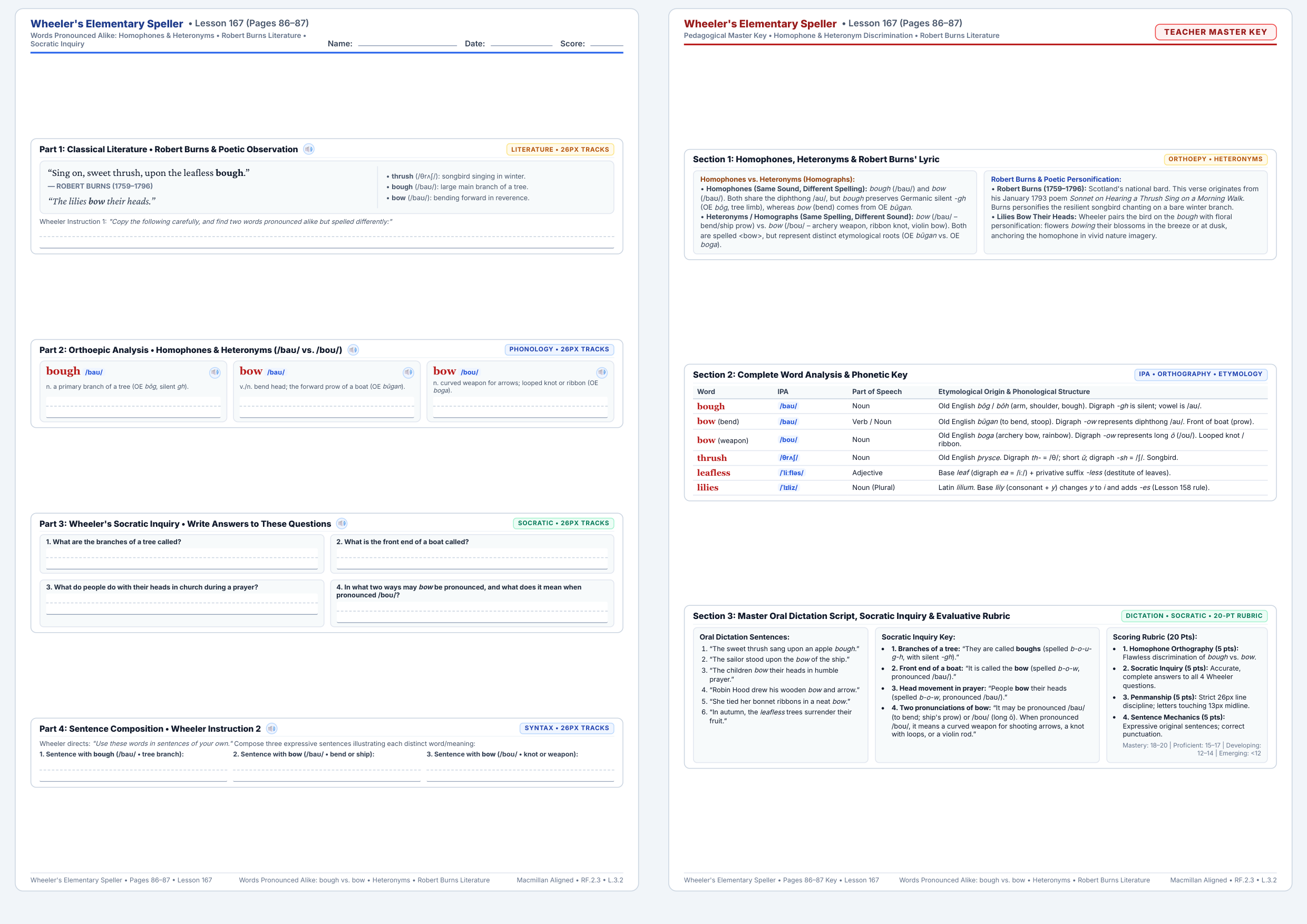
Lesson 167: Words Pronounced Alike: bough vs. bow • Heteronyms
Explore nuanced homophone discrimination between tree branch bough (/baʊ/) and verb/prow bow (/baʊ/), alongside heteronymic contrast with archery weapon/looped knot bow (/boʊ/). Feature Robert Burns' winter thrush sonnet, flower personification, and four analytical Socratic inquiry prompts on standard 26px handwriting tracks.
Open Student HTML
Lesson 168: Long a Digraphs (ai or ay = /eɪ/)
Long /eɪ/ spelled with interior ai (daily, daisy, dainty, praise, afraid, remain) versus syllable-final ay (payment, playful, dismay, betray, decay).
Open Student HTML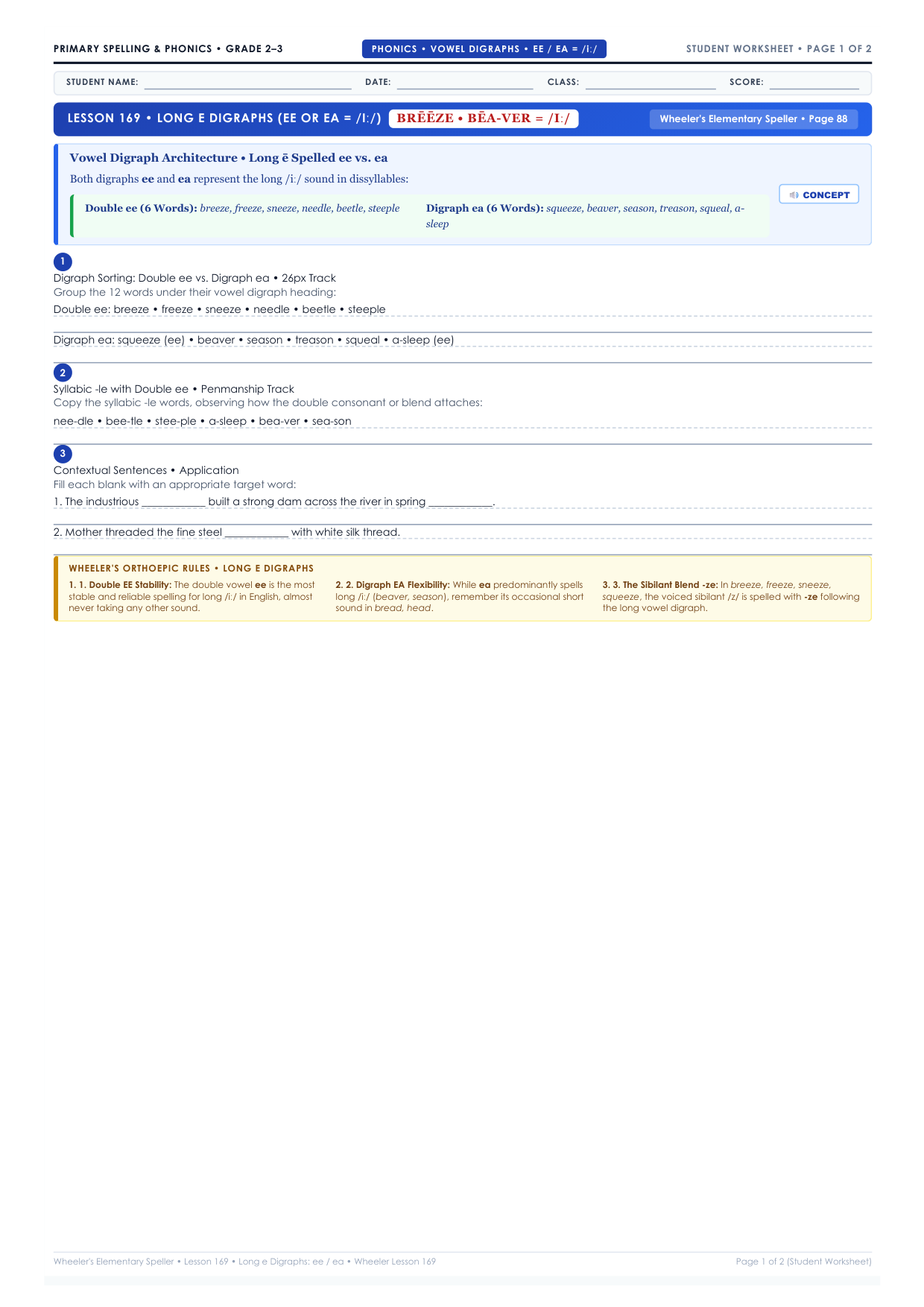
Lesson 169: Long e Digraphs (ee or ea = /iː/)
Long /iː/ dissyllables: double ee (breeze, freeze, sneeze, needle, beetle, steeple) versus digraph ea (beaver, season, treason, squeal, asleep).
Open Student HTML
Lesson 170: Memory Lesson: Margaret E. Sangster
Margaret E. Sangster classic New Year poem, midnight clock recital, allegory of the clean book of time, and active verbs of labor (dig, plant, delve).
Open Student HTML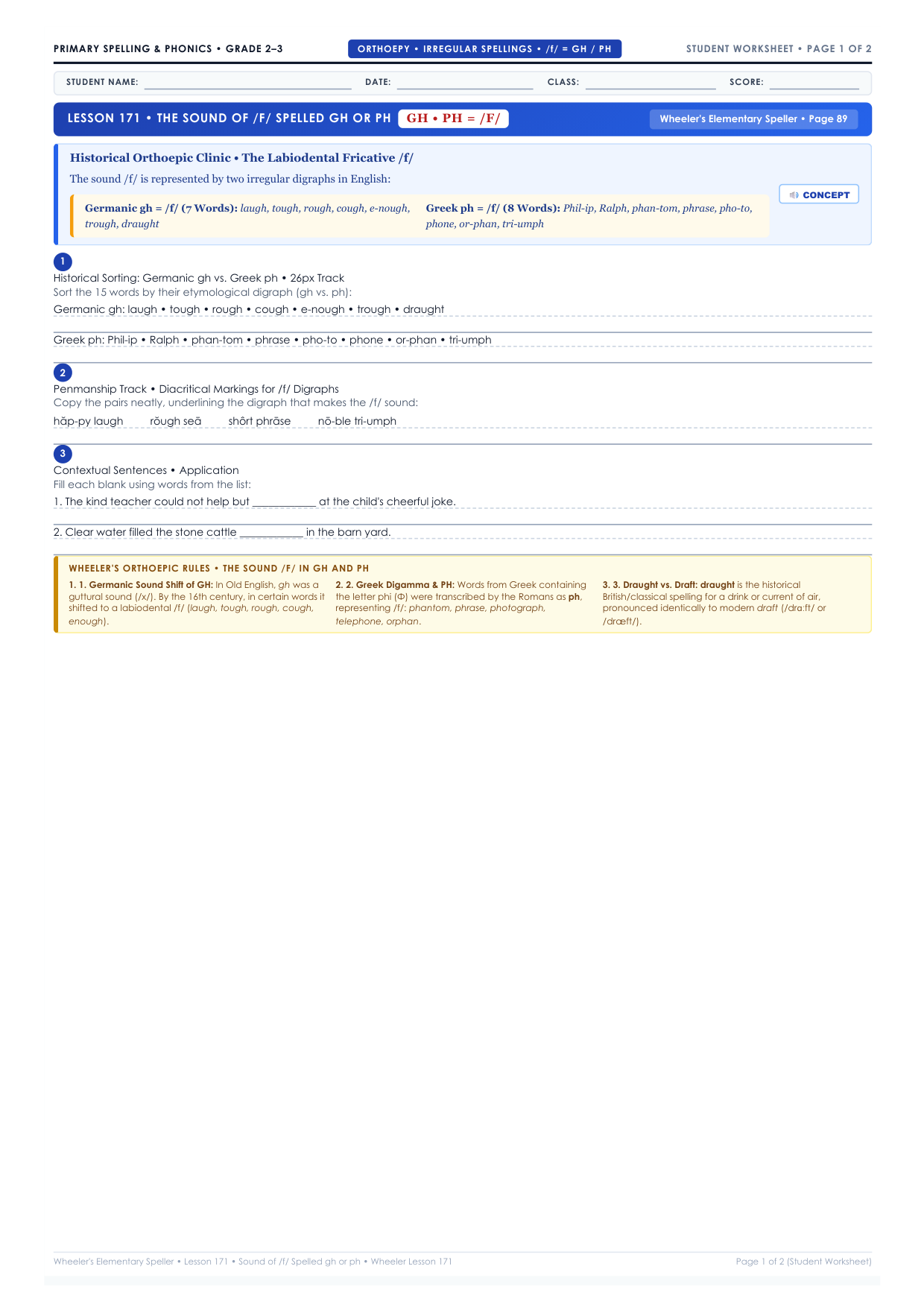
Lesson 171: The Sound of /f/ Spelled gh or ph
15 words representing /f/: historical Germanic gh (laugh, tough, rough, cough, enough, trough, draught) versus Greek ph (phantom, phrase, photo, phone, orphan, triumph).
Open Student HTML
Lesson 172: Long i in Open Dissyllables (ī as in pine)
12 two-syllable open words (spider, cider, tiger, viper, silence, Friday, giant, quiet, lilac, pilot, minus, climate), and soft c in cider.
Open Student HTML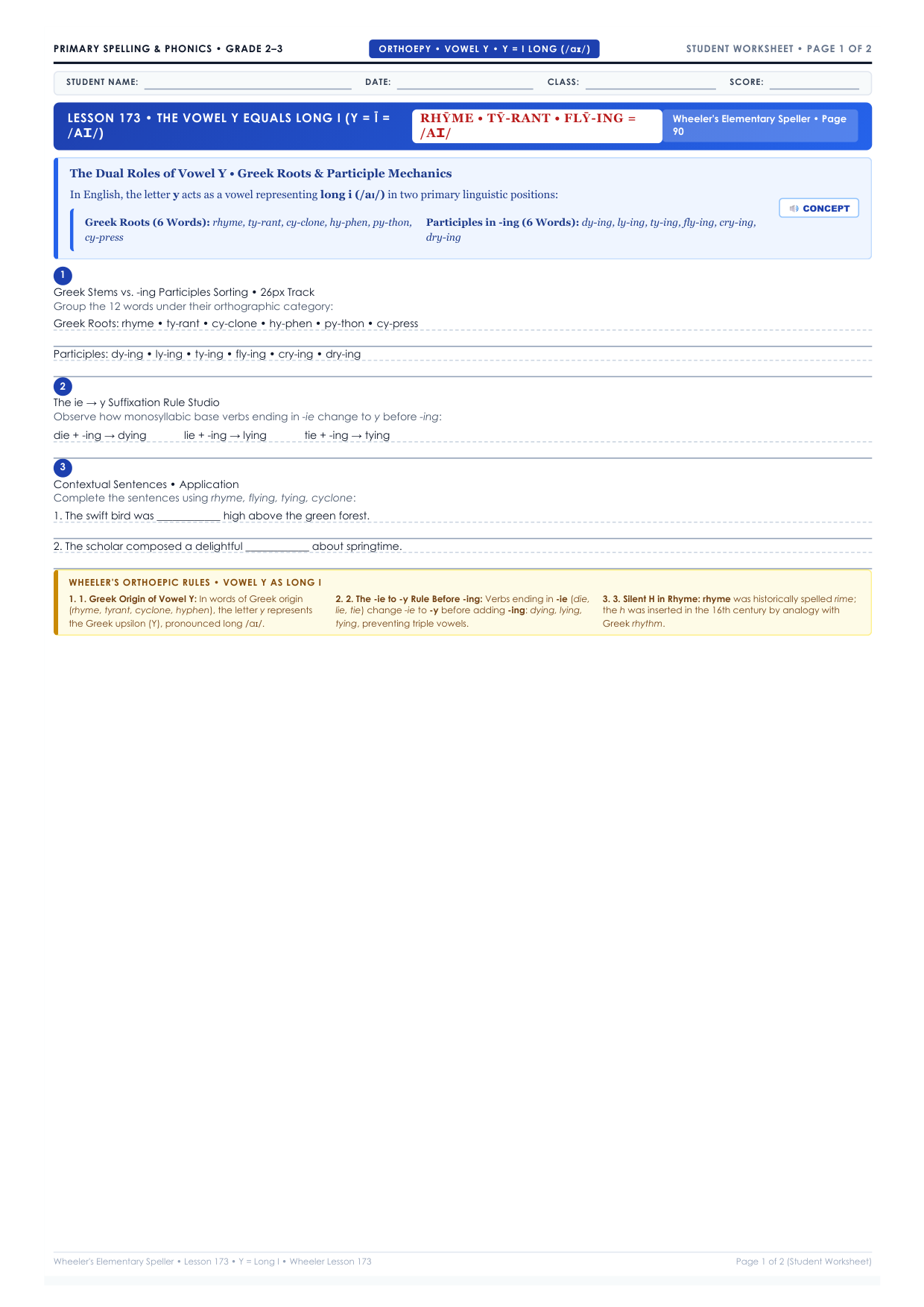
Lesson 173: The Vowel Y Equals Long I (y = ī = /aɪ/)
Greek loan words with vowel y (rhyme, tyrant, cyclone, hyphen, python, cypress), and the -ie → -y rule before -ing (dying, lying, tying).
Open Student HTML
Lesson 174: Long o in Open Dissyllables (ō as in old)
12 open two-syllable words (clover, grocer, frozen, broken, spoken, chosen, soldier, shoulder, poultry, notice, noble, motor).
Open Student HTML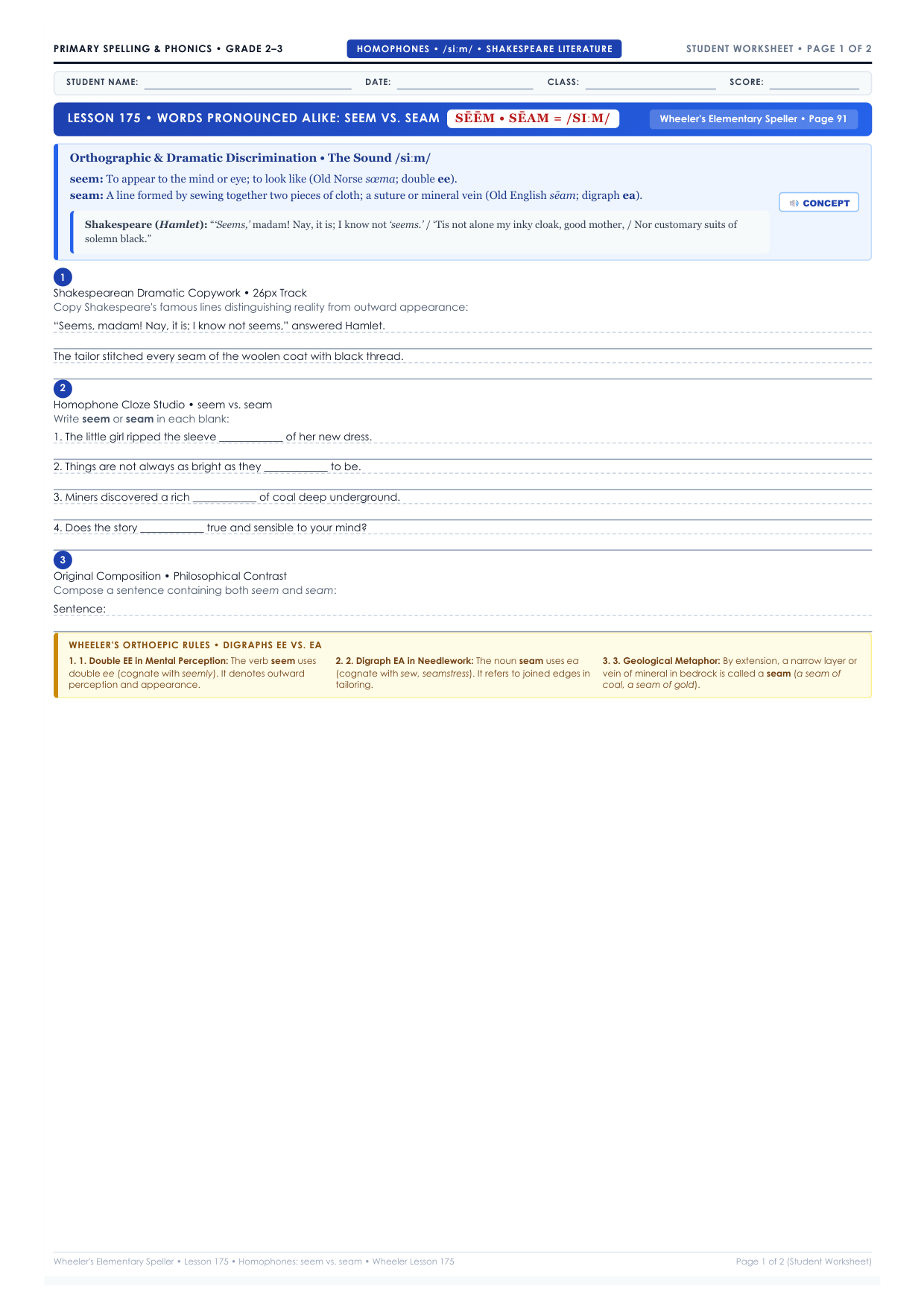
Lesson 175: Words Pronounced Alike: seem vs. seam
Mental perception seem (Shakespeare's Hamlet: 'I know not seems') versus tailoring edge seam (digraph ea), and geological mineral seams.
Open Student HTML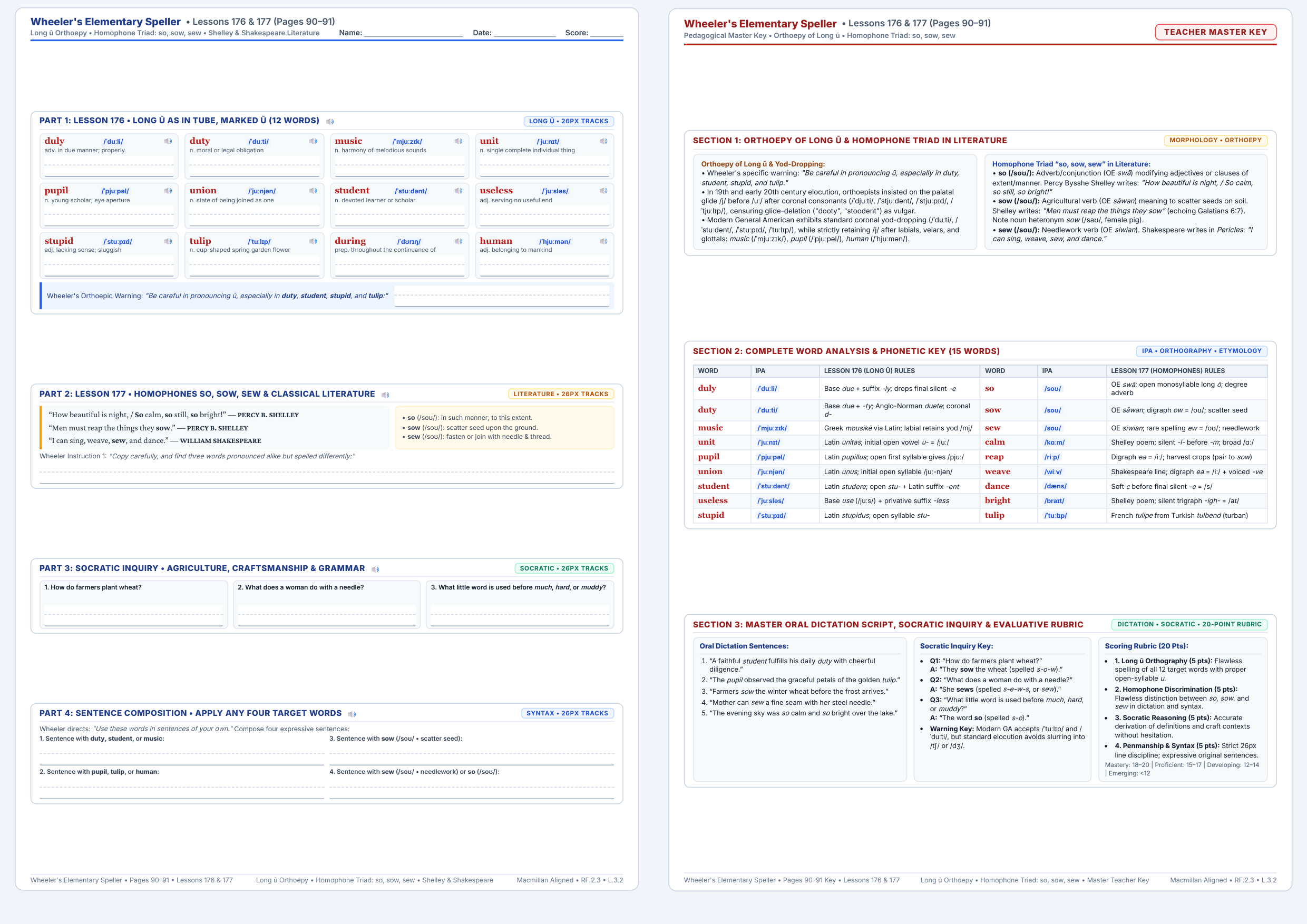
Lesson 176: Long u in Dissyllables (ū as in tube)
The palatal glide in long ū (music, pupil, tulip, duty, union, unit, human, future), and yod-dropping after r in cruel.
Open Student HTML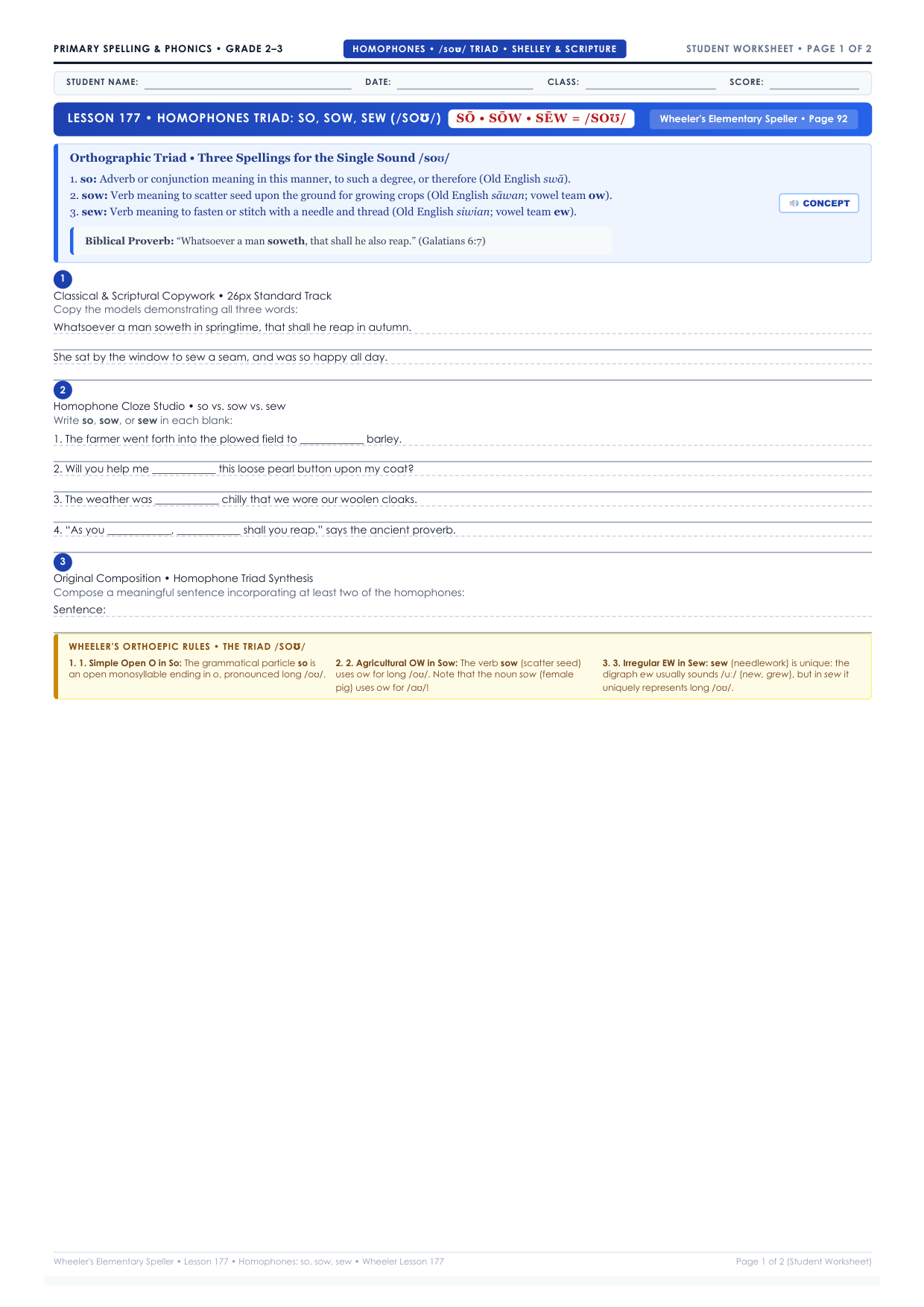
Lesson 177: Homophones Triad: so, sow, sew (/soʊ/)
Grammatical particle so, agricultural scattering of seed sow (Galatians 6:7), and needlecraft stitching sew (unique digraph ew).
Open Student HTML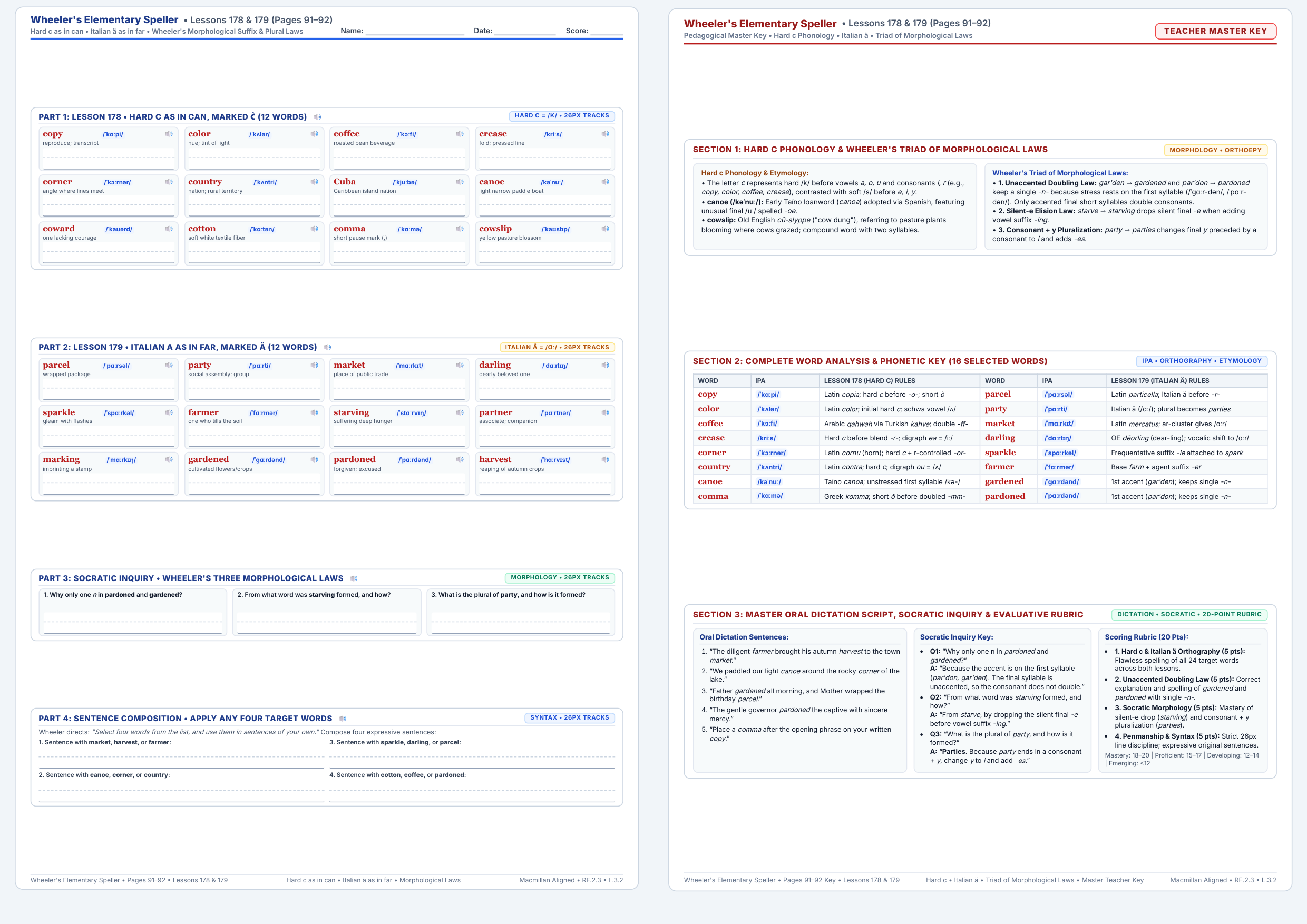
Lesson 178: Hard c as in can (c = k = /k/)
The hard sound of letter c before a, o, u and consonant blends (candle, cradle, corner, custom, cottage, copper, cattle, cabin, camel).
Open Student HTML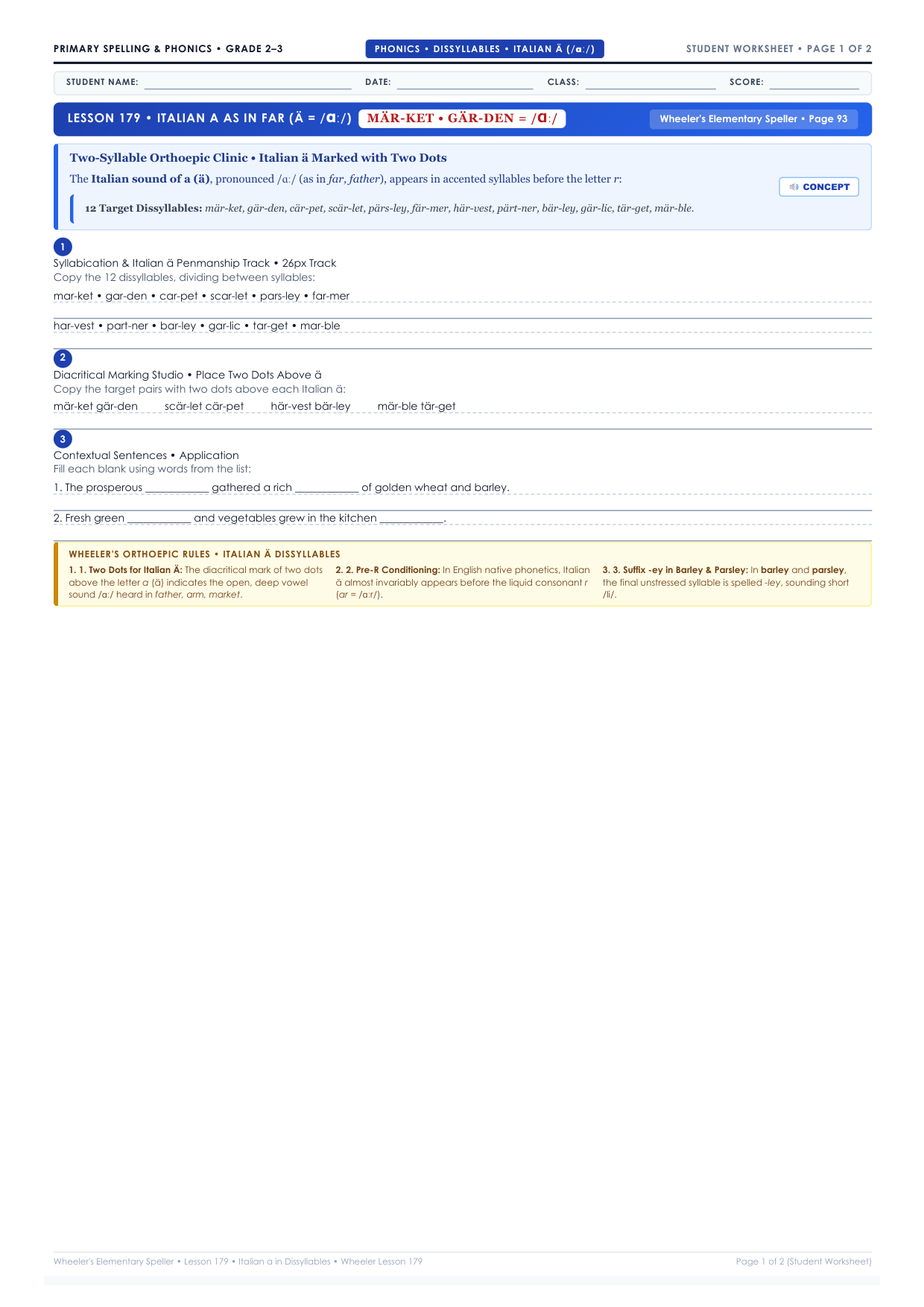
Lesson 179: Italian a as in far (ä = /ɑː/)
The deep Italian ä before liquid r (market, garden, carpet, scarlet, parsley, farmer, harvest, partner, barley, garlic, marble).
Open Student HTML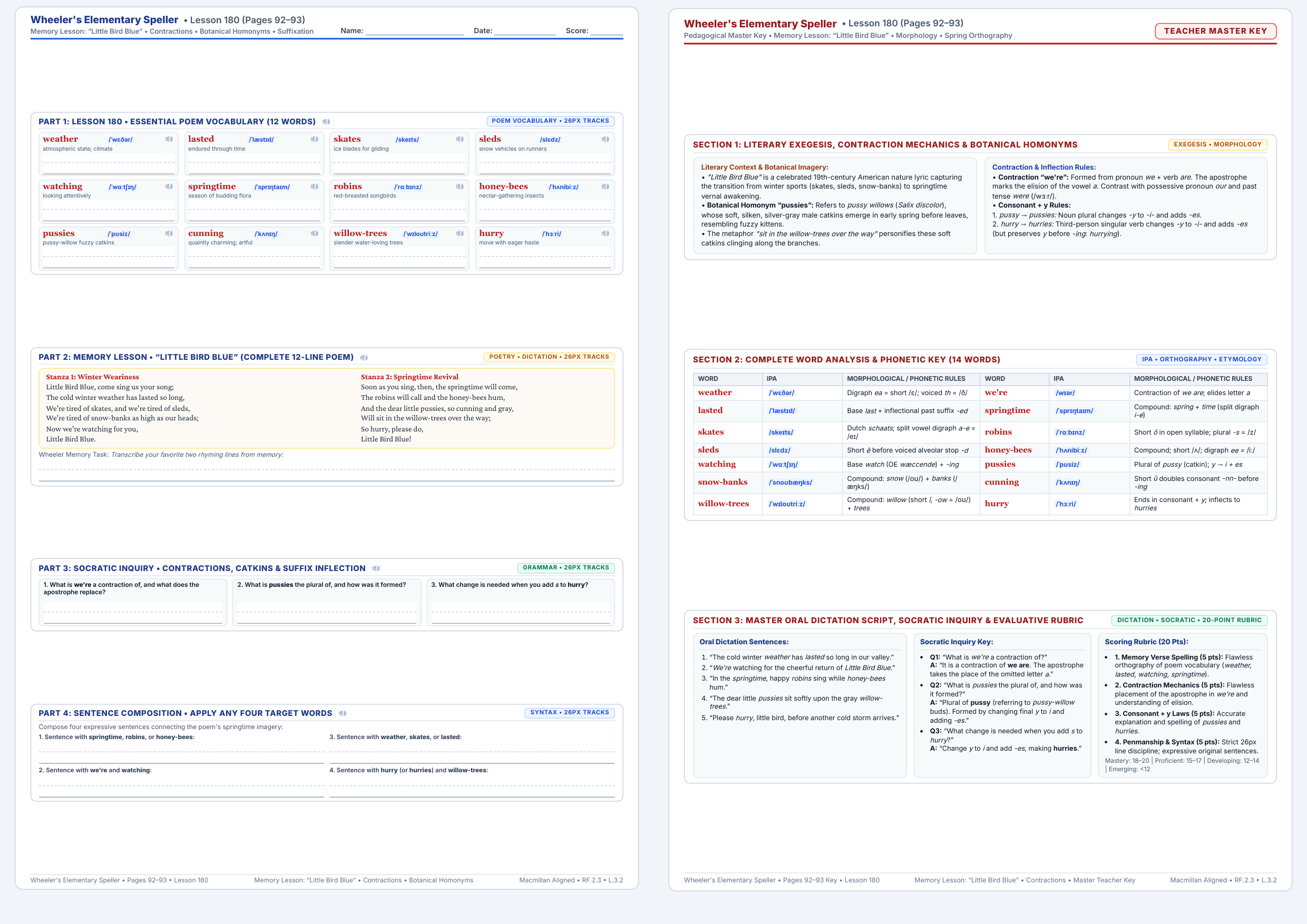
Lesson 180: Memory Lesson • “Little Bird Blue” • Springtime Orthography
Recite, transcribe, and spell the complete 12-line nature lyric “Little Bird Blue” across 2 stanzas (weather, lasted, skates, sleds, watching, springtime, robins, honey-bees, pussies, cunning, willow-trees, hurry). Master the contraction mechanics of we're (omitted a), the botanical homonym pussies (pussy-willow catkins), and suffix inflection on hurry → hurries on standard 26px handwriting tracks.
Open Student HTML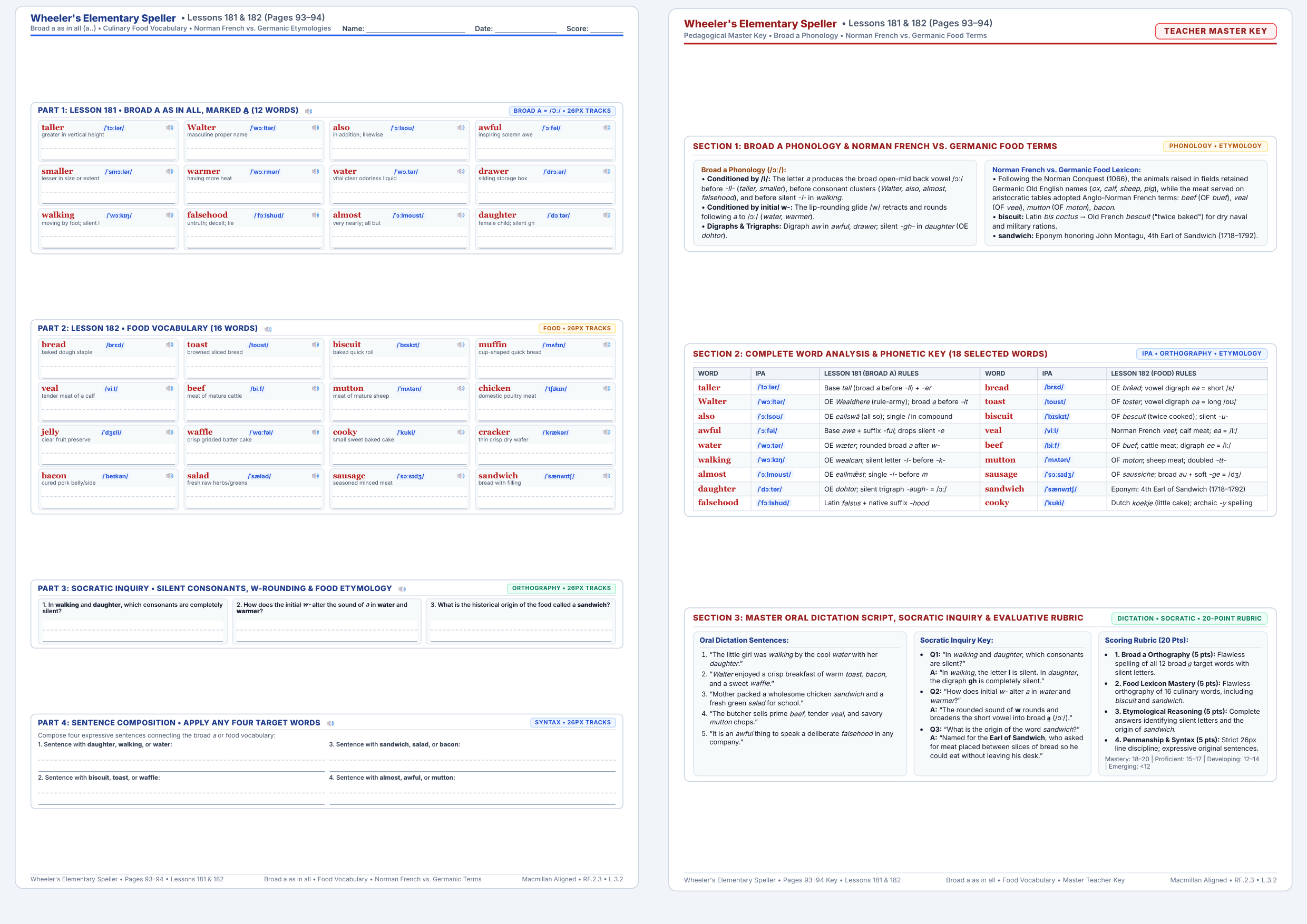
Lesson 181: Broad a as in all (ạ = /ɔː/)
Broad ạ spelled au, aw, al, augh (saucer, autumn, daughter, always, walnut, water, faucet, laundry, awful, author, sausage).
Open Student HTML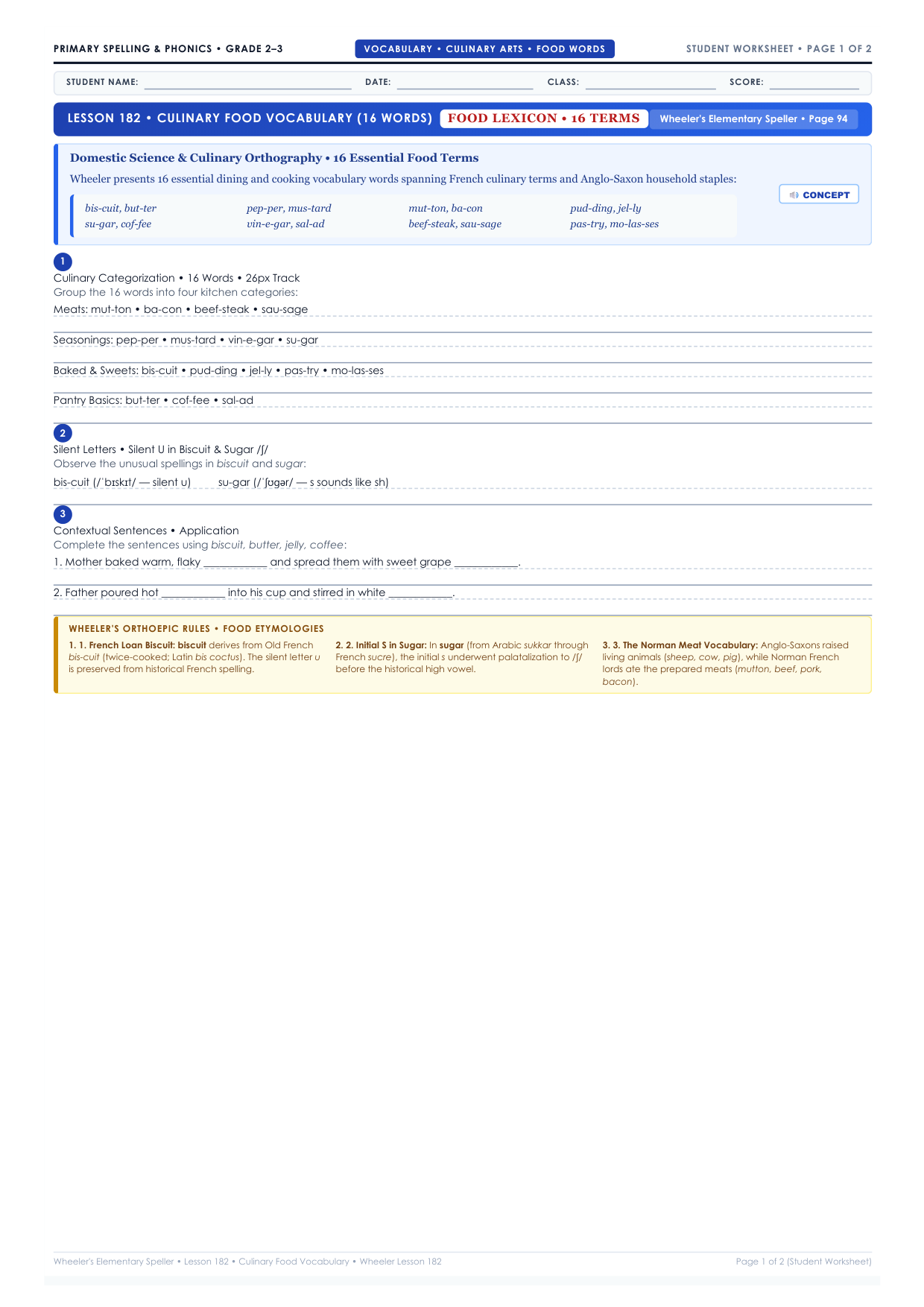
Lesson 182: Culinary Food Vocabulary (16 Words)
16 kitchen and dining terms (biscuit, butter, sugar, coffee, pepper, mustard, vinegar, mutton, bacon, beefsteak, sausage, pudding, jelly, pastry, molasses).
Open Student HTML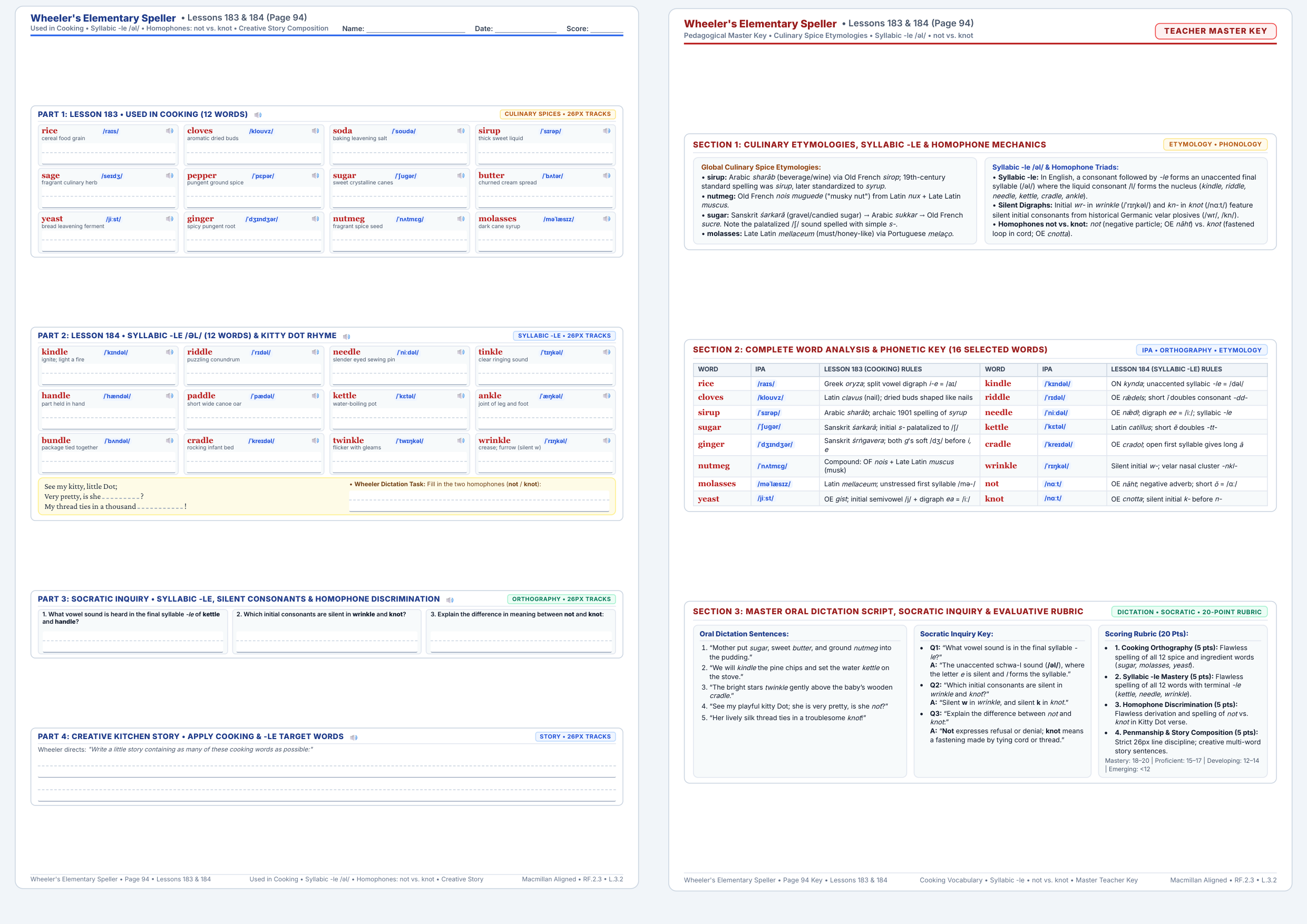
Lesson 183: Used in Cooking & Kitchen Implements
12 traditional cooking utensils (kettle, skillet, griddle, boiler, bottle, ladle, platter, strainer, saucer, pitcher, spider, beaker), and agent suffix -er.
Open Student HTML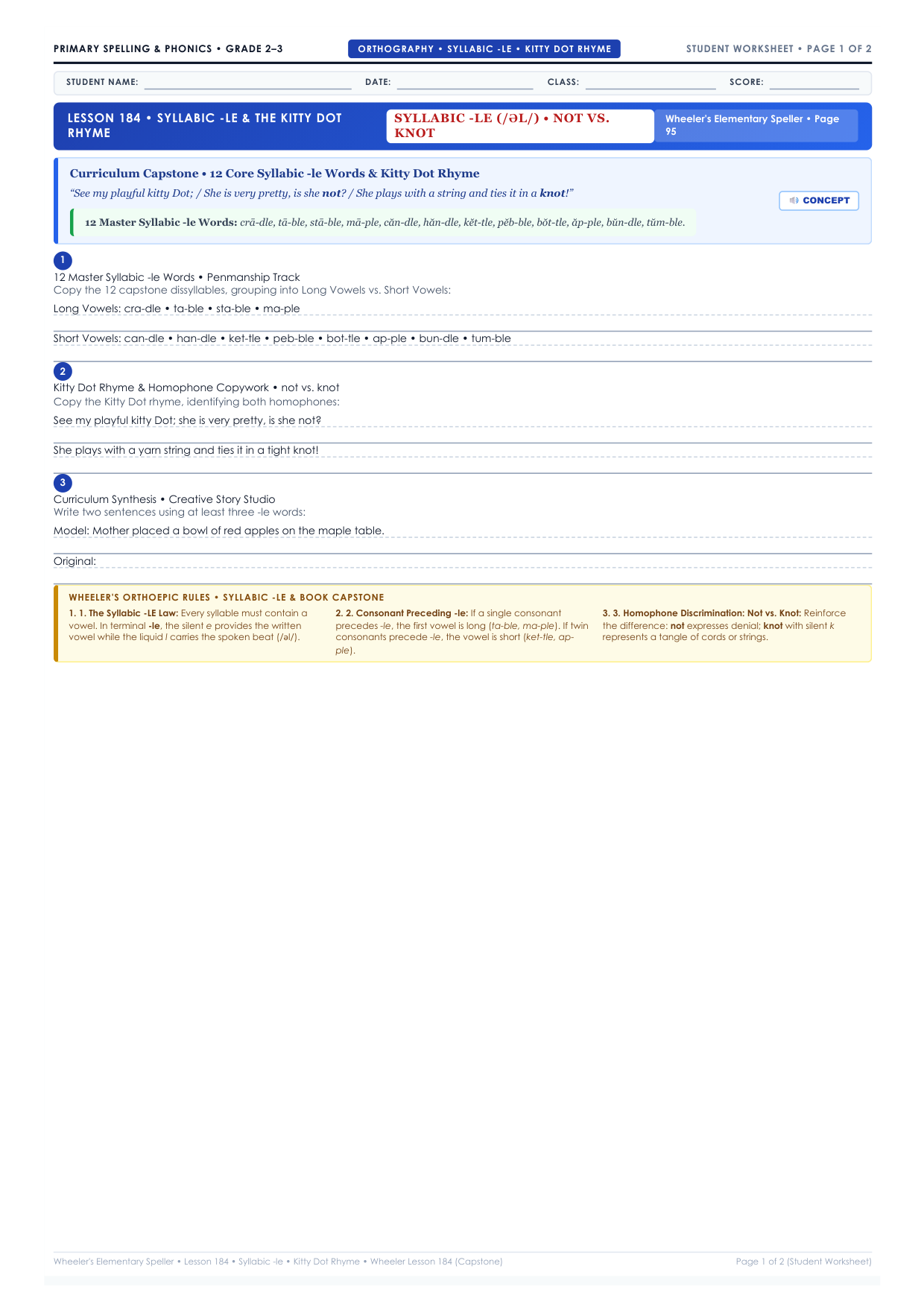
Lesson 184: Syllabic -le & The Kitty Dot Rhyme
Curriculum capstone: 12 master syllabic -le words (cradle, table, stable, maple, candle, handle, kettle, pebble, bottle, apple, bundle) and Kitty Dot rhyme (not / knot).
Open Student HTML